Religion is tricky when it comes to the classroom... especially when it comes to social studies. Indiana Standard 7.1.4 states: Describe the historical origins, central beliefs, and spread of major religions. (Individuals, Society and Culture) Example: Hinduism, Buddhism, Confucianism, Judaism, Christianity, and Islam.
I'd like to point out that is one standard. ...For 7th grade. One standard out of 52 such standards... Isn't that like, 6 undergrad credits right there?
Most years I teach the facts, dates, and names - but I've found there's no real connection with the students. So today, I asked a personal question: "Do you believe there is a God? If so, how does He (or She) want you to live your life? If not, how do you determine how to live your life? Please answer using at least 5 complete sentences."
We talked (at length in some classes) about the rights and privileges of living in the United States. We talked about religious freedom and religious persecution. We talked about respecting the rights of others while maintaining the integrity of our own beliefs. Overall, I thought it went really well, especially given the fact that we also reviewed the test and read a little bit of The Hunger Games.
I would also like to add that I didn't answer questions about my personal beliefs inside the classroom. While it's no big secret, I want the classroom to be as free as possible.
If you're reading this for extra credit, discuss the following questions:
How important is religious freedom in the United States?
Is it important to learn about other world religions?
How does religion impact our lives here in Indiana?
In order to get the extra credit, students have to bring in a piece of scrap paper signed by the adult they discussed this with. Grandparents/Parents/Step-Parent/Etc... by signing the paper, you're saying that you did read the blog and discuss it with the student that's bringing it to me.

Showing posts sorted by relevance for query indiana standard. Sort by date Show all posts
Showing posts sorted by relevance for query indiana standard. Sort by date Show all posts
Monday, November 28, 2011

Friday, March 15, 2013
Gandhi, Parks, King
Yesterday we started watching Gandhi. The movie is about the Indian independence movement, (Indiana Standard 7.2.1 - for those of you who care...), but it also ties in with a lot of other concepts and topics we've looked at throughout the year: I won't list the standards... if you really want them, just ask.
It also ties in with U.S. History because the United States was once a British colony as well. The United States fought for its independence, so tracing the paths of resistance and forms of oppression by the British is worthwhile.
If you want the extra credit today, bring your parents up to date with what is going on in the movie. Parents (or whatever adult is reading this) ask your kid some questions about it. Ask them to tie it in with Martin Luther King Jr. and the Civil Rights movement. Then, when you're done, write at least three sentences about the discussion. Have the adult you read the blog with sign the paper. Turn it in on Monday.
- Colonization
- Imperialism
- Human Rights
- Religions (Mainly Hinduism and Islam, but others are in as well)
- Geography
- Government and Law
It also ties in with U.S. History because the United States was once a British colony as well. The United States fought for its independence, so tracing the paths of resistance and forms of oppression by the British is worthwhile.
If you want the extra credit today, bring your parents up to date with what is going on in the movie. Parents (or whatever adult is reading this) ask your kid some questions about it. Ask them to tie it in with Martin Luther King Jr. and the Civil Rights movement. Then, when you're done, write at least three sentences about the discussion. Have the adult you read the blog with sign the paper. Turn it in on Monday.
Monday, April 29, 2013
Skatistan and Graduation
As you may have gathered, I wasn't here at school on Friday. I was increasing my human capital by continuing my education. Go me. I graduated with a 4.0 from Indiana Wesleyan University over the weekend. Pictures will be included at the bottom of the post - if you're interested.
Today we studied GDP (gross domestic product). We also graded some of the work from Friday and reviewed some of those topics as well. Most classes watched a video on "Skatistan" a skateboarding program currently going on in Afghanistan. The video is really well done, and I'm including a link here in case parents want to watch it, or if students want to watch it again. It's short. (Ok... at least I think I'm including a video. The site that hosts it - vimeo - is blocked here at school. I already have to mess around with the html when I embed videos from vimeo, now it's doubly difficult since I can't see if it worked or not...)
At any rate, if the video shows up, great. If not, I encourage you to google search "Skatistan Vimeo."
There was quite a bit to discuss after watching this - globalization, war, standard of living, unlimited governments, human rights, etc... but 45 minute classes go fast.
If you want the extra credit for reading and discussing the blog, here's how you can prove you checked it tonight. Tell the adult you're with what "human capital" is. (It's been a while since we've discussed it, but there's a hint in the opening paragraph.) Write down what you think it is, and have them discuss it. If you're in my 7th hour class, I'd like you to watch the video as well, since we didn't watch it in class.
And, here are some pictures from my graduation. Proof that I'm a life-long learner, as they say. You can be one too.


Today we studied GDP (gross domestic product). We also graded some of the work from Friday and reviewed some of those topics as well. Most classes watched a video on "Skatistan" a skateboarding program currently going on in Afghanistan. The video is really well done, and I'm including a link here in case parents want to watch it, or if students want to watch it again. It's short. (Ok... at least I think I'm including a video. The site that hosts it - vimeo - is blocked here at school. I already have to mess around with the html when I embed videos from vimeo, now it's doubly difficult since I can't see if it worked or not...)
At any rate, if the video shows up, great. If not, I encourage you to google search "Skatistan Vimeo."
SKATEISTAN: TO LIVE AND SKATE KABUL from Diesel New Voices on Vimeo.
There was quite a bit to discuss after watching this - globalization, war, standard of living, unlimited governments, human rights, etc... but 45 minute classes go fast.
If you want the extra credit for reading and discussing the blog, here's how you can prove you checked it tonight. Tell the adult you're with what "human capital" is. (It's been a while since we've discussed it, but there's a hint in the opening paragraph.) Write down what you think it is, and have them discuss it. If you're in my 7th hour class, I'd like you to watch the video as well, since we didn't watch it in class.
And, here are some pictures from my graduation. Proof that I'm a life-long learner, as they say. You can be one too.


Tuesday, April 15, 2014
World War I (Great... War...)
The Indiana State Standards for social studies are very good... overall. For real. But there are several standards dealing with World War II, and not one standard on World War I. I think it's difficult to gain any understanding of one without at least some background knowledge of the other.
.JPG)
.JPG)
.JPG)
.JPG)
.JPG)
.JPG)
So, yesterday I taught my yearly WWI lesson.
I grew up learning that WWI was fought over the assassination of Archduke Franz Ferdinand II. And that's partially true. But I teach that the war was more about the (faulty) system of alliances that were in place.
Before class (during bellwork) students are going around gaining alliances. They're supposed to get 4: a friend, someone of the opposite sex, someone they don't know very well, and someone of their choice.
Then, I start off by asking if any student wants a Jolly Rancher. Of course, a thousand hands go up.
I'll call on a rather delicate young lady to take the Jolly Rancher.
When she comes up to the front and sits down, I then ask if there's anybody who thinks they can beat her in an arm-wrestling match for the Jolly Rancher. I'll choose one of the strongest guys in the class to go against her.
Now, when she volunteered, she didn't realize she was going to have to arm-wrestle someone... In one class, she actually just tossed the Jolly Rancher at the guy in a huff of defeat.
I'll say, "now hold on. I'll tell you what. You can call on a couple of your allies to come and help you out." So, she then brings up several of her friends to help in this arm-wrestling match.
Now, the guy feels like this isn't fair either. He thought he was arm-wrestling a petite little girl, not her and 4 friends. So, I say he can call some friends as well if he wants to. And he does.
Things escalate quickly.
The Jolly Rancher represents the Assassination of Archduke Franz Ferdinand. When viewed against all of WWI, it's a relatively minor incident. You wouldn't expect 15 million deaths (and many, many more recognizing that WWI set the stage for WWII) to come from this one assassination.
And you wouldn't expect a class to fight an armed conflict (get it? ...Armed...? ...heh... seriously...) over a Jolly Rancher. Just like Serbia called Russia to come to her aid when attacked by the Austro-Hungarians, the girl called her allies to her aid.
And Austria-Hungary wasn't expecting to fight against the Russians, so they dialed up the Germans as well. And next thing you know: BAM! WWI.
If nothing else, I hope the students understand the concept of how the system of alliances escalated a minor incident into WWI.
I took some pictures too.
I hope you like them.
If you want the extra credit, you were supposed to read and discuss the blog post with an adult. If you did this, find a piece of paper and write down two sentences telling me what they thought about the activity. Then, have them sign the paper. Turn it in tomorrow.
Thursday, September 25, 2014
Globalization: The Good, The Bad, The Guilty
First of all, don't forget that my classes have a quiz tomorrow. You may want to study.
Globalization: The Good
Countries (and individual people) produce what they have access to, and what they are good at producing. We went to Banananovia - and this was great, because we couldn't grow bananas in northern Indiana. (Or Northern Industralia - thanks to the anonymous person who left the comment). We wouldn't be good at it. Globalization allows us to get the things we want and need - as well as make money selling what we are good at producing.
Not only that, but it's cheap labor that is driving globalization. Cheap labor means we make things for less - and that is good for us as consumers. Consider this chart we looked at today:

The production cost is often reflected in the price - though not always. ...I know I'm happy when I save money.
Globalization: The Bad
As we saw from Banananovia, global culture is replacing local cultures. The Banananovian culture has essentially died out - and if not died out, it has irrevocably been changed. ...Changed and supplanted with our own culture.
Furthermore, globalization has allowed for the exploitation of workers in developing nations - formerly called third-world countries. It allows companies to take advantage of places that don't (or won't) honor the rights of workers. It allows them to move their base where the standard-operating-procedures wouldn't be deemed illegal - even if we all agree this is unethical.
Today we watched a Simpsons clip where Mr. Burns outsourced his nuclear power plant to India in order to exploit the workers. You'll have to ask my students what they thought about the clip.
Globalization: The Guilty
We watched another short clip today as well. Maybe you recall the 2013 Savar building collapse? It was the factory in Bangladesh that collapsed - there weren't enough fingers to point out the blame. Here's what we watched:

Globalization: The Good
Countries (and individual people) produce what they have access to, and what they are good at producing. We went to Banananovia - and this was great, because we couldn't grow bananas in northern Indiana. (Or Northern Industralia - thanks to the anonymous person who left the comment). We wouldn't be good at it. Globalization allows us to get the things we want and need - as well as make money selling what we are good at producing.
Not only that, but it's cheap labor that is driving globalization. Cheap labor means we make things for less - and that is good for us as consumers. Consider this chart we looked at today:
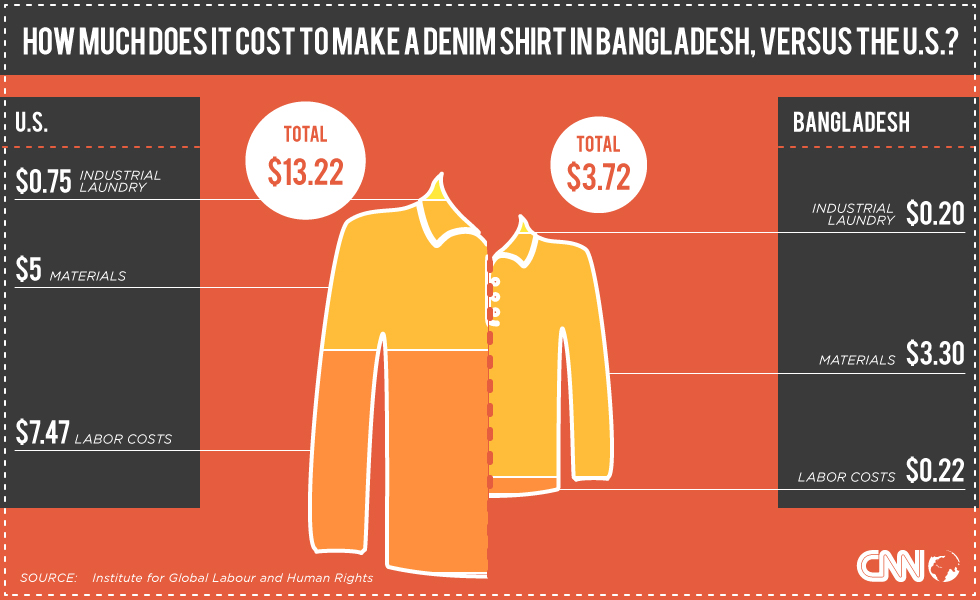
The production cost is often reflected in the price - though not always. ...I know I'm happy when I save money.
Globalization: The Bad
As we saw from Banananovia, global culture is replacing local cultures. The Banananovian culture has essentially died out - and if not died out, it has irrevocably been changed. ...Changed and supplanted with our own culture.
Furthermore, globalization has allowed for the exploitation of workers in developing nations - formerly called third-world countries. It allows companies to take advantage of places that don't (or won't) honor the rights of workers. It allows them to move their base where the standard-operating-procedures wouldn't be deemed illegal - even if we all agree this is unethical.
Today we watched a Simpsons clip where Mr. Burns outsourced his nuclear power plant to India in order to exploit the workers. You'll have to ask my students what they thought about the clip.
Globalization: The Guilty
We watched another short clip today as well. Maybe you recall the 2013 Savar building collapse? It was the factory in Bangladesh that collapsed - there weren't enough fingers to point out the blame. Here's what we watched:
There is a reason we have safety regulations in these United States. The question I posited to my students is, should we share in the guilt of these deaths? This is not a mere rhetorical question. I only wish we had more time to discuss it in class.
Some (hopefully) unbiased thoughts:
- Most of our clothes (98%) come from overseas; selection... what choice do we have?
- Should we adapt to a smaller selection?
- Some businesses treat their employees well - both at home and abroad.
- Some factories exploit their workers.
- Is it our place to fight for the rights of workers overseas?
- Should we leave that up to their country?
- Is it my responsibility to find out the working conditions of the people who made my clothes?
- How is this similar from the north buying goods from the south during US slavery?
- How is this different?
- Should we share in the guilt?
You can see that tons and tons of tough questions can come up when we discuss globalization - or really, any aspect of social studies. There is never enough time in the class day. The biggest question is, "what is my role in all of this?" And that one may be the most difficult to answer.
To get the extra credit for reading and discussing the blog today, you have to read and discuss it with an adult. I would suggest focusing on some of the questions/thoughts mentioned in the bullet points. Respond to a couple of those on a piece of scrap paper. Have the adult you read and discussed with sign the paper. (Make sure your name is on it as well.) Turn it in tomorrow.
PS: Some classes also discussed this cartoon, which I originally saw in Jr. Scholastic:
Friday, December 19, 2014
Religion
Many people in Northern Indiana will be celebrating Christmas next week. Perhaps you're one of them, perhaps not. Many are already celebrating Hanukkah, which started Tuesday evening. Perhaps you are lighting your Menorah.
Here in social studies, we're closing out 2014 by introducing a topic. It may be counter-intuitive, to start something that I'll have to reintroduce in a couple weeks, but I think it's worth it.
Teaching about religions in the United States can be a little bit tricky. But there they are in the 7th grade standards. Standard indicator 7.1.2 to be exact.
So, we're trying to foster understanding: what do we believe? What do other people believe? Why?
Students will need to be familiar with some terminology early on in this unit:
Monotheism
Polytheism
Pantheism
Atheism
Whether you're celebrating a holiday or not, I hope you enjoy the break. It'll be 2015 when we get back. Hopefully we have some hoverboards.
If you want some extra credit when you return, discuss what you believe with an adult in your house. Have them tell you what they believe about God or gods or the supernatural. Write down 4 sentences from your discussion and have them sign it. Turn it in when we return.
Until then, take it easy.
Thursday, October 29, 2015
Tying Things Together
So many of these big, BIG concepts that we've been learning about tie in with other big concepts we've been learning about. The term and idea of globalization encompasses so much. Economy is the production (making), distribution (selling), and consumption (buying/using) of goods - but we could go off on lessons about standard of living, and human capital, and banks, and economic spillover (externalities), and jobs, and industrialization, and urbanization... And each one of those terms/concepts/ideas/whatever you want to call them is another lesson or series of lessons.
Yesterday, we discussed the factory collapse in Bangladesh. We talked about people who lived in countries with low standards of living, where they worked for so much less than the U.S. minimum wage. And how, consumers possibly share the blame for the deaths of those factory workers.
In a way, globalization has led to the exploitation of those workers. Our desire to have well-made, inexpensive clothes led to that.
But globalization is also strengthening the economies of these countries. Their production is getting them money, and getting us the products we want. This is a case of everybody elevating everybody else.
Today, we showed this with a trading simulation. We formed groups of countries. Each country had a main export. All the other countries wanted that export. Yarn represented a trade deal between two countries. If there was talking, the trade deal fell apart, and I cut the string.
Ultimately, by trading, everybody


Yesterday, we discussed the factory collapse in Bangladesh. We talked about people who lived in countries with low standards of living, where they worked for so much less than the U.S. minimum wage. And how, consumers possibly share the blame for the deaths of those factory workers.
In a way, globalization has led to the exploitation of those workers. Our desire to have well-made, inexpensive clothes led to that.
But globalization is also strengthening the economies of these countries. Their production is getting them money, and getting us the products we want. This is a case of everybody elevating everybody else.
Today, we showed this with a trading simulation. We formed groups of countries. Each country had a main export. All the other countries wanted that export. Yarn represented a trade deal between two countries. If there was talking, the trade deal fell apart, and I cut the string.
Ultimately, by trading, everybody
- Got better stuff and a variety of stuff
- because certain goods only come from certain areas
- i.e. if you could only eat bananas grown in Indiana, you probably wouldn't be eating too many bananas
- Got cheaper stuff
- people can focus on producing what they're good at producing and make a lot of it
- i.e. if I had to make my own telephone, I would have no telephone
- also... cheap labor is driving globalization
We still haven't really tied all these things together, but we're going to try to. Maybe tomorrow? Maybe next week.
Here are some pictures of today's activity. Instructions on how to get the extra credit points will be below them.


If students want extra credit, they should read and discuss this blog post with an adult. When they've finished that, they should find a scrap of paper and write 2 sentences telling what they thought of the activity. Have the adult that they read and discussed the blog with sign the paper. Make sure your name, date, and hour are on it. Then, turn it in tomorrow in the extra credit turn-in tray.
...One more thing, for those who care. I try to conserve. You know, reduce, reuse, recycle. So, I spent a lot of my free time winding up the yarn. But boy, there were a lot of knots. Several times, I thought of the Gordian Knot. Alexander and I... we're two of a kind.


Friday, May 31, 2013
Historical Fiction
Here's Indiana Social Studies Standard 7.1.23:
(If you're ever wondering what our standards are, you can look them up anytime HERE.)
We looked at some nonfictional accounts in order to complete our Qin Shi Huang Di presentations. Today we watched the intro to The Mummy: Tomb of the Dragon Emperor. Much of what we studied was in there - the emperor's brutal rise to power, the building of the great wall, his search for immortality. But we also noticed the artistic license and fictionalization of the narrative as well.
I'm pretty sure the emperor couldn't manipulate fire with his hands... Also, this account depicts a witch turning his real army into clay soldiers.
I love historical fictions, but it does make it difficult to distinguish what really happened from that which was contrived.
We also took some notes. But that's not as exciting to talk about.
If you want the extra credit, you have to read and discuss the blog with an adult. Ask the adult if they've ever read, watched, or listened to any historical fiction. Talk about it. Ask if it was difficult to distinguish what was real from what was false. Then, on a sheet of scrap paper, answer this question: Have they read/watched/listened to historical fiction? What did they think about it?
Have them sign it. Make sure your name is on it. Turn it in on Monday.
"SS.7.1.23
Chronological Thinking, Historical Comprehension, Analysis and Interpretation, Research: Compare perspectives of history in Africa, Asia and the Southwest Pacific using fictional and nonfictional accounts."(If you're ever wondering what our standards are, you can look them up anytime HERE.)
We looked at some nonfictional accounts in order to complete our Qin Shi Huang Di presentations. Today we watched the intro to The Mummy: Tomb of the Dragon Emperor. Much of what we studied was in there - the emperor's brutal rise to power, the building of the great wall, his search for immortality. But we also noticed the artistic license and fictionalization of the narrative as well.
I'm pretty sure the emperor couldn't manipulate fire with his hands... Also, this account depicts a witch turning his real army into clay soldiers.
I love historical fictions, but it does make it difficult to distinguish what really happened from that which was contrived.
We also took some notes. But that's not as exciting to talk about.
If you want the extra credit, you have to read and discuss the blog with an adult. Ask the adult if they've ever read, watched, or listened to any historical fiction. Talk about it. Ask if it was difficult to distinguish what was real from what was false. Then, on a sheet of scrap paper, answer this question: Have they read/watched/listened to historical fiction? What did they think about it?
Have them sign it. Make sure your name is on it. Turn it in on Monday.
Subscribe to:
Posts (Atom)