Showing posts with label globalization. Show all posts

Tuesday, October 4, 2016

Globalization and Technology

This has been our progression:

The world (latitude, longitude, geography...) → cultures → cultural borrowing/cultural diffusion → globalization → technology's influence on globalization.

There have been other topics interspersed.  We've introduced industrialization (with Industralia) and some negative consequences of globalization (the loss of culture).

We learned about standard of living, and the September 11th attacks.  But in general, the progression holds.

The past couple days I've tried to hit home how much smaller the world is - or at least seems.  When we say that technology is shrinking the world, we mean that the world seems smaller.  Various classes have had google hangouts with people from all over the country and world.  In order to get the extra credit today, watch 5 minutes of one of the following videos.  When you're done, write at least 3 sentences about what you watched, and how it shows technology shrinking the world.


Technology has, and continues to shrink the world.  I think we should do some more of these.

Tuesday, April 12, 2016

Troublesome: Globalization

Yesterday, upon arriving back to class after spring break, I decided to give my students a little review sheet for bellwork.  When they had finished, and graded the sheet, I tallied up how many students missed each question in each class.

Most students did well - even thought they hadn't thought of school in over a week.  For instance, here are the numbers of students who missed a question about the British Empire in each class: 4, 1, 4, 5, 5, 3.

One question question (on human capital) came out like this: 3, 6, 3, 6, 14, 5.  So, I know I need to review with the class that had 14 students miss that one.

But two questions really stood out to me: one was on globalization, and one was on urbanization.

Here are the numbers: globalization:  17, 14, 20, 13, 19, 8.  Urbanization: 18, 21, 24, 15, 25, 19.

A SIGNIFICANT number of students missed those questions.  The globalization question is especially troubling, because we spent quite a bit of time covering it.  (...Although I didn't always tie the topics - such as cultural borrowing, cultural diffusion, etc... back to the term globalization.)

The two parts to globalization that students really need to know are world culture and international trade.  And even though they didn't get the answer on the test, my gut is they understand the concept.

The urbanization question had even worse results, but the students explained why they got it wrong.  I gave them a definition: "the increasing growth and spread of cities all all over the planet."  They had to come up with the term urbanization.

Several students pointed out that the definition I'd given them before was, "people moving to the city - usually for better paying jobs."

It didn't take long to point out that these definitions were essentially the same thing: if people move to the city for better paying jobs, what is going to happen to that city?  It's going to grow.

It's a continual struggle for teachers to get students to understand ideas and concepts rather than just memorize facts and definitions.

We've been studying Hinduism.  But, with ISTEP coming up, and the results of the globalization question on that review, I'm going to continue to review globalization while teaching Hinduism.

Today, we started in on a series by NPR.  It's worth checking out.  Here's what we watched today:


If you want extra credit for reading and discussing the blog with an adult, write a paragraph about your discussion.  Explain the two parts of globalization (world culture and international trade).  Have the adult you read the blog with sign the paper.  Turn it in tomorrow in the extra credit tray.

Monday, January 25, 2016

Stations! Stations, Everyone!

Ancient Civilization Quiz grades will be entered soon.  If students weren't here on Friday, they should make up the quiz on Wednesday.

Today and tomorrow we're working on stations.

In past years, I haven't done as good of a job as I've wanted reviewing throughout the year.  That changed today.  Around the room, I made 7 stations.  Students had a little over 10 minutes to complete each one.

Almost all of them focused on something we had studied earlier in the year.

Here's a picture from each
Station 1:  Globalization, Industrialization, Urbanization

Thursday, November 5, 2015

Juxtapositions: The Hunger Games and Banksy


Juxtaposition:  The fact of two things being seen or placed close together with contrasting effect.


Throughout The Hunger Games, Suzanne Collins has juxtaposed the life of the Capitol with that of Katniss and District 12.  We see it in the clothes, the food, the dress, the customs, the arts; every aspect or ingredient of their culture seems to be placed side-by-side for our comparison.

It should be obvious to readers that she is doing it intentionally.  And, she does it whether Katniss is living at home in District 12, or not.

Here is a paragraph from the chapter we just read today: chapter 26.

     "I slump down on the floor, my face against the door, staring uncomprehendingly at the crystal glass in my hand.  Icy cold, filled with orange juice, a straw with a frilly white collar.  How wrong it looks in my bloody, filthy hand with its dirt-caked nails and scars.  My mouth waters at the smell, but I place it carefully on the floor, not trusting anything so clean and pretty." (p. 347)


The difference between these two worlds is intentionally jarring, meant to illustrate the "let them eat cake" attitude of the Capitol.  (For the record, Marie Antoinette is supposed to have said this, but there's little evidence to support that.)

Of course, after having read the article, "The Real Cost of Clothes" or watching "The Deadly Cost of Fashion" or reading the article "21st Century Slaves" this juxtaposition hits a little harder.  It is impossible to read The Hunger Games after that and not put our own culture into it.

I'm here in my fancy classroom, with clothes, and shoes, and posters on the wall.  Coffee I can have at essentially the push of a button.  A computer in front of me that connects to a SMARTboard on the wall.  Both of which are connected to the internet that connects to computers all over the world.  I don't have to worry about the electricity going out, or not having clean water.


Juxtapose that against the life of a 7 year old child working 17 hour shifts 7 days a week.  (As mentioned in the Junior Scholastic Article on slavery.)

It's evident that The Hunger Games is a warning for all of us.

Art (an ingredient of culture) reflects the culture.   The message we find here in this book, we find in other pieces of art as well.  Banksy is one of the kings of unexpected contrast, and he (or she... or they) is giving the same message:


Collins also does this to show us the horrors of the Capitol, and perhaps what we could become if we're not careful.

     "When I manage to pull my eyes away from the flickering fabric, I'm in for something of a shock.  My hair's loose, held back by a simple hairband.  The makeup rounds and fills out the sharp angles of my face.  A clear polish coats my nails.  The sleeveless dress is gathered at my ribs, not my waist, largely eliminating any help the padding would have given my figure.  The hem falls just to my knees.  Without heels, you can see my true stature.  I look, very simply, like a girl.  A young one.  Fourteen at the most.  Innocent.  Harmless.  Yes, it is shocking that Cinna has pulled this off when you remember I've just won the games."  (p. 355)

In case you didn't catch it, Cinna is using a juxtaposition here as well.  He is showing the Capitol what Katniss really is: a young girl.  The Capitol, for entertainment, sees her as a Tribute; a killer.  Cinna, by dressing her this way shows that she's no monster, or rather it draws attention to the fact that now she is - because the Capitol made her so.  That being the case, those living in the Capitol must ask themselves who the true monsters are.

And as a reader of the book, and viewer of the arts, we must ask ourselves, who do we represent, and what should our reaction be?

If you're a student and you read and discussed this with an adult, write a couple sentences in response to the post.  What did you think?  Did you agree with it or not?  What did the adult think?  What parts did you agree with?  What parts didn't you agree with? 

Have the adult sign the paper when you're done.

Turn it in tomorrow.  (Make sure your name, date, and hour are on the paper.  For real... double check this.)

Wednesday, November 4, 2015

Malala and Kailash and Externalities

In class, we've been really focused in on globalization and its consequences.  Consumers pay less for goods, but cheap labor is exploited.  We have exposure to more cultures, but many cultures are dying out.

Every action has positive and negative consequences.  Economic development is no different.  Today we learned the term "externality."  It used to be called "economic spillover."

An economic spillover (externality) refers to the unintended positive and negative outcomes of economic development.

You can see why we have to teach what the economy is before we can begin teaching about externalities.

Countries (and states, and cities) want economic development.  They want people in their area to have jobs making and selling goods.  They want to have money to buy.  Often, they'll come up with incentives to bring companies or factories in.

When those factories come in, they're coming in because they want to make money.  THAT is what they care about.  Money.

The economic spillover would be the positives and negatives other than that money.

Does the factory take up space that used to be a park?  Negative economic spillover.
Did building the factory encourage others to check out the town?  Positive economic spillover.
Does the factory pollute?  Negative economic spillover.
Did the factory increase the standard of living for the town?  Positive economic spillover.


This idea of unintended consequences touches many areas of our lives.  Students wrote me a paragraph about it this morning.  Many were quite interesting: holding the door to be nice resulting in a piece of candy; play-fighting resulting in getting in trouble; forgetting to close the gate leading to the dog getting out of the yard and getting hurt.

Yesterday we read about Kailash Satyarthi, who won the Nobel Peace Prize in 2014 for his efforts to end modern slavery.  This was an unintended consequence of his actions.

He shared the award with Malala Yousafzai, who was shot in the face for speaking out in favor of education.  Being shot; winning the award - these were both unintended consequences of Malala's actions.

Their paring for the Nobel Peace Prize makes sense.  They were both fighting for children to have the opportunities they deserve.  No child should be forced to work 17 hour shifts 7 days a week.  All children should have the right to an education.  

Perhaps an unintended consequence of globalization is that children are being forced to work long hours so first-world nations can have cheap clothes.  But another unintended consequence of globalization is that we all have the opportunity to speak up and speak out - and our words have the potential to be heard all over the world.

If you are interested in how you can raise money for education - and specifically girls education - worldwide, check out The Malala Fund.  They've got some really interesting ideas.

If you are interested in Kailash Satyarthi's organization BBA, check this out.

As always, students in my class may earn extra credit if they read and discuss this post with an adult.  To prove you did this, write a paragraph about your discussion and have the adult you read it with sign the paper.

Here's the trailer to He Named Me Malala.  We watched the trailer in class today.


Thursday, October 29, 2015

Tying Things Together

So many of these big, BIG concepts that we've been learning about tie in with other big concepts we've been learning about.  The term and idea of globalization encompasses so much.  Economy is the production (making), distribution (selling), and consumption (buying/using) of goods - but we could go off on lessons about standard of living, and human capital, and banks, and economic spillover (externalities), and jobs, and industrialization, and urbanization...  And each one of those terms/concepts/ideas/whatever you want to call them is another lesson or series of lessons.

Yesterday, we discussed the factory collapse in Bangladesh.  We talked about people who lived in countries with low standards of living, where they worked for so much less than the U.S. minimum wage.  And how, consumers possibly share the blame for the deaths of those factory workers.

In a way, globalization has led to the exploitation of those workers.  Our desire to have well-made, inexpensive clothes led to that.

But globalization is also strengthening the economies of these countries.  Their production is getting them money, and getting us the products we want.  This is a case of everybody elevating everybody else.

Today, we showed this with a trading simulation.  We formed groups of countries.  Each country had a main export.  All the other countries wanted that export.  Yarn represented a trade deal between two countries.  If there was talking, the trade deal fell apart, and I cut the string.

Ultimately, by trading, everybody

  • Got better stuff and a variety of stuff
    • because certain goods only come from certain areas
    • i.e. if you could only eat bananas grown in Indiana, you probably wouldn't be eating too many bananas
  • Got cheaper stuff
    • people can focus on producing what they're good at producing and make a lot of it
    • i.e. if I had to make my own telephone, I would have no telephone
    • also... cheap labor is driving globalization

We still haven't really tied all these things together, but we're going to try to.  Maybe tomorrow?  Maybe next week.

Here are some pictures of today's activity.  Instructions on how to get the extra credit points will be below them.


If students want extra credit, they should read and discuss this blog post with an adult.  When they've finished that, they should find a scrap of paper and write 2 sentences telling what they thought of the activity.  Have the adult that they read and discussed the blog with sign the paper.  Make sure your name, date, and hour are on it.  Then, turn it in tomorrow in the extra credit turn-in tray.


...One more thing, for those who care.  I try to conserve.  You know, reduce, reuse, recycle.  So, I spent a lot of my free time winding up the yarn.  But boy, there were a lot of knots.  Several times, I thought of the Gordian Knot.  Alexander and I... we're two of a kind.


Wednesday, October 28, 2015

Outsourcing - A Couple Older Posts

I don't generally link back to previous posts, but I thought these were good.

If students want extra credit today, read this post: Globalization: The Good, The Bad, The Guilty.  Do what it says at the end of the post to earn extra credit.

If they want a couple bonus extra credit points tonight, they may read and discuss this one as well:  Outsourcing and Slavery.

Tuesday, October 13, 2015

Death of Language, Death of Culture

At the end of our fictional Banananovia Story, there are a couple ladies who are walking down the street clinging to their culture even as it is disappearing around them.

They are mocked by young Banananovians, but they do their best to maintain their dignity.  Heads held high, they continue down the street.

Even though they continued wearing the traditional clothes, and speaking the old language, there was nothing they could do to stop the onslaught of globalization.

It reminds me of a scene from The Matrix.  "You hear that, Mr. Anderson?  That is the sound of inevitability."


Sometimes, there's just nothing you can do.  (Granted, the Matrix analogy doesn't completely pan out if you've seen the movie... but you get my point.)

While Banananovia was fictional, we are becoming a world culture (or monoculture.)  Yesterday we discussed the Columbian Exchange.  Globalization was already happening before Columbus, but boy did he speed things up.

We read an article from 2012 which states, "There are some 6,000 to 7,000 languages in the world and it is estimated that they are disappearing at a rate of one every two weeks..."

Here's the article.  If you were absent today, make sure you read it.

We also watched this short video.  If you were absent, watch it:


If you were absent and want the points, or if you want extra credit, write a short summary of the article and the video, "Marie's Dictionary."  Discuss them with an adult.  (If the adult doesn't have time to read/watch with you, explain to the adult what the stories were about once you've finished.)

Then, have the adult sign your summary.  Turn it in tomorrow for extra credit.  The end of the marking period is going to be here soon.  Make sure you're keeping up.

Friday, October 9, 2015

Banananovia 2015

Well, that just happened.

I don't have time to type up the Banananovia story today.  Maybe I'll get this year's iteration down sometime.  There are always some notable changes between the years.  To get the extra credit this weekend, read these two posts from last year:

Going Bananas and Banananovia Part II.


At least, if you read those, you'll get the gist of the story.

To earn the extra credit points, either complete the extra credit from one of those two posts, or tell me some differences between what happened last year, and what happened this year.

Monday, April 27, 2015

Bucket List

I don't have a lot of time to post right now.  I just finished grading all the essays.  They're entered, in case you're wondering.

We did 2 main things today.  We talked about the earthquake in Nepal, and we read and discussed an article about a former Concord student.

If you weren't here, watch and discuss the video, then read and discuss the article.

Make sure you watch the video from 4/27/15.

Here's the article.

Among my favorite lines which tie into this class:

"The Concord High School graduate hopes he can use his travels to show others how human consumption impacts Earth’s resources, and how a ripple effect connects people all over the world."

If you're aiming to get some extra credit, discuss other ways the article ties in with our class.  Write down some thoughts from your discussion on a piece of paper.  Have the adult you read and discussed with sign the paper.

Turn it in tomorrow.

Saturday, April 18, 2015

Google Docs in the Classroom

I hope you're all having a great weekend.  I know I am.

Yesterday we tried something new.  I knew it would be chaotic.  I knew it had every chance of going poorly.  And it did.  It was awful.  But knowing that in advance made it okay.  (I'll add that I warned the kids of this potentiality as well.)

If you haven't heard, our students all have their own school google drives now.  I've been using my own personal drive to make up tests and quizzes that they could take online - but now that they have their own there is so much more we could potentially do.  The problem is, never having used it myself with the class, it was a little overwhelming.  I thought, why not jump in and see what possibilities are there.

(I had watched several videos on the subject, but they only go so far...  If there are any teachers out there reading this blog and thinking of using google docs in the classroom, you know what I mean.  Sometimes you just have to jump in.)

After setting up their google accounts - which took longer than I thought it should - we started off by watching this video:  (It's good.  You should watch it.  Seriously.)


Then, I had them answer some questions.  But answering questions on google docs is different than just answering questions...  In first hour, I ended up with this:  


And that was after about 5 minutes of typing.  I learned a lot.  And the students learned a lot.  It's true, they may not have learned a lot about social studies, per se, but about collaboration and technology.  And the sooner they get that, perhaps the sooner we can incorporate it into the classroom more effectively.

That's not to say they didn't get anything social studies related out of yesterday's lesson.  The video alone is powerful.  So often I teach about globalization as something happening somewhere else.  That the British colonized India.  And Japan invaded Manchuria.  And America fought the Revolutionary War to be free of British colonization.  When I was in China and I felt guilty about eating the occasional Big Mac, it was easy to see America's influence "Americanizing" another country.  Sometimes I think it's easy to lose sight of the fact that America is still Americanizing America.  ...If you know what I mean...

But that (as I said) wasn't the only point of the lesson.  Integrating technology, and just figuring out how it works was yesterday's push.

Did I have a student delete the entire document before I learned how to secure it?  ...Yes.  More than once?  ...Yes...  (I thought the students would be on my side on this, and help me out.  Help us all out.  ...There's always one though, right?  You'd think after 9 years of teaching I would have lost some of my naivety.)  

Did I have a student write in all caps, THIS THING IS ANNOYING ME after the first question because having 30 kids collaborate on the same document at the same time is perhaps a little overwhelming?  ...Yes...


I mean, in her defense, people kept typing in the middle of where she was typing.

Finally, in 8th hour, I set the parameters to "view only" instead of "able to edit" or "able to comment."  Students downloaded it and worked on it individually and then shared it with another student who could comment on the work.

Ideally, I would share this in smaller groups.  Then they could still have the collaboration piece without being overwhelmed.  I could make up a rubric for how much each student participates within that group, and I could see the comments they leave.  ...That may be enough of a disincentive to keep students from deleting the whole page.

I see a lot of potential here.  A lot.  This is, as they say, the tip of the iceberg.

If you're here because you want extra credit for reading and discussing this blog with an adult, you should have read and discussed the post.  Tell the adult how you think the lesson went.  What did you think about the video?  What did you think about having the whole class type together at the same time on the same document?  

When you're finished discussing, write down at least 3 sentences from your discussion, which will prove you were here.

Then, have the adult you read and discussed with sign the paper.  Turn it in to me next time you see me.

If you're interested in seeing the questions from the video, here they are. If you're a teacher from somewhere else and want to copy that, feel free.  Be aware there are some questions that are tailored specifically to my class.  All the best.

Wednesday, February 25, 2015

Review (Specifically Geography and Globalization)

Students could argue for a better grade, if they didn't like the one they got on their "Shooting an Elephant" summary.  Hopefully I have those changes entered today, but I stayed late yesterday, and I think it's important to spend time with my family.  (Students, if you're reading this with an adult right now, tell that adult how much you appreciate them.  ...For real.  It's really nice of them to read this with you.)


We took a quiz today as well.  (More grades to enter...)  Based on what I've seen so far, it went pretty well.  It was mostly review.  I took screen shots of Google Earth and asked students to identify various continents, oceans, regions and countries.

After that, we watched this sweet video.  If you weren't here today, watch it:


If I had time, we would have looked at the cost to cross the Panama Canal.  Or compared it to the cost of crossing the Suez Canal.  ...But something's gotta give.


If you read and discussed this with an adult, write 3  sentences telling about your conversation.  If you have trouble with that, you could write 3 sentences about the video.  Have the adult sign it, then turn it in tomorrow.  (Make sure your name, date, and hour are on it.)

Thursday, September 25, 2014

Globalization: The Good, The Bad, The Guilty

First of all, don't forget that my classes have a quiz tomorrow.  You may want to study.

Globalization: The Good

Countries (and individual people) produce what they have access to, and what they are good at producing.  We went to Banananovia - and this was great, because we couldn't grow bananas in northern Indiana.  (Or Northern Industralia - thanks to the anonymous person who left the comment).  We wouldn't be good at it.  Globalization allows us to get the things we want and need - as well as make money selling what we are good at producing.

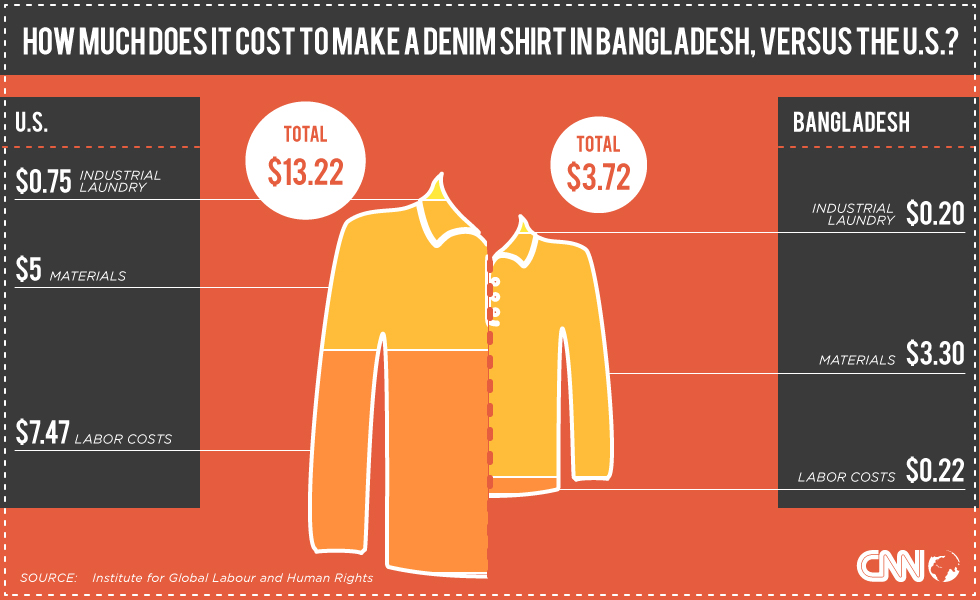
Not only that, but it's cheap labor that is driving globalization.  Cheap labor means we make things for less - and that is good for us as consumers.  Consider this chart we looked at today:


The production cost is often reflected in the price - though not always.  ...I know I'm happy when I save money.


Globalization:  The Bad

As we saw from Banananovia, global culture is replacing local cultures.  The Banananovian culture has essentially died out - and if not died out, it has irrevocably been changed.  ...Changed and supplanted with our own culture.


Furthermore, globalization has allowed for the exploitation of workers in developing nations - formerly called third-world countries.  It allows companies to take advantage of places that don't (or won't) honor the rights of workers.  It allows them to move their base where the standard-operating-procedures wouldn't be deemed illegal - even if we all agree this is unethical.

Today we watched a Simpsons clip where Mr. Burns outsourced his nuclear power plant to India in order to exploit the workers.  You'll have to ask my students what they thought about the clip.


Globalization: The Guilty

We watched another short clip today as well.  Maybe you recall the 2013 Savar building collapse?  It was the factory in Bangladesh that collapsed - there weren't enough fingers to point out the blame.  Here's what we watched:


There is a reason we have safety regulations in these United States.  The question I posited to my students is, should we share in the guilt of these deaths?  This is not a mere rhetorical question.  I only wish we had more time to discuss it in class.

Some (hopefully) unbiased thoughts:  

  • Most of our clothes (98%) come from overseas; selection... what choice do we have?
  • Should we adapt to a smaller selection?
  • Some businesses treat their employees well - both at home and abroad.
  • Some factories exploit their workers.
  • Is it our place to fight for the rights of workers overseas?
  • Should we leave that up to their country?
  • Is it my responsibility to find out the working conditions of the people who made my clothes?
  • How is this similar from the north buying goods from the south during US slavery?
  • How is this different?
  • Should we share in the guilt?
You can see that tons and tons of tough questions can come up when we discuss globalization - or really, any aspect of social studies.  There is never enough time in the class day.  The biggest question is, "what is my role in all of this?"  And that one may be the most difficult to answer.

To get the extra credit for reading and discussing the blog today, you have to read and discuss it with an adult.  I would suggest focusing on some of the questions/thoughts mentioned in the bullet points.  Respond to a couple of those on a piece of scrap paper.  Have the adult you read and discussed with sign the paper.  (Make sure your name is on it as well.)  Turn it in tomorrow.

PS: Some classes also discussed this cartoon, which I originally saw in Jr. Scholastic:


Friday, September 5, 2014

A Yarn About Globalization

My colleague/ student teacher came up with a great activity, which he taught in class yesterday.

You may be aware that we've been discussing what we mean by "culture."  And we've discussed some of the various aspects and ingredients that go into making a culture.  ...What is it that gives a group of people a collective identity?

Well, Mr. Helmuth took it to the next level - one culture interacting with another culture.  If you're an adult, you may recognize this as globalization.  If you're one of my students visiting the blog... you should definitely recognize this as globalization, since we just had a lesson on it.

Mr. Helmuth split the class into groups of countries.  Each country had a major export listed.  Bangladesh exported clothing, Saudi Arabia exported oil, etc...  He then took a ball of yarn, and started in one group.  That group had to determine what it wanted.  It passed the yarn to another group - so if it wanted grain, it would pass the yarn to the United States, establishing a trade partnership.

Because different cultures often speak different languages, and have various other cultural obstacles to overcome, speaking at all was not allowed in this activity.  ...Ok... this also made the activity easier to control.  If the students broke the rules and spoke, Mr. Helmuth came around with a pair of scissors and cut the yarn... stupid break-down in trade.  Sometimes he was the U.N. imposing sanctions.  Bravo, Helmuth!

By the end, an elaborate web of trade was woven all around the classroom:


This activity introduced many topics that could come up later in the year, and which may be used as a reference point later - even if we didn't explicitly discuss it yesterday.  (For instance, this illustrates the idea of economic interdependence, quite well - but we didn't give that term yet.)

If you want the extra credit, you were supposed to read and discuss the blog with an adult.  To prove that you did that, go to google, and type "Define interdependence."  Then, find a scrap of paper and write the first sentence of the definition.  Have the adult you discussed the blog with sign the paper.  If you want to discuss it further, go ahead.  But if you'd rather watch football or something, go ahead.  Thanks for stopping by. 

Monday, April 28, 2014

In Honor of ISTEP

We went back and brushed up on latitude and longitude.  We gave it a shot on paper, then moved to globes.  After we practiced on the globes, we reviewed globalization a little bit.  You guys all remember that, don't you?  Banananovia and what not?  If not, you should click on the link.

We reviewed the positives and negatives of globalization, once again referring to Banananovia.

Most classes got a chance to watch this video, although some did not finish it:


If you want the extra credit for reading and discussing the blog today, tell the adult reading with you whether 30°N is a line of latitude or longitude.  Then, tell them what the driving force behind globalization is - and whether it is good, bad or both, and why.

After you discuss it, write a simplified version of your answers on a scrap of paper, and turn it in tomorrow.

See you then.

Don't forget your calculator.  Seriously, post something to facebook reminding everybody to bring one tomorrow.  And get a good night sleep.  You owe it to yourself, and to Mrs. Gowdy.

Monday, October 21, 2013

Worth Your Salt

We finished up our gold/salt trade game today.  Most of the students were worth their salt, when it came to getting deals, but of course some were better than others.

We're studying Africa right now - specifically Ghana, Mali, and Songhai.  We'll continue to look at them after fall break.  The game featured the gold/salt trade that led to the rise of Ghana.  Some of the concepts of the game include the benefits of voluntary trade, natural barriers, traditional economies, and several others.

If you want to get extra credit for reading and discussing the blog today, tell the adult you're reading and discussing with how the game went.  Explain the different roles people played.  Tell what you were.  Tell how you did.

After that, write two sentences about the discussion.  Have the adult sign the paper, and turn it in tomorrow.


Here are some pictures of the simulation.  I hope you can find yourself.


Tuesday, September 17, 2013

Huh... Technology Shrinking the World and Plagiarism

So, we're talking about technology shrinking the world in here and I thought about getting an image to spice the blog up, so I searched it.  And here's something fun, the top image when you google image search "technology shrinking the world" is student work from this blog...  Fun, huh?  Try it out.

The problem was that there were two images later in the search that were identical and side-by-side.  One was from this blog, the other wasn't.  The one that wasn't was older.

I guess I can't catch every instance of plagiarism.  Technology definitely has it's ups and downs.  Either way, I took down the picture the kid drew.  And I watched the video about technology shrinking the world.  So, I guess it's not all bad, right?

Size is measured by both distance and space, right?  So often when someone says "how far is it to ________________" the answer is given in minutes rather than miles.

When people talk about technology shrinking the world, this is why.  We no longer have to travel 5 months to get to China.  We can fly, Skype, Facetime, etc...  The distance is the same, but we can access what was once inaccessible.

Technology is shrinking the world via transportation, media, and communication.

To get the extra credit for reading and discussing today's blog, come up with and example of each one.  How is technology shrinking the world via transportation?  Media?  Communication?  Discuss it with an adult.  Write down what you came up with and have the adult sign it.

Make sure your name date and hour are on it and turn it in tomorrow.

Here's the video if you're interested.


Monday, October 8, 2012

Cromarty Fisherfolk, Farewell

Bobby Hogg died.

 I'm tracking with you. You don't know who Bobby Hogg was, or how he relates to my class. Well, Bobby Hogg (according to this CNN article) was the last speaker of a Scots dialect known as Cromarty Fisherfolk.

As a class, we've been studying globalization, the economy, and the effects of technology on both.  My Banananovian story spoke explicitly about a nation that - due to globalization lost its culture.  It was a fictional story.

This is true.  Some points from the article:
  • When a culture becomes technologically advanced, it loses its culture faster.
  • Industrialization and trade spurs this on.
  • Languages (it is estimated) are disappearing at the rate of one every two weeks.
  • 96% of the world speak 4% of the worlds languages.
This was the point the Banananovian story was trying to hit home.  I'm not sure if it was accomplished or not.  But I know my students got something out of it.  One student made me a children's book.  I'm publishing it here:

(Text:  The students on the bus are saying, "An island over there," "I see it," and "Me too.")


 (Text: Arrow pointing at man: "Mr. Frizzile White Becker" - He is thinking about money, and telling the students to follow the Banananovians.  The Banananovians are saying, "follow us.")

(As they follow the Banananovians: Mr. FWB is complaining about the bus breaking down.  They pass the statue of the Big Banana.  Some Banananovians are bowing down to it.)

(Mr. FWB: "Lets take some bananas back to our country."  - Backstory: Up until this point in human history nobody has ever tried bananas before...  -  They load the bananas on the bus.)

(Text: "Mr. Frizzile Banana Becker: 'I'm Gonna Be rich'"  The sign says: "By some Bananas.  10$ Really Good!"  People: "I'll take some."  "Me Too."  "So will I.")

(The text is a little out of order on this picture, but essentially Mr. FBB/FWB tells the students they made $10 Million.  Everyone is excited.  One student suggests going back and paying the Banananovians for their bananas.)


(Back on the bus.  The Banananovians are saying, "They're Back.")

(We give money to the Banananovians, they're grateful.)

(Banananovia 40 years later.  Notice Mr. FBB/Mr. FWB's hair isn't what it used to be.  He's saying, "This place looks GOOD!"  But of course, their culture is no longer the same.)


To get the extra credit for the blog, read and discuss it with an adult.  Then, write 3 sentences base on your discussion.  You may want to include a comparison of the Banananovian story to what happened to the Cromarty Fisherfolk.


Friday, September 28, 2012

Banananovia II

Yeah... you decide:
Who is that guy?  Mr. Frizwhitelbecker.  Bam!  And he can even snowboard.  Poorly.

We broke down the Banananovian story today.  We looked at the ingredients in its culture, and how they changed.  Most of our time was spent debating whether we should have contacted them or not.  Unfortunately, we didn't get that all sorted out.  Both sides were argued well.

We also looked at a story I came across today on CNN.  It was interesting, and related to Banananovia in a number of ways.  Sometimes people mock others - or the culture of others - and they do it without thinking, or realizing it's inappropriate.  Often, they are bringing themselves down in the act.

In order to get the extra credit for today's blog, read it and discuss it with an adult.  Some questions to ask: should it be illegal to contact uncontacted peoples?  How does globalization help and hurt smaller cultures?

When you're done, write two sentences from your discussion on a scrap piece of paper, then have the adult you discussed it with sign the paper.

Thursday, September 27, 2012

Banananovia Goes Global

Well, I thought I might record the Banananovia story this year, but I didn't have time to get it all hooked up.  Hollywood, you'll have to wait at least one more year before your next big star can take off.

I've heard there are some pictures of Mr. Shaun White Frizzle floating around out there.  If I come across any I'll post them.  I did an image search on Shaun White to see if we were as similar as everybody said.  I think the real Shaun White would be highly insulted if he heard the comparisons.  So, sir: please don't blame me.  Blame the students.  They're the ones who compared us.


The Banananovia story is a look at culture, globalization, and the loss of culture.  The question for tomorrow is, "Was it worth it?"  It's interesting that this question actually comes up for Anthropologists.  The ethical and moral implications of the question: should we contact uncontacted tribal nations abound.  And as of 2010, there were over 100 "Uncontacted Tribes" in the world.  But I'm getting ahead of myself.  We'll talk about that tomorrow.

We also watched the "Banksy Simpsons Intro."  When it comes to globalization, there's a lot to think about.  Yesterday I said that the search for cheap labor was the driving force behind globalization.  Perhaps the Banksy Intro is overstated (I mean, the unicorn is a bit much...)  But it makes its point - even if it's biting the proverbial hand that's feeding it and perhaps misplacing some of its outrage.

Truth be told, there are a lot of companies - American and other that outsource jobs to get around labor laws.  Nike, Adidas, Walmart, as well as many others have been accused of such practices.  Whether the allegations are true or not, they're worth talking about.

Here's the Banksy Intro in case you're interested in watching it:


Well, I think that's enough writing for today.  I'm sure all you extra credit lovers have other stuff you want to get to as well.  If you want the extra credit, read and discuss the blog with an adult.  Talk about:

  • Banannovia
    • What was the story about?
    • Who were the Banananovians?
    • Was what happened to them good or bad?  Why?
  • The Simpsons Intro
    • How did that tie in with the Sweatshirt Map we looked at yesterday?
    • What parts of the intro were fake?

When you're done discussing, write two questions you have about Banananovia (or anything else we're discussing in class) on a sheet of paper.  Then, have the adult you read the blog with sign the paper.