Showing posts sorted by relevance for query Islam. Sort by date Show all posts

Thursday, January 15, 2015

Monotheism: Abraham's Journey; Judaism, Christianity, and Islam

Yesterday we started class by reading a passage from Genesis - from the Christian and Jewish Holy books.  According to Jews and Christians, God and Abraham made a covenant, or agreement/promise.

You can read what we read HERE.  They answered a few questions from the reading.

After they were done, we had a little refresher on the ancient civilizations of Mesopotamia and Egypt.  Abraham left Mesopotamia, and by the end of the passage we read yesterday, ended up in Egypt.

We reviewed the polytheism of these ancient civilizations, and then I read a section from the Qur'an.  In book 6, God shows the errors of polytheism.  Abraham tries to explain this to the people of Mesopotamia, but they will not listen.  (In fact, later in the Qur'an Abraham's father threatens to stone him if he doesn't accept the Mesopotamian gods.)

You can read the section of the Qur'an HERE.  (We actually read 72-81.)

The point of yesterday's lesson was that all three major monotheistic religions trace their roots back to Abraham.  An interesting thing to consider: the lives of more than 3 billion people today are directly influenced by that man.  (2 billion Christians, and 1 billion Muslims.)  That doesn't even take into account the number of non-religious people whose lives are influenced by him because of the countries in which they live.  Governments are set up that use the Qur'an or Bible or Torah to help inform how their countries are run.

Side note: In a couple classes, we discussed social media: many of my students have Facebook or Instagram.  We all agreed that it's fun when people "like" the stuff we post.  I happen to love being able to experience winter.  Driving in to work yesterday, the trees looked AMAZING, so I snapped a picture.


Social media connects us to other people.  It allows us to influence others.  It's crazy to think about how much influence Abraham has had on the world.  How many people would follow him on Facebook or Twitter...

We finished out yesterday by beginning a map of Abraham's journey.  Instead of giving it as an assignment, we're completing it as a class.

We haven't finished it yet.  I plan on wrapping it up tomorrow.  I'll post a picture when it's finished.

Today we've moved on from Judaism and Christianity to Islam.  We watched the Islam video - the last video we'll watch for quite some time.

If you want extra credit today, you need to write two names on a piece of scrap paper, then have the adult you read it with sign the paper.  All three major monotheistic religions trace their roots back to one man, who is it?  Who is the founder of Islam?  Those are the names you need.  ...Well... you should also make sure your name is on it...

...Man... I didn't even get to tell how I time-traveled with a couple classes...  Was it your class?

Thursday, February 13, 2014

Homework? What? Are you crazy?

I know, right?  You only have 4 days to complete it...

We finished up our 3 monotheistic religions charts today.  If you weren't here or you lost yours, you can download it by CLICKING ON THIS LINK.  That link will work for the rest of the quarter.  It's also on the school's website.  So imagine you're in the future trying to remember which blog post is housing this chart...  no need to worry.  Just go get it from H-Block Assignments.

Today's homework is also posted there.  (Or you can just click THIS HOMEWORK LINK.)  Students have to have 5 beliefs, thoughts, practices, etc... for each religion, and 5 for all three.  Anything falling in the two out of three category counts as all three.  So, for instance Judaism and Islam teach that pork is unclean - and should be avoided.  That would fall under the "all three" category, but should be placed between Judaism and Islam.

Students need 20 total on the diagram, and it's worth 20 points.  The instructions aren't on the top of the diagram, but we went over it in class.

We also finished watching the Islam video today.

Thanks for all your support.

Students, if you want extra credit for reading and discussing the blog, make sure you have your homework done.  If it's done, on the back of the homework write the 5 pillars of faith for Islam.  If you don't remember them, look them up online.  Then, have the adult you read and discussed the blog with sign the back of your homework.

Put a note in the extra credit tray telling me to check it... I'd hate to miss it.

Have a great weekend.

Monday, December 5, 2011

On to Islam

Today we took our pop quiz.  I think most students did pretty well on it.

We're moving into Islam over the next couple of days.  The students have now finished filling out their chart.  By the end of the week they should be able to explain everything that's on it.  They usually have some trouble with the founders.  Because all three monotheistic religions trace their roots back to Abraham, they often list him as the founder of the religion on the test.  They are not the same thing...  I gave the example today of a billionaire grandfather who started a car business.  If he gave some money to two of his grandchildren to start their own businesses, he would still only be the founder of his business.  His grandchildren would be the founders of their respective businesses, even though we could trace the money back to the grandfather.

Here's the chart in case your kid forgot it, lost it, or loaned it out to a friend.

We wait until this week to study extremism.  Students often associate extremism with Islam, so that's a separate lesson as well.  We take the time to define religious extremism, and point out that there are extremists in every religion.


For the extra credit, discuss the following questions:

How did you do on the pop quiz?
How much of the chart do you think you'll be able to explain?

In order to get the extra credit today, write a question you have about the blog or about class in general.  The question can come from student or adult.  The paper must be signed.  Adults, by signing the paper, you are signifying that you really did discuss those two questions with the student in my class.


Thursday, January 24, 2013

Almost No Post

I almost didn't post this because it takes so much extra time and effort.

To the 3 students that read and turned in the extra credit last night:  Kudos to you.  Thanks for putting forth the effort.  And had you not done that, you wouldn't have had the chance for extra credit today, as I wouldn't have had the effort to write.

We watched one of those Crash Course videos today - this one was on Islam.  You can watch it below if you're so inclined.


I'll finish up teaching about Islam tomorrow.

Here are some similarities between the monotheistic religions:

  • They're monotheistic
  • They follow religious rules
  • They trace their roots back to Abraham
  • They originate in the Middle East
  • They believe Moses was a prophet
Here's some other stuff to think about:

  • Muslims and Christians believe Jesus was a prophet.
  • The majority of Christians believe Jesus was/is God
  •  Muslims believe Jesus was not God.
This all came up in class today regarding why Muslims find pictures of the Prophet Mohammed offensive.

So, here's the deal: if you want extra credit read and discuss the blog with an adult.  Then, write two comments, facts, or whatever that came up in your discussion.  Have the adult you discussed with sign the paper.  Put it in the extra credit tray.

Tuesday, February 18, 2014

5 Pillars of Faith

Today students drew pictures of the 5 Pillars of Faith for Islam, and then shared the pictures with someone else - having them label the pictures.  I hope to post some of these pictures later, but I don't have time right now.

Here's my rendition of the 5 Pillars.  Don't judge it too harshly.


Don't ask me how the pillars in the second picture are being lifted off the ground...  I'm guessing they're attached somehow.  Ask an architect.

The point is, that to be a "good Muslim" one would have to submit to these pillars of faith.  For instance, if a Muslim said, "I don't believe in God," he wouldn't be a very good Muslim.  In fact, one could argue he's not a Muslim at all.

I had a student in 6th hour ask about that though.  "What if there was a Muslim who didn't give to the poor."  Great question.  I think other Muslims might say that person's not being a very good Muslim.  Maybe they don't want to judge their brother, but they might believe that since Allah commands it, they should do it.

I also compared it to a game of Jinga.  Eventually the tower will fall.  Maybe they only pray twice a day.  Maybe they don't fast during Ramadan...  There will come a time when their faith falls - or at least when they are considered "nominal" Muslims.

If you're in my class and want extra credit for reading and discussing the blog with an adult, write two sentences from your discussion, and have the adult sign it.  Maybe tell them the 5 pillars of faith for Islam.  If you can't remember them, just scroll up.

Have the adult sign the paper, and turn it in tomorrow.


Monday, December 19, 2011

Is the Capitol Actually North Korea?

First off all, I’d like to remind everyone that I post what we do every day.  Students can receive extra credit by reading the blog and discussing it with the adult they live with.  (Or in some cases some other adult.)  It’s five points a day… I think it’s worth it.

Please notice the polls at the top of the blog.  If you haven’t yet voted on them, do so now.  We’re going to discuss them in class tomorrow.  You will also have time to finish up your Hammurabi power point while we read The Hunger Games. 

We compared Islam and Judaism at the beginning of class, and then we spent the rest of the day in the book.

An excerpt from page 80:

“Electricity in District 12 comes and goes, usually we only have it a few hours a day.  Often the evenings are spent in candlelight.  The only time we can count on it is when they’re airing the Games or some important government message on television that it’s mandatory to watch.  But here there would be no shortage.  Ever.”

An excerpt from page 83-4:

“’I’d leave here,’ Peeta blurts out.  Then he looks around nervously.  It was loud enough to hear above the chimes.  He laughs.  ‘I’d go home now if they let me.  But you have to admit, the food’s prime.’
                He’s covered again.  If that’s all you heard it would just sound like the words of a scared tribute, not someone contemplating the unquestionable goodness of the Capitol.”
(Emphasis mine.)

We’ve discussed standard-of-living multiple times because of this book, but here it comes up again.  This time, though, it’s a little bit different.  We see that the people in District 12 have a low standard of living because the money gets funneled into the government.  We also see examples of government propaganda.

One of the countries we study in this class is North Korea.  The Capitol and North Korea share some striking similarities: dictator, food shortages, and government sponsored propaganda.  In the first quote above Katniss mentions important government TV messages that are mandatory to watch.  North Korea has state sponsored radio in every house.  You can turn it down, but you can’t turn it off.  (I learned that from THIS MOVIE, by the way.  It’s pretty good.)

In the second quote, Peeta is scared to speak out against (or even appear to speak out against) the Capitol.  Kim Jong Il just died.  (If you haven’t seen this on the news, go ahead and check for yourself…)  Here’s aline from one of the CNN articles: “There will be the compulsory large crowds of mourners in the streets of Pyongyang to honor Kim Jong Il.” (article by Scott Snyder)  Of course there will be.  Will there be people who refuse to go?  Will there be North Koreans who “contemplate the unquestionable goodness of Our Dear Leader?”

So, today we hit standards 7.1.2 – dealing with theocracy  - Kim Jong Il is revered as a deity and his dead father Kim Il Sung even more so.  He actually maintained the role of President after his death… his position according to their constitution is “Eternal President of the Republic.”

7.1.18 – deals with recent political conflicts.  The state gives North and South Korea as an example.

7.2.2 – identify and compare contemporary governments in Japan, Korea, China, etc…

I’m hoping to discuss this more in depth tomorrow, but we’ll see.  We also have to discuss historical context, and Hammurabi…

In order to get the credit for the homework, vote on the polls at the top.  Then, read the blog and discuss it with an adult.  Discuss the following questions: what were the similarities between Islam and Judaism that I gave at the beginning of class today?  Will people attend Kim Jong Il’s funeral because they want to, or because they were coerced?  Will there be any exceptions?  Why?  What makes you think that?  What’s happening right now in The Hunger Games?

Like usual, it’s not enough to read and discuss the blog.  Write the following on a piece of scrap paper:  “I wish we could learn B about chess P during social studies.”  Have the adult you read this with sign the piece of paper.  Adults, by signing the paper you are signifying that you did indeed read the blog and discuss the questions with whoever is in my class.  Please don’t sign it unless this is true.

Thursday, February 11, 2016

Religious Diversity Within the Monotheistic Religions:Part I

First of all, we managed to stave off any snow days and keep our 4-day weekend. ENJOY IT!

We've been studying 3 monotheistic religions: Judaism, Christianity, and Islam.  Quick - students, if you're reading this with an adult, turn to that adult and tell them what monotheistic means.

TADA!  Look!  They've learned something!  (Seriously, if they didn't get that right...  I just...  Look it up on google...)

Today students finished copying down a cladogram on the 3 monotheistic religions.  Here's what they copied.


I also made a version using Prezi, and I've got to say: it's pretty good.  Check it out if you have time.  (It's easier and makes more sense if you view it on a desktop.  Just click the first arrow once you're in.)


A couple of the main things I wanted students to get out of this presentation were that the 3 monotheistic religions trace their roots back to Abraham, but also that there's great diversity within Christianity - and even great diversity within the denominations of Christianity.

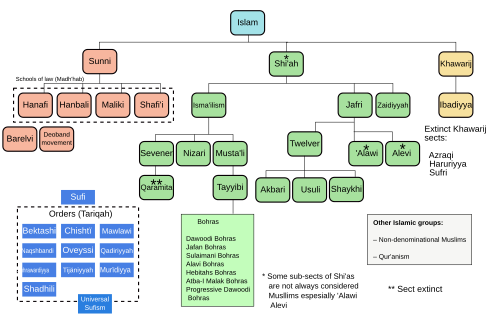
I understand that one of the failings of this presentation is that it doesn't show the diverse thought within the other religions.  And it should.  For instance, check out this picture on the denominations within the Sunni and Shia branches of Islam:

(The image was created by Angelpeream.)

Well, it's a work in progress.  I'm hoping to continue improving it every year I teach.


While I have a lot more I want to say on the topic, I'll say that's all for now.

If students want extra credit, they may read and discuss this blog with an adult.  Once they've finished, the student should write down 3 thoughts about the Prezi.  Then, have the adult sign the paper.

Turn it in Tuesday.

Enjoy the 4-day weekend.

Friday, January 23, 2015

Similarities Between Judaism, Christianity, and Islam Venn Diagram

If you've been keeping up with what we're doing in class, you know that we have a quiz on Tuesday.  It will include some multiple choice questions, as well as an essay section.

If you're interested in knowing the essay questions ahead of time, here they are:

1.  Compare the 3 major monotheistic religions we have studied.  Describe how they are similar, and how they differ.  Explain their main beliefs and practices.

2.  Who was Abraham?  Where was he from and why is he important to each of the three monotheistic religions?  What do each of the three monotheistic religions believe about him?

In class today, we took 3 mini-quizzes.  Two dealt with the pictures of the Five Pillars of Faith for Islam that the students had drawn yesterday.  I gave them a practice quiz first using pictures students had drawn last year.  Then they traded their pictures and gave each other a "pictionary quiz."

Then, we looked at some of the different beliefs of the 3 monotheistic religions we've been studying and put them on a Venn Diagram.  After I showed we went through the list, and they placed each on their own Venn Diagram, the students went and placed them on the board.

If you want some added practice, you could do it again.  Here's the Venn Diagram followed by the list:


1.Bible
2.Trace their roots back to Abraham
3.Name of God = YHWH
4.Monotheistic
5.Does not eat pork
6.Founder is Jesus Christ
7.Founder is Abraham
8.Founder is Mohammed
9.5 Pillars of Faith
10.10 Commandments
11. Believe in a Messiah
12. Believe Jesus is the Messiah
13. Believe the Messiah has not arrived yet.
14. Uses the Old Testament/Torah
15. Uses the Torah only
16. Uses Old Testament AND New Testament
17. Uses the Qu'ran
18. Believes Jesus is God
19. Believes Jesus is a prophet
20. Believes Jesus was just a man
21. Oldest (c. 1700 BC)
22. Middle (c. 33 AD)
23 Newest (c. 600 AD)
24. Jerusalem is a holy city
25. Some branches/denominations wear head-coverings
26. Originated in the Middle East
27. Two greatest commandments are love God and love people

And now for the answers.

...

Don't cheat...

...


If you want extra credit today, you should have read and discussed the blog with an adult.  It'd probably be a good idea to think about which essay you're going to write.  You could even write a rough draft.  (No pressure though, it's the weekend.  ...Lets keep work at work...)  To prove that you were here, write a paragraph from your discussion, and have the adult you read the blog with sign it somewhere.


If you want to look at some other stuff to study, check it out:


...You could always quiz yourself.  Though, make sure you'relaxing a little bit too.  It is the weekend, after all.

Thursday, January 31, 2013

Pillars of Being a Good Student

We graded the quiz today.  They'll be in the grade book shortly.  It's a good idea to check your grades at least once a week to make sure you're keeping up with everything.  This might be a good time to do that.

We're basically finished with the 3 monotheistic religions.  However, some people still don't understand the 5 Pillars of Islam.

So, I had the students come up with "The 5 (or a couple more) Pillars of Being a Good Student."

Here are some they came up with:
  • Attentive
  • Respectful
  • Does the work/ Productive
  • Organized/ Prepared
  • Prompt
If my students want to be "good students" they have to do all these things.  Now, they might be good kids, and have a good heart.  They might be intelligent.  But that doesn't necessarily make them good students.  If a student is constantly disrespectful, he's not a good student.  If he never brings his materials to class, he's not a good student.

We applied this to the "5 Pillars of Islam."  Hopefully it made a little more sense.

We also talked about OPEC today.  We're introducing international organizations.  We didn't deal with this much yet, but we will.  Oh, we will.

If you want the extra credit, read and discuss the blog with an adult.  Then, on a scrap piece of paper write a sentence telling whether or not you are a "good student" as defined by the pillars above.  If you're lacking in any category, tell me which one or ones.  If you think the list is missing something, write it down.

Have the adult you read and discussed the blog with sign the paper.

Turn it in tomorrow.

Thursday, December 8, 2011

Natural Barriers II

We had shortened classes today because of the writing prompt: "Instant Riches."

Yesterday we discussed natural barriers a little bit.  It's interesting to me because most of the class was actually dominated by a discussion of Islam and reading The Hunger Games, yet when I wrote the blog I only really discussed natural barriers.  (That's not that interesting, you say...)  What I mean is, I spent the majority of yesterday's blog discussing something that was discussed for maybe... 10 minutes.  I just figure, we do SO much in class it'd bore you all half-to-death (or closer) to get my full lesson in text form.  Or maybe it wouldn't bore you, but who has time to read all that?

So, today we went more in depth on the whole "natural barrier" thing.  Students had to circle four of China's natural barriers, and one (I bet you can guess what it is) of China's man-made barriers.  Then they went to the board and showed us where those barriers were.  (You'll notice this ties in much nicer with the actual standard: 7.3.10: Describe the limitations that climate and land forms place on land or people in regions of Africa, Asia and the Southwest Pacific.  China, being in Asia... Panem, of course, is in a fictional dystopic North America... 

Last year I emailed a website and received permission to use a map I found online.  I'm not sure if that includes posting it to my blog, so I emailed them again this year.  If they ask me to take it down, I will... but I can't imagine them doing that.  They seemed so nice.  *EDIT: They emailed and said I could post it on here.  Thanks worldatlas.com.*END EDIT*  Anyway, here is what it looked like when the students finished showing the natural barriers:
The map came from THIS website.  It wouldn't hurt to check them out.  In case you want to see this map without all the writing on it, you can find it HERE.

Officially, we're still studying religions, but everything overlaps so much, it made sense to do this now.  Tomorrow, back to Islam.


If you want extra credit, discuss the following questions with an adult: How did you do on the writing prompt?  What did you write about?  So, natural barriers, huh?  Those are pretty crazy.  That's not a question.  I know... ummm... can you make it into one?  Some question about China and natural barriers, and how it affects the people and surrounding cultures.  BAM!  In order to get the extra credit points, write the following phrase on a scrap of paper: If I get murdered in the city, don't go revenging in my name.  One person dead from such is plenty, no need to go get locked away.  Adults, by signing the paper, you're saying that you really did discuss those ummm... "questions" with whoever's in my class.  ...I realize they're not all questions today... sorry about that.  : )

Friday, January 25, 2013

Time Travel

Ahhhh... The Grandfather Paradox.  If you were to travel back in time and kill your grandfather - you wouldn't be born...  Which means you couldn't travel back in time to kill your grandfather... which means your grandfather lives.  If he lives - you'll be born... which means...  Ugggggg!

I love time travel.

It came up while we finished talking about the monotheistic (believes in 1 God) religions today.

Think about this:
  • Christianity: 2.1 Billion
  • Islam: 1.6 Billion
  • Nonreligious: 1.1 Billion
  • Hindu: 1 Billion
  • Chinese traditional: 394 Million
  • Buddhism: 376 Million
  • Primal-Indigenous: 300 Million
  • African Traditional: 100 Million
  • Sikh: 23 Million
  • Juche: 19 Million
  • Spiritism: 15 Million
  • Judaism: 14 Million
  • Baha'i: 7 Million
  • Jainism: 4.2 Million
  • Shinto: 4 Million
This is all taken from the more and more reliable Wikipedia -  though I don't advise using the site for academic purposes.

Here's the question I asked: I only teach 5 religions during the year.  Judaism is not in the top 5.  Why do I teach about Judaism?

It's the grandfather paradox.  Judaism is taught because of its influence.  Without Judaism, Christianity and Islam would not exist as we know them today.  Furthermore, the influence extends past the religions: Israel (and the teachings of Judaism) influence the Middle East as a region today.

Some students still got caught up in the difference between being the "founder" of a religion, and "tracing roots back to..."  As in, the founder of Christianity is Jesus Christ.  However, Christianity can trace its roots back to Abraham.

I told a story about this.  It involved Papa John in most classes.

You probably read this because you want extra credit.  Well, I hope you discussed the three monotheistic religions.  Write down two sentences telling me how the discussion of the blog went - maybe tell me what you talked about.  Have the adult you read the blog with sign the paper.  Turn it in on Monday.

Have a great weekend.  I can't believe it's already here.

Friday, January 31, 2014

Mono, Poly, and Pan

Mono = One
Poly = Many
Pan = Everything or all

We started off the lesson finishing up yesterday's lesson, and introducing the terms monotheism (the belief in one god), polytheism (the belief in many gods), and pantheism (the belief that everything is god).

Normally, when I teach religions, I start with the "three major monos."  And I teach them chronologically, so we start with Judaism since it came first c. 1700 B.C.  Then move to Christianity c. 33 A.D., and then move on to Islam c. 632 A.D.

However, this year, I decided to start with Christianity, since the majority of my students have some background with this.  Even if they are not Christians themselves, many have been exposed to the ideas of Christianity by their peers or neighbors.

I gave them a little pretest to see if any of them knew anything about the religion.  I asked if they could name any of the 10 Commandments, any of the Gospels, or if they knew the "Golden Rule."

Some classes asked a LOT of questions.  ...I mean a lot.  I fielded questions about some controversial subjects: adultery, homosexuality, creation and evolution.  I was as honest as possible - probably being overly cautious not to misrepresent either side.  If I felt like the topic was controversial, I tried to point them back to you (that is, the adult that is reading this with the student from my class...)  

For instance, when a student 6th hour said, "I get where babies come from - you know, I came from my mom, and she came from her mom, and on and on and on... but where did it start?"  I had to pause.  And during my pause, when someone else shouted out, "I heard we came from monkeys!" I had to hold up my hands, and pause a little longer.

I tried to preface what I said with, "Many _____________ believe" because even inside Christianity, Judaism and Islam there is much diversity about beliefs.  And the same is true with science: while the vast majority of the scientific community may agree on the evolutionary model, there is diversity in the hows and whys: for instance, the consequences of genetic drift.

For the record, in the class where the student shouted out, "I heard we came from monkeys," I told the class that that's not actually what evolution teaches, but rather we came from a common ancestor.  Either way, we didn't really have time to get into it, so we didn't.

It's 3:30 and I still have to put in some grades, so I'm going to cut this post short.

If you want extra credit for reading and discussing this post, write out the definitions of monotheism, polytheism, and pantheism.  Then, have the adult you read and discussed the blog with sign the paper.  If you have any thoughts, questions or comments, you can put them on there as well - or leave them in the comments section of the blog.  (Sorry, I censor swears...  This includes rap lyrics...)

Also, your friends are forgetful.  I had a lot of people turn this in because you guys reminded each other to do it.  Thanks for helping one another out.  

Tuesday, December 6, 2011

Video Days

Sometimes I think social studies classes are misrepresented, or at least common perception of them is off.  I think people picture us setting up a DVD player (some parents probably imagine us setting up a film strip projector...) on day one, pressing play, then kicking our feet up the rest of the year while getting paid a modest salary for relatively little work.

Hopefully this blog will help dispel some of those rumors.  We watch very few movies in here.  We do usually hit a couple big ones - Gandhi and Promises - but other than that they are rare.  (Even the big ones we usually trim down to fit into a week or two...)

Well, today was an exception - and I may add an exception that didn't take up the entire period.  We watched the last of the monotheistic religions videos today.  Each one lasts about 20 minutes and gives some insight into the religions we're studying.  Obviously, at 20 minutes there's only so much that can get covered, but they're a nice way to introduce the religion.

I don't think students get a whole lot of the video itself.  They get far more from the discussions that follow.  Tomorrow we'll go over the sheets that they were to fill out during the movie.  Honestly, it's a way for them to get some free points.  It helps them stay focused and follow along, but it's not a big deal if they miss an answer because we go over it together in class later.

The beginning of class was taken up with a discussion of religious extremism.  I thought it went pretty well.  I would love to show a 2 minute summary video about that to all my classes, but there are no good ones out there.  Go ahead and search youtube for yourself.  They either have an anti-religion bias, or they have an anti-religion-that-isn't-Christian bias.  I don't really feel comfortable showing either of those in class.  (If you do find one, please attach it to this blog as a comment.)

For today, discuss the following questions after reading the blog: what is religious extremism?  Do you think Islam gets a bad rap?  Give some instances of religious extremism other than Islamic Extremism?  We talked about people willing to kill or die for their faith.  Is there anything you're willing to die for?  If so, what?  Would that make you an extremist?  Why or why not?

To get the extra credit, write the following on a piece of paper: I'm an extremist when it comes to skateboarding.  Backside 50/50 baby.  Parents/Adult signing paper... (oh yeah, kids... you still have to get it signed...) by signing that scrap of paper you're saying your kid really did read and discuss the blog and questions with you.)

Thursday, December 1, 2011

Books Are In

The Hunger Games were dropped off this afternoon.  I'm so excited!  We've been reading a little bit here, a little bit there, but we haven't had enough for every kid.  Needless to say, sharing is not the forte of every student...  I think tomorrow will be a Hunger Games day.  I want to be done by break so the other teachers can get to it before the movie comes out.

Class today went well.  We're still comparing Judaism and Christianity.  Next week we'll start on Islam.

One thing that came up in class today was the benefits of television.  We talked about strength in unity, and the importance of having a homogeneous culture.  This came up both in studying Judaism/Christianity, as well as today's reading in The Hunger Games.

It's late, and I have to put in a bunch of grades (video viewing guide)... so I'll save you from reading and discussing a ton.

Question of the day: Why did I say TV is a good thing?  We talked about Sponge Bob in most classes.  Do you remember?

One more question:  In studying religion, I asked the question: "Have you ever played a game with the kid, only to have the kid change the rules on you in the middle?  (I think I used the example of a kid making a "new base" in the middle of a game of tag...)  What did that question have to do with the religions we're studying?

In order to get the extra credit, discuss those two questions and bring in a sheet of paper signed by the adult you discussed them with.  Include the phrase: Bakers bake bread for Prim.  Adults, by signing the paper, you're saying you really did discuss this with your kid.  : )

I've been enjoying getting the extra credit slips of paper.

Wednesday, February 19, 2014

Happy Birthday Poppy!

Look, I know you're not here to hear about my kids, but it's my daughter Penelope's birthday, so I thought I'd post this picture that my wife sent to me this morning:


*Sigh*  They grow up so fast.  She's two today.

In class we're finishing up the three monotheistic religions: Judaism, Christianity, and Islam.  We looked at the 5 pillars of faith again, and then did an interactive Venn Diagram.

There will be a quiz coming up pretty soon.

But tomorrow we're moving on to Hinduism.  I haven't decided yet if I'm going to break the religions apart - you know - give a quiz on the three monotheistic religions, and then a separate quiz on Hinduism and Buddhism.  I'm leaning on giving one test covering all the religions we've studied.

Last thought: one of the vocabulary words that's going to be on the Wellness vocabulary test on Friday is monogamous.  This is where learning those prefixes and suffixes comes in handy.

If you're in my class and want extra credit for reading and discussing the blog, make sure you read it and discuss it with an adult.  Tell them the 5 Pillars of Faith from memory, if you can.  Tell them about the Venn Diagram we did together as a class.  Explain how it worked.

Then, write the quote: "Happy birthday, Poppy."  on a piece of paper, and have them sign it.

Wednesday, January 23, 2013

2 Hour Delays Won't Get My Praise...

...although, it's nice to have a little extra time to prepare in the morning.

We accomplish a lot less when we have less time.  (That's my brilliant contribution to the day's dialogue.)

We finished up filling out the chart on Judaism and Christianity.  We'll discuss Islam over the next couple days, and we'll probably have a little quiz over the topics next week.

We also read an article on Abraham, and saw why the three major monotheistic religions traced their roots back to him.

Two hour delays shorten everything up.  Yesterday's post... today's post...

I'm off to make new seating charts.

If you want extra credit, read and discuss the blog with an adult.  (I know, there's not much here today...)  Write the date on a scrap piece of paper.  Put your name on it, and have the adult you discussed the blog with it sign it.

Turn it in tomorrow.

Monday, April 24, 2017

Progress Reports and an Influx of People Wanting Extra Credit

So, progress reports come out tomorrow.  And we just took a little quiz that a lot of people got Ds on.  SOOOoooo... I'm anticipating an influx of students who are looking forward to some extra credit.

You've come to the right place.

We've finished studying religions.  You should now know the difference between monotheistic and polytheistic religions.  What theocracy is, and when it comes into play.  You should know some differences between the monotheistic religions - what Jews and Christians believe about the Messiah, for instance.  What are the Five Pillars of Faith for Islam?  What does "poly-morphic monotheism" mean?  Which religion is it specifying?  Which religions believe in karma and reincarnation?  How is the idea of karma in Hinduism different from the idea of mercy in Christianity?

We'll come back to the religions in review, but we're done for all intents and purposes.

For now, we're doing some moderate review - both for the ISTEP, and for our final, which is coming up in about 3 weeks.

It's been a while since we've discussed globalization, standard of living, or human capital.  Hopefully you still remember the differences between limited and unlimited governments.  More recently we've talked about colonization and imperialism.  How many of you remember the colonization simulation?

Does anyone remember why you learned TKWA?  Not just what each letter stands for, but why you learned it?

If you want extra credit for reading and discussing the blog with an adult, you need to read and discuss it with an adult.  To get the points, write the answer to at least 3 questions asked above.  They can be any three questions.  Third paragraph.  Fifth.  Have the adult you read it with sign your paper.  Turn it in tomorrow in the extra credit tray.

Tuesday, December 13, 2011

Time and Tutoring

I don't have a lot of time to write today, since I am going to help with tutoring after school.  Our school really does offer a lot of opportunities to help our students succeed.

We worked on our Five Pillars of Faith drawings today.  We also watched a little video of the Kaaba, Islam's holiest site.  Here's the video:


We compared it to the Ark of the Covenant for Judaism.

THE PICTURES ARE HOMEWORK.  IF THEY'RE NOT FINISHED, FINISH THEM NOW!

After that we worked on the webquest.  I think it went pretty well.  We'll see how they turn out.


To get the extra credit for reading the blog, discuss the following questions:

Are your pictures finished?  (Ask to take a look at them, ask what they each mean...)

How did the webquest about Hammurabi go?  How far did you get?

In order to get the extra credit for reading today's blog, write the following phrase on a scrap of paper: "If I go to China, I'm not going to go to the Nike store."  Have the adult that you read the blog with sign the paper.  Adult, by signing the paper you are signifying that you really did read the blog and discuss the questions with the kid from my class...

Wednesday, December 7, 2011

Natural Barriers

Oh, Katniss Everdeen, how you tie in to social studies - let me count the ways:
Governments, standard of living, culture, customs, civil disobedience, economic systems, ...  Today, in most classes, we got to the part where... (dang it... I don't want to give away what's happening in the book...)  Ok, some people have to travel through some mountains.  This is what is said:

 "I realize we must be in the tunnel that runs up through the mountains into the Capitol.  The mountains form a natural barrier between the Capitol and the eastern districts.  It's almost impossible to enter from the east except through the tunnels.  This geographical advantage was a major factor in the districts losing the war..."

Man, that hits so many standards.  (Granted, the standards apply to Asia, Africa and Australia - but I'm more concerned with the concepts they're teaching rather than the facts about places themselves...)

For instance:  "7.3.10: Describe the limitations that climate and land forms place on land or people in regions of Africa, Asia and the Southwest Pacific.

Example: Deserts in Africa, Saudi Arabia and China; the islands of Japan; mountains of Iran and Afghanistan; northern regions of China."

Yes, that deals with those specific places, but the concepts are the same for all of them.  I took a break from reading to discuss this with the kids - the difference between natural and man-made barriers.  My hands were the cow people and the lettuce people, separated by the Adidas Mountain range.  ...


It looked something like this:
We talked about why having a mountain range between these two groups of people might be beneficial - if the lettuce people try to attack the cow people, they have to cross the natural barrier - the Adidas Mountains.  That would make it more difficult.  Of course, if the lettuce people wanted to trade with the cow people, that would be more difficult as well. ...  I kept mixing up my voices... I couldn't keep them straight - which voice went with cow, which one went with lettuce... 

Anyway, we then discussed other forms of natural barriers, and types of man-made barriers as well.  Every class came up with the Great Wall of China as a man-made barrier.

Of course, we're still studying religions.  (You remember, standard 7.1.4 - which I mentioned in an earlier post.  I can't see how you can adequately teach a religion in a meaningful way - a way the kids will remember it, connect it with other religions, understand it in a way that is relevant to them and their world -  in less than a week.  (Classes are 45 minutes...)  The idealist in me says 3 days per religion...

We did go a little cross-curricular in one class today and use some algebra to figure out what year we're in on the Muslim calendar...


At any rate, it was a good day today.  If you're in my class and want extra credit - or if you're reading this and you want your kid (the one that's in my class) to receive extra credit, discuss the following questions:

1. What is a natural barrier?  What might be some positives and negatives from natural barriers?
2.  What does "standard of living" mean?  Can you give any examples from today's reading that Katniss had a relatively low standard of living in district 12?
3.  What is Islam?  What do you know about it so far?  Is there anything you don't understand about it?

When you're done discussing those, write the following phrase on a slip of paper: "It looks like you were ready for a flood in that picture Mr. Habecker..."  In order to get the extra credit points, the paper must be signed by the adult that discussed this stuff with you.  Adults, by signing it, you're saying that yes, so-and-so really did discuss those questions with you last night.

Monday, February 13, 2012

A Couple Games

To get the extra credit today, play the Middle East Geography Games found HERE.

We spent a little time today discussing similarities between the three monotheistic religions - Islam, Christianity, and Judaism.  One of the similarities we mentioned is that they all originated in the Middle East.

Some of the students were unsure of what/where the Middle East is, so I talked about the term a little bit - and how it's Eurocentric - and therefore, one could argue - ethnocentric.  (Basically, the term comes from the European point of view.)

Here's a nice picture: map of near east middle east and far east

To get the extra credit today, students have to play the game (play the "country" column - in the middle) 5 times, and show an adult that they've played it 5 times. Once they're done, have the adult sign a piece of scrap paper, along with the scores.