We're having an Economics quiz on Friday. I sent home a review guide today. If you weren't in school today, you can view or download the review guide here.
We spent a good portion of the day reviewing. Part of that review was reading and discussing THIS ARTICLE about Elkhart County's GDP. There was also a 10 point worksheet that went along with it. If you weren't here, I'd download it and turn it in. You can do that here.
If you weren't in class today, read and discuss that article with an adult. If you were in class, you may summarize it and discuss it with an adult.
To earn the extra credit, write two sentences from your discussion, and ask one question about the article, GDP, or economics in general. Have the adult you read and discussed with sign the paper.
Turn it in tomorrow. (Make sure your name, date, and hour are on it.)
*Update/Edit* A couple ladies from my 7th hour class watched Frozen over the weekend. They pointed something out to me... Extra extra credit to anybody who tells me how this clip ties in with what we're studying.

Showing posts sorted by relevance for query economics. Sort by date Show all posts
Showing posts sorted by relevance for query economics. Sort by date Show all posts
Monday, December 8, 2014

Monday, October 24, 2016
No Post in 20 Days?!?!?!
I've become horrible at posting the extra credit blog. I get that. And I apologize. There are a number of reasons for it, but I'm not going to go into it here.
Instead, I'm going to give you a bunch of opportunities to get extra credit. The rules have changed a little bit with this post.
You still need to read and discuss these posts with an adult. But you may only do one of these a day. (And you may only do one for the entirety of Fall Break.) Sure, you may read more, but you'll only get credit for one.
Some of the things will have changed, since the posts are from previous years, but overall the content is the same.
In order to get credit, you need to write the current date, the date of the post, do whatever the post tells you to do, and have the adult you read it with sign signifying that you read and discussed that post with them.
Here are the posts: Dealing with Economics:
Instead, I'm going to give you a bunch of opportunities to get extra credit. The rules have changed a little bit with this post.
You still need to read and discuss these posts with an adult. But you may only do one of these a day. (And you may only do one for the entirety of Fall Break.) Sure, you may read more, but you'll only get credit for one.
Some of the things will have changed, since the posts are from previous years, but overall the content is the same.
In order to get credit, you need to write the current date, the date of the post, do whatever the post tells you to do, and have the adult you read it with sign signifying that you read and discussed that post with them.
Here are the posts: Dealing with Economics:
Dealing with Human Capital:
Monday, November 24, 2014
Economics
The test grades were sent out. Shazaam! (They were a little late... I had some issues with technology.)
I'm impressed by the report though. If you didn't sign up to have your grades emailed to you, you should next time: tre cool.
We're in to economics now. This is the definition I gave the kids:


We discussed the difference between a good (or healthy) economy and a bad (unhealthy) economy:


I'm impressed by the report though. If you didn't sign up to have your grades emailed to you, you should next time: tre cool.
We're in to economics now. This is the definition I gave the kids:
After that, we simplified the definition. (I also added services in after goods...)
So, we could say, "the economy deals with the production, distribution, and consumption of goods and services."
Or, we could say, "the economy deals with the making, selling, and buying of stuff."
I prefer the former, but for 7th graders the latter is easier to understand.
We discussed the difference between a good (or healthy) economy and a bad (unhealthy) economy:
And of course, we discussed Black Friday just a little bit.
I'm not a big fan of rampant consumerism. I'm worried it's destroying our country.
But, of course, I'm glad people buy things. If they didn't, where would we be? It's because people buy that allows us to have jobs and a higher standard of living. The problem comes in when "stuff" becomes more important than people.
To get the extra credit today, you should read and discuss the blog with an adult. On a sheet of scrap paper, write a paragraph about your discussion. Write your thoughts about the paragraph from above. Do you agree? Do you disagree? Why? What should we do about it?
Some classes also watched some videos about this topic. Watch if you want to, but you don't have to for the blog credit if that's what you're here for:
Saturday, September 21, 2013
Outsourcing
We're continuing on with globalization, and soon we'll be moving into economics.
Yesterday in class (I'm writing this on Saturday) we watched a 5 minute clip of the Simpsons. In it, we find out that Mr. Burns, the boss of Springfield's nuclear power plant is going to move the factory to India. He says no one should worry - the jobs are still there - they're just being done by someone else in a foreign country.
We look at the causes of globalization, and I also ask the students to refer back to previous lessons as well - for instance we note ingredients of culture in the clip.
Monday we'll be reading about and discussing the factory that collapsed in Bangladesh. Soon we'll tie it all together - looking at the positive and negative implications of globalization as a whole.
Students, I hope you have time to discuss some of this with a parent or other adult.
Adults, please feel free to ask them what outsourcing is, why it happens, and how it is an example of globalization.
When you're done, write this phrase on a scrap of paper: "Last night I dreamt I went to Manderley again." Then have the adult you read and discussed with sign the paper.
Yesterday in class (I'm writing this on Saturday) we watched a 5 minute clip of the Simpsons. In it, we find out that Mr. Burns, the boss of Springfield's nuclear power plant is going to move the factory to India. He says no one should worry - the jobs are still there - they're just being done by someone else in a foreign country.
We look at the causes of globalization, and I also ask the students to refer back to previous lessons as well - for instance we note ingredients of culture in the clip.
Monday we'll be reading about and discussing the factory that collapsed in Bangladesh. Soon we'll tie it all together - looking at the positive and negative implications of globalization as a whole.
Students, I hope you have time to discuss some of this with a parent or other adult.
Adults, please feel free to ask them what outsourcing is, why it happens, and how it is an example of globalization.
When you're done, write this phrase on a scrap of paper: "Last night I dreamt I went to Manderley again." Then have the adult you read and discussed with sign the paper.
Monday, October 5, 2015
Busy, Busy Days
It's been pretty busy around here. Grades continue to be updated. If I were you, I would double-check them to make sure they're accurate. If there's anything you need to turn in, well... Get it turned in.
I'm hoping to post some of the ingredients of culture pictures here on the blog, but I might not get that done for a day or two. We're still studying culture, but we're mixing it with economics. We're working our way toward globalization.
Today students reviewed the ingredients of culture by writing a short story which included each ingredient.
After that, we got new seats.
Then, they looked in The Hunger Games and found examples of some of the things we've been studying.
They had to find:
I'm hoping to post some of the ingredients of culture pictures here on the blog, but I might not get that done for a day or two. We're still studying culture, but we're mixing it with economics. We're working our way toward globalization.
Today students reviewed the ingredients of culture by writing a short story which included each ingredient.
After that, we got new seats.
Then, they looked in The Hunger Games and found examples of some of the things we've been studying.
They had to find:
- standard of living (3 examples)
- economies
- traditional (1)
- market(1)
- command(1)
- ethnocentrism (1)
- ingredients of culture
- food (1)
- dress (1)
- religion (1)
- customs (1)
- ethnicity (1)
- values (1)
- the arts (1)
- government (1)
- language (1)
- standard of living (already listed above)
I think it went pretty well.
Students can get extra credit by reading and discussing this blog with an adult. After you've read and discussed it, write a sentence about your discussion. Have the adult you read with sign the paper. Make sure your name, date, and hour are on it. Turn it in tomorrow.
Tuesday, December 9, 2014
Africa, Economy, Ancient Civs, and Dunk a Chicken
We'll be tying a few things together tomorrow... geography, history, economics, etc...
We'll be trading gold for salt in the trans-Saharan trade.
Today we worked on a map looking at that.
We started off the class, however, by watching a video. (It started playing just before the bell, and ended just after the bell.) If you want extra credit, watch it again and tell the adult why we watched it in class. What did I want you NOT to forget?
We'll be trading gold for salt in the trans-Saharan trade.
Today we worked on a map looking at that.
We started off the class, however, by watching a video. (It started playing just before the bell, and ended just after the bell.) If you want extra credit, watch it again and tell the adult why we watched it in class. What did I want you NOT to forget?
Wednesday, April 24, 2013
Successful Review
We continued reviewing for ISTEP today by going over our last test. Again, most of my students did a good job. Today we focused on the questions a lot students missed.
Before going on, I'd like to explain something - should it come up tonight:
One of the questions a lot of students missed asked was "Which religion could be categorized as monotheistic, polytheistic, or pantheistic?" The answer is Hinduism. It's true they believe in many gods - such as Hanuman, Vishnu, Krishna, Kali, Ganesha, etc... which would make them polytheistic. But they believe those gods make up the God/God Spirit Brahma. This is somewhat similar to the Christian concept of The Trinity - except that there are more than three parts to the Godhead. Either way, because of this Hinduism is sometimes labeled as monotheistic. And since Brahma is part of everything Hinduism is often designated as pantheistic.
I mentioned that this is partially where the idea of karma comes from - that Brahma keeps the universe in balance. Much like the scientific idea of homeostasis. I thought students learned about homeostasis in science this year - but it must be next year. ...ANYWAY, homeostasis is the body's way of keeping itself in balance. For example, if you get too hot - you sweat. If you get too cold, you shiver and get goosebumps. I mentioned that if you try to drink a gallon of milk in an hour, you'll end up throwing up. I had a couple students who were adamant that they either a) could accomplish this, or b) had already accomplished this.
At any rate, I told the kids they could believe what they want, but I was advising them not to try it because 1 - vomit is disgusting, and 2 - it's potentially dangerous.
Ultimately, the point was - like homeostasis, Hindus believe karma keeps the universe in balance.
Students did a great job on the economics section of the test, but most needed to work on the religions section. So, in order to get the points for today's extra credit - discuss 3 questions that were asked during the game today. Write down the questions on a piece of paper. Then have the adult you read the blog with sign the paper.
If you weren't at school today, write something about each one of the 5 religions we've studied this year, and have the adult you read the blog with sign the paper.
Before going on, I'd like to explain something - should it come up tonight:
One of the questions a lot of students missed asked was "Which religion could be categorized as monotheistic, polytheistic, or pantheistic?" The answer is Hinduism. It's true they believe in many gods - such as Hanuman, Vishnu, Krishna, Kali, Ganesha, etc... which would make them polytheistic. But they believe those gods make up the God/God Spirit Brahma. This is somewhat similar to the Christian concept of The Trinity - except that there are more than three parts to the Godhead. Either way, because of this Hinduism is sometimes labeled as monotheistic. And since Brahma is part of everything Hinduism is often designated as pantheistic.
I mentioned that this is partially where the idea of karma comes from - that Brahma keeps the universe in balance. Much like the scientific idea of homeostasis. I thought students learned about homeostasis in science this year - but it must be next year. ...ANYWAY, homeostasis is the body's way of keeping itself in balance. For example, if you get too hot - you sweat. If you get too cold, you shiver and get goosebumps. I mentioned that if you try to drink a gallon of milk in an hour, you'll end up throwing up. I had a couple students who were adamant that they either a) could accomplish this, or b) had already accomplished this.
At any rate, I told the kids they could believe what they want, but I was advising them not to try it because 1 - vomit is disgusting, and 2 - it's potentially dangerous.
Ultimately, the point was - like homeostasis, Hindus believe karma keeps the universe in balance.
Students did a great job on the economics section of the test, but most needed to work on the religions section. So, in order to get the points for today's extra credit - discuss 3 questions that were asked during the game today. Write down the questions on a piece of paper. Then have the adult you read the blog with sign the paper.
If you weren't at school today, write something about each one of the 5 religions we've studied this year, and have the adult you read the blog with sign the paper.
Tuesday, April 21, 2015
No Computers
We gave up the computer labs today for the practice ISTEP test. Still, I feel like the lesson went pretty well, even if we didn't get to work with google drawings. We'll get there.
Yesterday's video dealt with Mexico and Cambodia, among other things. One of the questions on the google doc asked students to tell me which continent the countries were located on. (The video showed them on a map, so I thought it wouldn't be too difficult. Also, ...Mexico. I mean, we know what continent Mexico is on, right?)
Turns out a lot of us don't. I know what you're thinking: Mexico is not in your jurisdiction. It's not a 7th grade standard. Well, you're right. But still.
Today, I gave students a pop quiz over the continents and oceans. It was the same quiz they all had to pass at the beginning of the year. It's interesting that almost everybody earned a perfect score, and almost everybody could place Mexico on the map, but so many students still named Mexico as being in South America when the map wasn't in front of them.
Well, hopefully we cleared that up.
I'm also trying to go over any of the smaller standards that I've missed. Some standards are huge. Religions? Ancient civilizations? Governments? Economics? Those take a lot of time.
Banking is pretty straight forward - at least for what 7th graders need to know.
Yesterday's video dealt with Mexico and Cambodia, among other things. One of the questions on the google doc asked students to tell me which continent the countries were located on. (The video showed them on a map, so I thought it wouldn't be too difficult. Also, ...Mexico. I mean, we know what continent Mexico is on, right?)
Turns out a lot of us don't. I know what you're thinking: Mexico is not in your jurisdiction. It's not a 7th grade standard. Well, you're right. But still.
Today, I gave students a pop quiz over the continents and oceans. It was the same quiz they all had to pass at the beginning of the year. It's interesting that almost everybody earned a perfect score, and almost everybody could place Mexico on the map, but so many students still named Mexico as being in South America when the map wasn't in front of them.
Well, hopefully we cleared that up.
I'm also trying to go over any of the smaller standards that I've missed. Some standards are huge. Religions? Ancient civilizations? Governments? Economics? Those take a lot of time.
Banking is pretty straight forward - at least for what 7th graders need to know.
Here's the 3 minute video we watched on that. We discussed quite a bit as well.
We talked about allowances, and doing chores. Keeping money in a jar, versus keeping it in a bank where it can collect interest... the irony of having a savings account while also having a mortgage.
Students may earn extra credit by reading and discussing this post with an adult. Discuss money a little bit. Talk about saving versus spending. Talk about buying now and interest rates. When you're done, students should write a couple sentences about their discussion. The adult they discussed the blog with should sign the paper. That will prove that they've been here.
Turn it in next time you see me.
Wednesday, December 11, 2013
Study For the Test.
Study. Study. Study for the test.
Here's how I want you to do it: get your review guide - OR A NEW ONE, if you must.
At the top of this webpage, on the left-hand side - there's a search engine. Use it to search for the topics you need to study about. Try typing Ancient Civs, Ancient, Ancient Civilizations, Economy, Economics, etc... Let your study guide guide you.
When you're done, write down 5 things you searched. For each one, tell me one thing you found. Have the adult you studied them with sign the paper. Turn it in tomorrow.
Here's how I want you to do it: get your review guide - OR A NEW ONE, if you must.
At the top of this webpage, on the left-hand side - there's a search engine. Use it to search for the topics you need to study about. Try typing Ancient Civs, Ancient, Ancient Civilizations, Economy, Economics, etc... Let your study guide guide you.
When you're done, write down 5 things you searched. For each one, tell me one thing you found. Have the adult you studied them with sign the paper. Turn it in tomorrow.
Friday, October 30, 2015
Urbanization
We're still tying everything together, and looking at the pros and cons of globalization - and there are a lot of both. We worked on understanding some of the terms that tie in to globalization:
- GDP
- Economics
- Interdependence
- Industrialization
- Standard of Living
...All things we've talked about before. We added two today: developing nations, and urbanization.
To teach urbanization, I had students draw flowers on their bellwork. They were in their groups, as they always are. Each group represented a village, or town. I told them I'd pay them in construction paper for the flowers they were drawing. And I did.
But one group was a city. They drew cars instead of flowers. ...And I paid that group in Starburst.
At the end of the week, I offered students the opportunity to move to the city, if they wanted to. Many, MANY students did.
Some students still did not move. Maybe they liked drawing flowers more than cars. Maybe they didn't feel like moving their desk.
This is like real life: maybe moving to the city is worth it to get a higher paying job. ...But it may not be worth it for everybody.
Hopefully this sent home the idea that urbanization = moving to the city. It usually happens because the person moving is looking for a higher paying job.
If you want the extra credit, tell the adult you're reading and discussing this with what you thought of the activity. Then, when you're done, write a couple sentences from your discussion on a piece of notebook paper. Make sure your name, date, and hour are on it. Turn it in on Monday.
There are some pictures below the page break:
Monday, January 23, 2012
A Case of the Mondays
Ok, parents and students sitting around reading this. I know you think that I have mountains of time where I just sit around thinking up witty things to say on the computer, but that's not the case. Mondays are crazy for me. I've got chess in less than 10 minutes, and I just sent out half a dozen emails. (Including one to Mr. Zook... you know the email I'm talking about...) I put in a couple grades, and talked to Mr. Ogle about the CAP Reading Group...
Five minutes left to come up with some meaningful extra credit. (I almost cancelled the blog extra credit today, but I didn't want to deal with the glares of the students who ended up with a 79.43999 come report card...)
So, it's short. Today for bellwork, we discussed economics and tied it into The Hunger Games. (I actually wrote about it before in THIS POST (CLICK HERE) but never taught about it in class...)
To get the extra credit points, read and discuss this blog with a parent, grandparent, auntie, step-parent, or other adult at your home. Here are some things I want you to talk about: how does the economy deals with jobs? What are some other words for production, distribution, and consumption? Can you tell me how The Hunger Games shows examples of command, market, and traditional economies? What is happening right now in The Hunger Games?
When you're done with discussing it, write the following quote on a piece of scrap paper: "Turns out I was a vampire myself." Then, have the adult you read and discussed the blog with sign the paper.
Adults, by signing the paper you are stating you really did DISCUSS its content. Please don't sign it unless that happened. *Emoticon Smiley Face*
Five minutes left to come up with some meaningful extra credit. (I almost cancelled the blog extra credit today, but I didn't want to deal with the glares of the students who ended up with a 79.43999 come report card...)
So, it's short. Today for bellwork, we discussed economics and tied it into The Hunger Games. (I actually wrote about it before in THIS POST (CLICK HERE) but never taught about it in class...)
To get the extra credit points, read and discuss this blog with a parent, grandparent, auntie, step-parent, or other adult at your home. Here are some things I want you to talk about: how does the economy deals with jobs? What are some other words for production, distribution, and consumption? Can you tell me how The Hunger Games shows examples of command, market, and traditional economies? What is happening right now in The Hunger Games?
When you're done with discussing it, write the following quote on a piece of scrap paper: "Turns out I was a vampire myself." Then, have the adult you read and discussed the blog with sign the paper.
Adults, by signing the paper you are stating you really did DISCUSS its content. Please don't sign it unless that happened. *Emoticon Smiley Face*
Thursday, October 3, 2013
Review for the Test
We're having a test in here on Wednesday. It's probably a good idea to review for the test. So, here's what's going to on it:
Latitude & Longitude:
• Know the difference
• Plot on a map
• Locate places using
Cultures:
• Ingredients
• Definitions of ingredients
• Examples of ingredients
• Standard of living
o Infant mortality rate
o Literacy rate
• Ethnocentrism
• Cultural borrowing
• Cultural diffusion
Globalization:
• Technology speeds globalization
• Positives of globalization:
o i.e. gain knowledge
o improve standard of living
o etc…
• Negatives of globalization:
o i.e. loss of culture
o outsourcing
o spread disease
o etc…
Economics:
• Definition
• 4 types
o Traditional
o Market
o Command
o Mixed
Anything I forgot… ...like continents and oceans or 9/11.
If you want the extra credit for reading and discussing the blog today, read and discuss it with an adult.
Adult, ask them about 5 topics from this list. Hopefully they're able to answer. If not... looks like it's time to break out the notes.
If you discussed at least 5 topics, find a sheet of scrap paper, and write: "No need to break out the notes here..." Then have the adult sign it.
FYI, there will be no blog post tomorrow.
Latitude & Longitude:
• Know the difference
• Plot on a map
• Locate places using
Cultures:
• Ingredients
• Definitions of ingredients
• Examples of ingredients
• Standard of living
o Infant mortality rate
o Literacy rate
• Ethnocentrism
• Cultural borrowing
• Cultural diffusion
Globalization:
• Technology speeds globalization
• Positives of globalization:
o i.e. gain knowledge
o improve standard of living
o etc…
• Negatives of globalization:
o i.e. loss of culture
o outsourcing
o spread disease
o etc…
Economics:
• Definition
• 4 types
o Traditional
o Market
o Command
o Mixed
Anything I forgot… ...like continents and oceans or 9/11.
If you want the extra credit for reading and discussing the blog today, read and discuss it with an adult.
Adult, ask them about 5 topics from this list. Hopefully they're able to answer. If not... looks like it's time to break out the notes.
If you discussed at least 5 topics, find a sheet of scrap paper, and write: "No need to break out the notes here..." Then have the adult sign it.
FYI, there will be no blog post tomorrow.
Wednesday, December 3, 2014
#Money #GDP
A good quiz for my students: what is the economy? Whenever you see or hear the word economy, what should you think of?
Production, distribution, and consumption of goods.
Every. Time.
So, when they see words like economic spillover, they know that it has something to do with the production, distribution, and consumption of goods.
I taught economic spillover yesterday, but didn't have time to post. Economic spillover - which is now being called externalities - are the unintended positive and negative consequences of economic development. When someone decides to build a factory, why do they build it? Profit. To make money.
Some by-products may be air pollution or noise pollution. Maybe a Starbucks around the corner popped up to sell the workers coffee in the morning. Did the factory owner build the factory because he wanted to pollute and drink Starbucks? No. He wanted to make a profit; those are externalities - they happened anyway.
GDP = Gross Domestic Product. When my students see the word product, it should now be linked to economics, or the economy. Things made.
What's the Gross Domestic Product of the United States? 16.8 Trillion. What about Indiana? 246.4 Billlion.
So, if you took everything the U.S. made in a year and added the profit for all of it, you would get 16.8 trillion dollars. Not bad. We're #1 baby. (That is, if you go by country...) If you figure GDP per capita, then we're ranked 10th.
GDP and money are difficult to visualize. I mean, a trillion dollars? I can't really conceive how much a billion is. Honestly, when I bought my house I had trouble understanding the high thousands...
This chart really helps with that:

Production, distribution, and consumption of goods.
Every. Time.
So, when they see words like economic spillover, they know that it has something to do with the production, distribution, and consumption of goods.
I taught economic spillover yesterday, but didn't have time to post. Economic spillover - which is now being called externalities - are the unintended positive and negative consequences of economic development. When someone decides to build a factory, why do they build it? Profit. To make money.
Some by-products may be air pollution or noise pollution. Maybe a Starbucks around the corner popped up to sell the workers coffee in the morning. Did the factory owner build the factory because he wanted to pollute and drink Starbucks? No. He wanted to make a profit; those are externalities - they happened anyway.
GDP = Gross Domestic Product. When my students see the word product, it should now be linked to economics, or the economy. Things made.
What's the Gross Domestic Product of the United States? 16.8 Trillion. What about Indiana? 246.4 Billlion.
So, if you took everything the U.S. made in a year and added the profit for all of it, you would get 16.8 trillion dollars. Not bad. We're #1 baby. (That is, if you go by country...) If you figure GDP per capita, then we're ranked 10th.
GDP and money are difficult to visualize. I mean, a trillion dollars? I can't really conceive how much a billion is. Honestly, when I bought my house I had trouble understanding the high thousands...
This chart really helps with that:
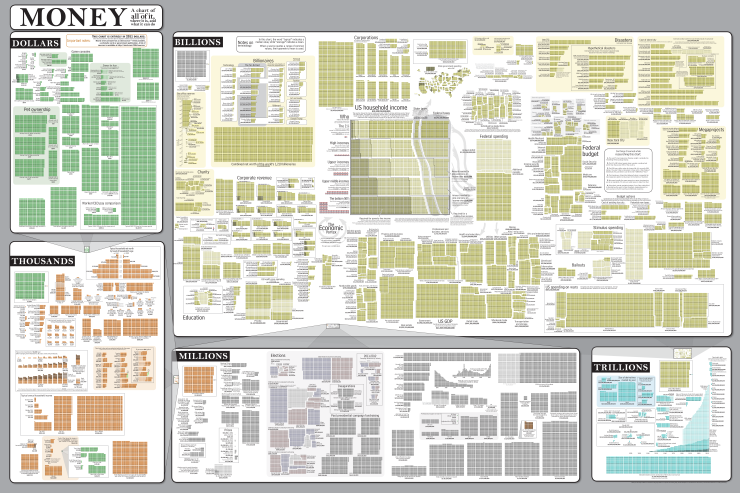
I'm not sure if my blog will let you zoom in on the chart as much as xkcd does. If it doesn't you should check it out there. Each little green square represents one dollar. Each little orange square represents $1000. Yellow = $1,000,000,000. Gray/purple = $1,000,000,000. Blue = $1,000,000,000,000.
If you want the extra credit for reading and discussing today, start by asking this question: what is the economy? Then discuss GDP. Finally, look at that chart for a couple minutes. On a scrap of paper, write down 2 things that stood out to you on that chart. Write them down. Have the adult you read and discussed with sign the paper. Turn it in tomorrow.
Thursday, September 28, 2017
Culture to Standard of Living to Economy to Human Capital
There is no perfect path to teaching social studies.
I want to review culture, and the cultural ingredients:
I want to review culture, and the cultural ingredients:
- food
- dress
- religion
- language
- standard of living
- the arts
- government
- values
- customs
- ethnicity
But I also want to dig deeper into understanding them. But digging deeper takes time. Take standard of living, for instance.
To understand that, we've got to understand the economy.
And to understand the economy, we have to know what GDP is.
And when I teach economy, I want to teach human capital, because they tie together so well.
...But now we're many degrees of separation from culture.
So, Monday we're going to fly back to culture, and hope that we don't all forget the lessons on economics.
If you want credit for reading discussing the blog today, find a scrap of paper and define human capital on it. (We did this today in class.) If you were absent, and need to make up the points, go to the "human capital" link. Figure out what human capital is from that. Write it on a scrap of paper, and turn it in tomorrow.
Monday, September 21, 2015
Hunger Games Quotes
Thursday and Friday of last week, I gave the students 6 "big idea" terms, along with a definition/explanation:
- culture
- government
- economics
- standard of living
- ethnicity
- ethnocentrism
Today, in class the white boards around the room had a quote from The Hunger Games. Each quote dealt with a term. Before we started reading, the students had to figure out the term, and why it fit with the quote. Here they are, page numbers included.
Quote 1: "Besides, the Capitol accent is so affected, almost anything sounds funny in it." p.8
Quote 2: "'Mm, still warm,' O say. He must have been up at the crack of dawn to trade for it. 'What did it cost you?'
'Just a squirrel.'" p.7
Quote 3: "Since almost no one can afford doctors, apothecaries are our healers." p.8
Quote 4: "He could be my brother. Straight black hair, olive skin, we even have the same gray eyes." p.8
Quote 5: "It's to the Capitol's advantage to have us divided among ourselves." p.14
Bonus: Quote 6: (More than one term applies): "No one in the Seam would turn up their nose at a good leg of wild dog, but the Peacekeepers who come to the Hob can afford to be a little choosier." p.11
Students can get extra credit if they read and discuss the blog with an adult. If they've done this, have the students ask the adult if they can match any of the terms with the quotes. On a sheet of paper, either write how the adult answered, or tell me how they did. Did they get them all? Most of them? Did they miss any?
When you're done, have the adult sign the paper. Make sure your name, date, and hour are on the paper. Then turn it in tomorrow in the extra credit tray.
Wednesday, October 3, 2012
More Pictures
Dear Earthlings,
We're finishing up globalization and moving on to economics in general tomorrow or Friday.
Students today did some *shock* book work. ...Yes, it still exists. After that, we continued our discussion on technology's impact on globalization and society in general.
My grandfather was born in 1902. My father in 1941... hopefully they don't mind that I'm publishing that online... You'll have to look up the history of the automobile on your own - and what constitutes a horse-less carriage that was accessible to the majority of the world... For all intents and purposes, my grandfather was born before the car. True, Oldsmobile was producing in 1902, and there were precursors to that - history builds on itself as does technology. But the Ford Model T didn't come around until 1915, and in Lancaster County Pennsylvania in 1902, automobiles were still a long way off. My grandfather went from walking, to driving, to flying, to seeing the U.S. put a man on the moon. (We think, right?)
I asked my 7th hour class to imagine my grandfather at their age. They've somehow found themselves back in time 1914 or so... They're tasked with explaining the internet, and how it's impacted the world. It's tough, given they couldn't use words like "digital, computer, pixels, etc..."
Anyway, maybe I'll make that tomorrow's bellwork. Currently, I have it set to be, "Finish the picture you started in class yesterday."
We'll see. The students started a visual representation of "Technology is Shrinking the World."
If you want the extra credit for reading and discussing this, write three sentences about how the discussion went. Have the adult you discussed it with sign the paper with those sentences.
We're finishing up globalization and moving on to economics in general tomorrow or Friday.
Students today did some *shock* book work. ...Yes, it still exists. After that, we continued our discussion on technology's impact on globalization and society in general.
My grandfather was born in 1902. My father in 1941... hopefully they don't mind that I'm publishing that online... You'll have to look up the history of the automobile on your own - and what constitutes a horse-less carriage that was accessible to the majority of the world... For all intents and purposes, my grandfather was born before the car. True, Oldsmobile was producing in 1902, and there were precursors to that - history builds on itself as does technology. But the Ford Model T didn't come around until 1915, and in Lancaster County Pennsylvania in 1902, automobiles were still a long way off. My grandfather went from walking, to driving, to flying, to seeing the U.S. put a man on the moon. (We think, right?)
I asked my 7th hour class to imagine my grandfather at their age. They've somehow found themselves back in time 1914 or so... They're tasked with explaining the internet, and how it's impacted the world. It's tough, given they couldn't use words like "digital, computer, pixels, etc..."
Anyway, maybe I'll make that tomorrow's bellwork. Currently, I have it set to be, "Finish the picture you started in class yesterday."
We'll see. The students started a visual representation of "Technology is Shrinking the World."
If you want the extra credit for reading and discussing this, write three sentences about how the discussion went. Have the adult you discussed it with sign the paper with those sentences.
Tuesday, October 16, 2012
Welcome Back.
Welcome back, and thanks for reading.
A lot has happened since I've been away. We're studying a large swath of Africa right now.
So, the Sahara desert is pretty big. We're looking at 3,320,000 sq. mi. of desert there. That's getting close to the size of the United States - in desert. Now, keeping in mind the scale we're dealing with here - the U.S. is roughly 3.79 million square miles (This is counting Alaska of course. ALASKA! YOU KNOW I LOVE YOU!) The Sahara is around 3.32 million. But if we're looking at just land, the U.S. drops to about 3.5. Some of you are arguing - quite rightly - that there's a big difference between 3.5 million and 3.3 million. Agreed. But when we're looking at a map that's drawn at a scale where 1 inch = 500 miles, you can understand what I'm saying. California's falling into the ocean soon anyway.
The Africa maps have been entered into the grade book. Chances are, the homework from last night will be added by the time you read this as well. You may want to check your grades. Just saying.
At any rate, we're also looking at Ghana, Mali, and Songhai. We've looked at how family units become villages, villages become cities, and cities become kingdoms. And a lot of it has to do with economics - which is why we studied that first. Different geographical regions produce different goods, so people meet in cities to trade. And we looked at these pictures:


I asked the question, "If someone is going to open a McDonald's, which is a better location?" Granted, most students answered, "The second one," because they thought they were being funny... But I think they all got the point.
The same rules applied in the ancient world. Rivers were used as the method of transportation, and you wanted your business where it would get the most... uh... business.
It's late. Half of you are zoning out while you're reading this. I'm sorry. Thanks for reading.
If you want the extra credit today, discuss the blog with an adult and play the African Landscapes Geography Games at least 5 times. Then either print out, or write down your scores and have that adult sign it. (Thank you, adult for taking the time to talk to my student about social studies nonsense.)
A lot has happened since I've been away. We're studying a large swath of Africa right now.
So, the Sahara desert is pretty big. We're looking at 3,320,000 sq. mi. of desert there. That's getting close to the size of the United States - in desert. Now, keeping in mind the scale we're dealing with here - the U.S. is roughly 3.79 million square miles (This is counting Alaska of course. ALASKA! YOU KNOW I LOVE YOU!) The Sahara is around 3.32 million. But if we're looking at just land, the U.S. drops to about 3.5. Some of you are arguing - quite rightly - that there's a big difference between 3.5 million and 3.3 million. Agreed. But when we're looking at a map that's drawn at a scale where 1 inch = 500 miles, you can understand what I'm saying. California's falling into the ocean soon anyway.
The Africa maps have been entered into the grade book. Chances are, the homework from last night will be added by the time you read this as well. You may want to check your grades. Just saying.
At any rate, we're also looking at Ghana, Mali, and Songhai. We've looked at how family units become villages, villages become cities, and cities become kingdoms. And a lot of it has to do with economics - which is why we studied that first. Different geographical regions produce different goods, so people meet in cities to trade. And we looked at these pictures:

I asked the question, "If someone is going to open a McDonald's, which is a better location?" Granted, most students answered, "The second one," because they thought they were being funny... But I think they all got the point.
The same rules applied in the ancient world. Rivers were used as the method of transportation, and you wanted your business where it would get the most... uh... business.
It's late. Half of you are zoning out while you're reading this. I'm sorry. Thanks for reading.
If you want the extra credit today, discuss the blog with an adult and play the African Landscapes Geography Games at least 5 times. Then either print out, or write down your scores and have that adult sign it. (Thank you, adult for taking the time to talk to my student about social studies nonsense.)
Thursday, December 11, 2014
Gold Salt Trade
Yesterday and today, students participated in a simulation trading gold for salt.
 |
| Make It Rain |
The activity tied together a lot of our studies. The civilization/empire of Ghana originated around the Senegal and Niger Rivers. (Can anybody guess why?)
It was in the middle of the trans-Saharan trade, which allowed it to become rich.
The students traded gold for salt - bartering in a traditional economy. Each aspect of the activity was intended to represent actual aspects of the trades that happened hundreds of years ago.
The king (so it's a monarchy) tightly controlled the supply of gold. All of the gold nuggets, or chunks, found in the kingdom had to be given to the king. (Sounds like an absolute monarchy...) (pg. 146)
People from one country are trading with people from another country: globalization.
Again, we're tying a lot together.
If you want the extra credit, you were supposed to read and discuss this with an adult. Tell them about the activity. What did you think. How did you do? Did you end up with more than when you started? How did Ghana become so rich?
After you discuss it, write two sentences from your discussion. Turn it in tomorrow.
DON'T FORGET THAT WE HAVE OUR ECONOMICS QUIZ TOMORROW!!!
Wednesday, November 13, 2013
Review
We spent the day going over some of the bigger topics/concepts from the year:
- Human capital
- Trade routes
- Globalization
- Economics (consumers)
- International trade
- Ancient civilizations - rivers/development
- Standard of living
As is generally the case, the students who got it, got it. The students who didn't, didn't. And some students were strong in one area, and weak on another.
I was planning on going over the review, and then finishing The Hunger Games, but the review took most of the hour. I tried to get into some of the aspects of each topic we may have overlooked. For instance, when we did the gold/salt trade simulation we learned that Ghana made it's money by taxing the people who came through. But we didn't really talk about the importance of the location of Ghana. And really, isn't that what is't all about? Location, location, location?
And earlier in the year, we studied globalization quite a bit - but I worded questions a bit differently. I've been trying to get students to see how it applies to us.
If you want the extra credit today, you had to read and discuss the blog with an adult. If you did that, explain to them why location was so important to Ghana. Then tell them about the speech Mr. Zook gave at convo - and what it actually had to do with. (I didn't share this with every class, so students, if you forget that one, don't worry about it...)
Write the answer to the location question down on a piece of scrap paper. Have the adult you read it with sign it. Then, turn it in tomorrow.
Monday, March 26, 2012
Study Study Study
The test tomorrow is going to be a little bit more economics-heavy than I had originally anticipated, but you should all be able to handle it. It's all on the review guide. (Or at least most of it is...)
To get the extra credit today, study the review guide with an adult for 15 minutes. (If you don't have one, look at yesterday's post.)
Then, on a piece of scrap paper, write the following sentence: "Yeah, I heard a funny thing - somebody said to me, "I think that I can be in love with social studies."
Make sure your name is on the paper, and have the adult you studied with sign it too.
To get the extra credit today, study the review guide with an adult for 15 minutes. (If you don't have one, look at yesterday's post.)
Then, on a piece of scrap paper, write the following sentence: "Yeah, I heard a funny thing - somebody said to me, "I think that I can be in love with social studies."
Make sure your name is on the paper, and have the adult you studied with sign it too.
Subscribe to:
Posts (Atom)