Showing posts with label human capital. Show all posts

Tuesday, May 23, 2017

Spanish Lunch

We're at the end of the school year.  Everyone has taken the final.  They are graded, and the grades are entered.  We're winding down, and really, the kids are ready to be done.  I want to start off this post by thanking all the students and parents for pushing me to be an even better teacher.  It's been a good year, and that's on you as much as it's on me.

As it's the end of the year, I don't have anything content related to share, per se...  But I wanted to give a shout out to some students who have been helping me out.

If you remember the beginning of the year, one of the big topics of our class was culture.  We listed 10 ingredients of culture: food, dress, religion, language, customs, etc...  You get the idea.  The past nine weeks, I've invited some of my students who are fluent in Spanish to help me learn.  Any student who was fluent, or was interested in learning Spanish (and had 3rd lunch) was invited to have lunch with me.

The rules (though they were sometimes broken) were that they could only speak Spanish unless I asked them for a translation.  I had to speak Spanish as much as I could, and English when I couldn't.

I invited students who weren't fluent as well.  But I didn't want them to just show up with no intent to learn.  They had to prove they were trying to learn as well.  I've been using the free app, Duolingo.  It's not perfect, but it's really helped as well.  Alas, only a couple students started to learn, and they quickly dropped out.  No hard feelings though, we're all busy.

Still, in a class where we discussed culture, language, loss of language, and increasing human capital, I thought it was worth sharing that I'm trying to practice what I preach.

If you want extra credit for reading and discussing the blog, tell me if you've ever considered learning another language.  Are you planning on taking one next year?  How do you plan on continuing to increase your human capital over the summer?  Write your responses on a scrap of paper, and have the adult you read and discussed with sign the paper.

Put your name, date, and hour on it.  Turn it in tomorrow or Thursday.


Monday, October 24, 2016

No Post in 20 Days?!?!?!

I've become horrible at posting the extra credit blog.  I get that.  And I apologize.  There are a number of reasons for it, but I'm not going to go into it here.

Instead, I'm going to give you a bunch of opportunities to get extra credit.  The rules have changed a little bit with this post.

You still need to read and discuss these posts with an adult.  But you may only do one of these a day.  (And you may only do one for the entirety of Fall Break.)  Sure, you may read more, but you'll only get credit for one.

Some of the things will have changed, since the posts are from previous years, but overall the content is the same.

In order to get credit, you need to write the current date, the date of the post, do whatever the post tells you to do, and have the adult you read it with sign signifying that you read and discussed that post with them.

Here are the posts:  Dealing with Economics:


Dealing with Human Capital:

Thursday, October 15, 2015

Human Capital: People With Skills

Mr. Gingerich, from Goshen College, came up with a great lesson that we used today in class.  He introduced the concept of "human capital."

First off, he had students write down five unique skills.  They went around the room sharing them.

Then, he shared a unique skill: saying the alphabet backwards, while hopping on one leg, rubbing his tummy and patting his head.

We agreed that skill probably isn't going to land him a teaching job...  at least, not that skill alone.  It was a nice transition into talking about human capital, however.  Here's the definition he gave:

We may or may not have watched a 22 second clip from Napoleon Dynamite at this point...:


Then, the students worked at various stations around the room where they wrote examples of the human capital different jobs would require.  After 2 minutes, the groups rotated to the next occupation.  At the end of class, the papers were full of examples of human capital:


Essentially, human capital is your value to an employer.  All the skills, knowledge, creativity, life experiences, etc... that will make you good at your job.  And it's at your job that you convert that human capital into financial capital.  And we could all use a little more of that.

Students may get extra credit by reading and discussing this blog post with an adult.  Once they've done that, they should write a couple sentences about how their discussion went.  Have the adult sign the paper.  Turn it in tomorrow in the extra credit tray.


Tuesday, January 29, 2013

Human Capital II

First of all, don't forget that we have a quiz over the 3 monotheistic religions tomorrow.  I posted the chart yesterday, so if you forgot it, you can find it there.

Today we tied social studies in to a number of other subjects.  Students wrote about a protagonist from a book they read in LA.  They had to explain how the character had gained human capital through the course of the story.

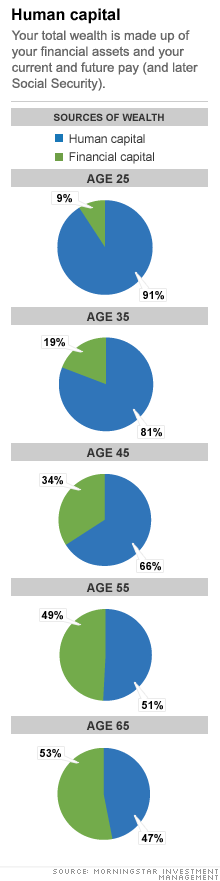
We also discussed kinetic energy and potential energy.  I compared human capital to potential energy, and financial capital (money) to kinetic energy.  Human capital is the amount of potential financial capital you have.  I showed the students this chart I got from CNN.

(It's embedded in THIS ARTICLE if you want to check it out...)

My students probably want extra credit for reading and discussing the blog.  They can get this by reading it and discussing it with a parent or adult.  To prove that you read today's post, please write the following on a scrap piece of paper: "Never be so focused on what you're looking for that you overlook the thing you actually find."  Then, have the parent/adult sign the scrap piece of paper.  Turn it in tomorrow.  (Parent/adult: by signing that scrap of paper, you are stating that you read and discussed the post with my student.)

Monday, January 28, 2013

Human Capital

To start off, I didn't create this graphic - I only created this version of it:

I originally obtained it from hcdexperts and linked back to their webpage.  Unfortunately, that is now defunct, and I have no way of contacting them.  If you work for hcdexperts and have any questions regarding the use of this graphic, please feel free to email, or leave a comment.

We spent a lot of time going over human capital today.  I had the students explain the chart.  Then they thought of a job, and gave examples of human capital that would help them in that job.  The students were supposed to be specific.  If they listed "doctor" they couldn't just say, "A doctor needs knowledge, life experience, skills and abilities, and to be creative."  Students had to explain the types of knowledge a doctor would need.  What life experiences would be beneficial, etc...

I recently went to a 1:1 conference at East Noble School Corporation.  Concord paid my way.  This increased my human capital.  My knowledge, and skills/abilities increased.  I learned creative ways to incorporate 1:1 technology in the classroom.  I asked the students if it was worth it for the school to invest in my human capital.

It's also worth mentioning the quiz Wednesday.  Yes... a quiz.  The quiz will be over the three monotheistic religions.  It'd be a good idea to study the chart.  I had the students write a little bit more information today as well.  You can check it out below:

Study study study...


Remember, to get the extra credit, you're supposed to read and discuss this blog with an adult.  I would suggest talking about the human capital chart, and spending some time studying for Wednesday's quiz.  To prove you did this, write the following quote on a sheet of scrap paper:  "Better for my having been there."  St. Petersburg High School Motto; St. Petersburg, Florida.  Have the adult you discussed the blog with sign the paper.


Tuesday, April 24, 2012

Human Capital and China

A good example of a young lady who took her human capital and turned it into financial capital:


The Hinduism/Buddhism Venn diagram is homework.

We'll finish up the China maps in class tomorrow.

If you want the extra credit for today's blog, discuss the following questions with an adult:

1.  Give some examples of Angela's human capital.  (You may want to refer back to the first chart I posted yesterday...)
2.  What do I mean when I say she turned it into financial capital?
3.  What are you doing to increase your human capital outside of the school day?

After you discuss those questions, write two sentences mentioning what you discussed, and have the adult you discussed it with sign the paper.  Then, write down roughly how many minutes this extra credit assignment took.

Monday, April 23, 2012

Human Capital

Today we studied human capital.  Students looked at the term, and explained some charts.

Image credit: http://www.hcdexperts.com/about.html

The students listed a job and gave examples of human capital that fit that job.  (For example, if they chose teacher, they gave examples of Knowledge: curricular content, math for grading, technology/computer knowledge - such as SMARTboard, document cam, etc...; Skills & Abilities: interpersonal, classroom management, technology; Creativity: classroom decor, lesson plan creation; Life Experiences: student teaching, travel experience.)

Then they went around the class, sharing their examples with three others.  They did a really good job with this activity - listing various jobs, and being very accurate about what skill sets, and knowledge bases were needed to succeed in them.

We also looked at another graph from the Department of State:


Human Capital FSA Countries
 Image credit: http://www.state.gov/p/eur/rls/rpt/eurasiafy07/116185.htm


If you want the extra credit for today for reading the blog, discuss the following questions: What job did you choose for the bellwork assignment?  Give examples of human capital needed for those jobs.  Why might a company want to invest in increasing the human capital of it's employees?

When you are finished discussing the blog, write a brief definition of human capital, and how you are investing in your own human capital.  Then, have the adult you discussed the blog with sign the paper.  Finally, write down the number of minutes it took you to complete this.