Showing posts with label Islam. Show all posts

Thursday, February 11, 2016

Religious Diversity Within the Monotheistic Religions:Part I

First of all, we managed to stave off any snow days and keep our 4-day weekend. ENJOY IT!

We've been studying 3 monotheistic religions: Judaism, Christianity, and Islam.  Quick - students, if you're reading this with an adult, turn to that adult and tell them what monotheistic means.

TADA!  Look!  They've learned something!  (Seriously, if they didn't get that right...  I just...  Look it up on google...)

Today students finished copying down a cladogram on the 3 monotheistic religions.  Here's what they copied.


I also made a version using Prezi, and I've got to say: it's pretty good.  Check it out if you have time.  (It's easier and makes more sense if you view it on a desktop.  Just click the first arrow once you're in.)


A couple of the main things I wanted students to get out of this presentation were that the 3 monotheistic religions trace their roots back to Abraham, but also that there's great diversity within Christianity - and even great diversity within the denominations of Christianity.

I understand that one of the failings of this presentation is that it doesn't show the diverse thought within the other religions.  And it should.  For instance, check out this picture on the denominations within the Sunni and Shia branches of Islam:
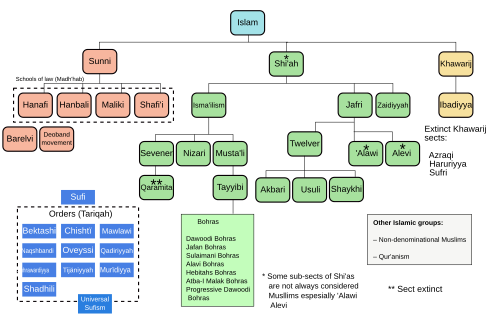
(The image was created by Angelpeream.)

Well, it's a work in progress.  I'm hoping to continue improving it every year I teach.


While I have a lot more I want to say on the topic, I'll say that's all for now.

If students want extra credit, they may read and discuss this blog with an adult.  Once they've finished, the student should write down 3 thoughts about the Prezi.  Then, have the adult sign the paper.

Turn it in Tuesday.

Enjoy the 4-day weekend.

Friday, January 23, 2015

Similarities Between Judaism, Christianity, and Islam Venn Diagram

If you've been keeping up with what we're doing in class, you know that we have a quiz on Tuesday.  It will include some multiple choice questions, as well as an essay section.

If you're interested in knowing the essay questions ahead of time, here they are:

1.  Compare the 3 major monotheistic religions we have studied.  Describe how they are similar, and how they differ.  Explain their main beliefs and practices.

2.  Who was Abraham?  Where was he from and why is he important to each of the three monotheistic religions?  What do each of the three monotheistic religions believe about him?

In class today, we took 3 mini-quizzes.  Two dealt with the pictures of the Five Pillars of Faith for Islam that the students had drawn yesterday.  I gave them a practice quiz first using pictures students had drawn last year.  Then they traded their pictures and gave each other a "pictionary quiz."

Then, we looked at some of the different beliefs of the 3 monotheistic religions we've been studying and put them on a Venn Diagram.  After I showed we went through the list, and they placed each on their own Venn Diagram, the students went and placed them on the board.

If you want some added practice, you could do it again.  Here's the Venn Diagram followed by the list:


1.Bible
2.Trace their roots back to Abraham
3.Name of God = YHWH
4.Monotheistic
5.Does not eat pork
6.Founder is Jesus Christ
7.Founder is Abraham
8.Founder is Mohammed
9.5 Pillars of Faith
10.10 Commandments
11. Believe in a Messiah
12. Believe Jesus is the Messiah
13. Believe the Messiah has not arrived yet.
14. Uses the Old Testament/Torah
15. Uses the Torah only
16. Uses Old Testament AND New Testament
17. Uses the Qu'ran
18. Believes Jesus is God
19. Believes Jesus is a prophet
20. Believes Jesus was just a man
21. Oldest (c. 1700 BC)
22. Middle (c. 33 AD)
23 Newest (c. 600 AD)
24. Jerusalem is a holy city
25. Some branches/denominations wear head-coverings
26. Originated in the Middle East
27. Two greatest commandments are love God and love people

And now for the answers.

...

Don't cheat...

...


If you want extra credit today, you should have read and discussed the blog with an adult.  It'd probably be a good idea to think about which essay you're going to write.  You could even write a rough draft.  (No pressure though, it's the weekend.  ...Lets keep work at work...)  To prove that you were here, write a paragraph from your discussion, and have the adult you read the blog with sign it somewhere.


If you want to look at some other stuff to study, check it out:


...You could always quiz yourself.  Though, make sure you'relaxing a little bit too.  It is the weekend, after all.

Thursday, January 15, 2015

Monotheism: Abraham's Journey; Judaism, Christianity, and Islam

Yesterday we started class by reading a passage from Genesis - from the Christian and Jewish Holy books.  According to Jews and Christians, God and Abraham made a covenant, or agreement/promise.

You can read what we read HERE.  They answered a few questions from the reading.

After they were done, we had a little refresher on the ancient civilizations of Mesopotamia and Egypt.  Abraham left Mesopotamia, and by the end of the passage we read yesterday, ended up in Egypt.

We reviewed the polytheism of these ancient civilizations, and then I read a section from the Qur'an.  In book 6, God shows the errors of polytheism.  Abraham tries to explain this to the people of Mesopotamia, but they will not listen.  (In fact, later in the Qur'an Abraham's father threatens to stone him if he doesn't accept the Mesopotamian gods.)

You can read the section of the Qur'an HERE.  (We actually read 72-81.)

The point of yesterday's lesson was that all three major monotheistic religions trace their roots back to Abraham.  An interesting thing to consider: the lives of more than 3 billion people today are directly influenced by that man.  (2 billion Christians, and 1 billion Muslims.)  That doesn't even take into account the number of non-religious people whose lives are influenced by him because of the countries in which they live.  Governments are set up that use the Qur'an or Bible or Torah to help inform how their countries are run.

Side note: In a couple classes, we discussed social media: many of my students have Facebook or Instagram.  We all agreed that it's fun when people "like" the stuff we post.  I happen to love being able to experience winter.  Driving in to work yesterday, the trees looked AMAZING, so I snapped a picture.


Social media connects us to other people.  It allows us to influence others.  It's crazy to think about how much influence Abraham has had on the world.  How many people would follow him on Facebook or Twitter...

We finished out yesterday by beginning a map of Abraham's journey.  Instead of giving it as an assignment, we're completing it as a class.

We haven't finished it yet.  I plan on wrapping it up tomorrow.  I'll post a picture when it's finished.

Today we've moved on from Judaism and Christianity to Islam.  We watched the Islam video - the last video we'll watch for quite some time.

If you want extra credit today, you need to write two names on a piece of scrap paper, then have the adult you read it with sign the paper.  All three major monotheistic religions trace their roots back to one man, who is it?  Who is the founder of Islam?  Those are the names you need.  ...Well... you should also make sure your name is on it...

...Man... I didn't even get to tell how I time-traveled with a couple classes...  Was it your class?

Tuesday, February 18, 2014

5 Pillars of Faith

Today students drew pictures of the 5 Pillars of Faith for Islam, and then shared the pictures with someone else - having them label the pictures.  I hope to post some of these pictures later, but I don't have time right now.

Here's my rendition of the 5 Pillars.  Don't judge it too harshly.


Don't ask me how the pillars in the second picture are being lifted off the ground...  I'm guessing they're attached somehow.  Ask an architect.

The point is, that to be a "good Muslim" one would have to submit to these pillars of faith.  For instance, if a Muslim said, "I don't believe in God," he wouldn't be a very good Muslim.  In fact, one could argue he's not a Muslim at all.

I had a student in 6th hour ask about that though.  "What if there was a Muslim who didn't give to the poor."  Great question.  I think other Muslims might say that person's not being a very good Muslim.  Maybe they don't want to judge their brother, but they might believe that since Allah commands it, they should do it.

I also compared it to a game of Jinga.  Eventually the tower will fall.  Maybe they only pray twice a day.  Maybe they don't fast during Ramadan...  There will come a time when their faith falls - or at least when they are considered "nominal" Muslims.

If you're in my class and want extra credit for reading and discussing the blog with an adult, write two sentences from your discussion, and have the adult sign it.  Maybe tell them the 5 pillars of faith for Islam.  If you can't remember them, just scroll up.

Have the adult sign the paper, and turn it in tomorrow.


Monday, December 5, 2011

On to Islam

Today we took our pop quiz.  I think most students did pretty well on it.

We're moving into Islam over the next couple of days.  The students have now finished filling out their chart.  By the end of the week they should be able to explain everything that's on it.  They usually have some trouble with the founders.  Because all three monotheistic religions trace their roots back to Abraham, they often list him as the founder of the religion on the test.  They are not the same thing...  I gave the example today of a billionaire grandfather who started a car business.  If he gave some money to two of his grandchildren to start their own businesses, he would still only be the founder of his business.  His grandchildren would be the founders of their respective businesses, even though we could trace the money back to the grandfather.

Here's the chart in case your kid forgot it, lost it, or loaned it out to a friend.

We wait until this week to study extremism.  Students often associate extremism with Islam, so that's a separate lesson as well.  We take the time to define religious extremism, and point out that there are extremists in every religion.


For the extra credit, discuss the following questions:

How did you do on the pop quiz?
How much of the chart do you think you'll be able to explain?

In order to get the extra credit today, write a question you have about the blog or about class in general.  The question can come from student or adult.  The paper must be signed.  Adults, by signing the paper, you are signifying that you really did discuss those two questions with the student in my class.