Showing posts sorted by relevance for query banananovia. Sort by date Show all posts

Thursday, September 18, 2014

Banananovia Part II

Man, we're rich.  We are STINKING RICH!!!!!!!

We have a monopoly on bananas, since nobody knows where they come from aside from us.  Our magic school bus flying school bus had been fixed, and the students came up with tons of stuff the Banananovians might be interested in: steak, pizza, shoes, electronics, cars, schools, our language, books, bananas...

It's crazy, but in almost every class I've got a joker who will say "bananas."

We took bananas back to Industralia, and manufactured goods back to Banananovia.  Over the course of several trips, and several years we became very wealthy.

Banananovia increased it's standard of living.  Before we arrived, the literacy rate was at 0%.  Now Banananovia has several schools.  It has several hospitals.  The infant mortality rate has dropped.  People are healthier.  They're living longer.  They don't need to make new clothes every two days.  Overall this has been a win-win for everybody involved.

But I was down in Banananovia the other day, and all at once it hit me: Where am I?

I looked around, and I didn't see anybody wearing the traditional Banananovian dress.  People everywhere were speaking English, wearing T-shirts and jeans.  They were going into McDonald's and ordering in English.  The Bananafest has barely any bananas.  They're selling cotton candy and corn dogs.

I was in Banananovia, but it sure felt like Elkhart, Industralia.

If you want extra credit, you're supposed to read and discuss this blog with an adult.  Once you've read and discussed it, find a scrap of paper.  To prove that you were here, write whether you think what happened to the Banananovians was a good thing, or a bad thing overall.  Then, write one sentence telling me why.  Finally, have the adult you read it with sign the paper.

Turn it in tomorrow.  (Make sure your name/date/hour is on it.)

For fun, here are some pictures of the Banana-dance.


Thursday, September 27, 2012

Banananovia Goes Global

Well, I thought I might record the Banananovia story this year, but I didn't have time to get it all hooked up.  Hollywood, you'll have to wait at least one more year before your next big star can take off.

I've heard there are some pictures of Mr. Shaun White Frizzle floating around out there.  If I come across any I'll post them.  I did an image search on Shaun White to see if we were as similar as everybody said.  I think the real Shaun White would be highly insulted if he heard the comparisons.  So, sir: please don't blame me.  Blame the students.  They're the ones who compared us.


The Banananovia story is a look at culture, globalization, and the loss of culture.  The question for tomorrow is, "Was it worth it?"  It's interesting that this question actually comes up for Anthropologists.  The ethical and moral implications of the question: should we contact uncontacted tribal nations abound.  And as of 2010, there were over 100 "Uncontacted Tribes" in the world.  But I'm getting ahead of myself.  We'll talk about that tomorrow.

We also watched the "Banksy Simpsons Intro."  When it comes to globalization, there's a lot to think about.  Yesterday I said that the search for cheap labor was the driving force behind globalization.  Perhaps the Banksy Intro is overstated (I mean, the unicorn is a bit much...)  But it makes its point - even if it's biting the proverbial hand that's feeding it and perhaps misplacing some of its outrage.

Truth be told, there are a lot of companies - American and other that outsource jobs to get around labor laws.  Nike, Adidas, Walmart, as well as many others have been accused of such practices.  Whether the allegations are true or not, they're worth talking about.

Here's the Banksy Intro in case you're interested in watching it:


Well, I think that's enough writing for today.  I'm sure all you extra credit lovers have other stuff you want to get to as well.  If you want the extra credit, read and discuss the blog with an adult.  Talk about:

  • Banannovia
    • What was the story about?
    • Who were the Banananovians?
    • Was what happened to them good or bad?  Why?
  • The Simpsons Intro
    • How did that tie in with the Sweatshirt Map we looked at yesterday?
    • What parts of the intro were fake?

When you're done discussing, write two questions you have about Banananovia (or anything else we're discussing in class) on a sheet of paper.  Then, have the adult you read the blog with sign the paper.

Wednesday, September 26, 2012

Banananovia Begins

One of these days, I'm going to have to tape my Banananovia story.  I was going to this year, but I'm splitting it up into two parts.

Maybe I'll still go down to the media center and get a camera.  We'll see.

Students, if you're reading this for extra credit, you'll have to tell the adult what the story is about so far.  It's just been introduced.

We also played a little bit of Jenga today.  I thought it was a nice little object lesson for globalization and interdependence.  (Our definition - or perhaps the book's definition of globalization is 'the development of a world culture and interdependent (world) economy.)

In Jenga, a point comes where every block relies on every other block for support.  All of the blocks are interdependent.

If you want extra credit, read and discuss the blog with an adult.  Talk about Jenga and Banananovia.  Explain why making a sweatshirt in the U.S. would probably cost more than if it was made in China.  On a scrap piece of paper, tell me if you're looking forward to the second part of the story or not.  If you're not, that's ok.  I'll take an honest person over a sycophant any day.  Then, have the adult you read and discussed the blog with sign the paper.  Turn it in tomorrow.

Friday, October 9, 2015

Banananovia 2015

Well, that just happened.

I don't have time to type up the Banananovia story today.  Maybe I'll get this year's iteration down sometime.  There are always some notable changes between the years.  To get the extra credit this weekend, read these two posts from last year:

Going Bananas and Banananovia Part II.


At least, if you read those, you'll get the gist of the story.

To earn the extra credit points, either complete the extra credit from one of those two posts, or tell me some differences between what happened last year, and what happened this year.

Friday, September 27, 2013

Banananovia Finale

There are new twists on the Banananovia story every year.

Last year I added in our home country: Industralia.  The year before, I added in the ladies walking down the street in the customary Banananovian attire.

This year, I accidentally left a kid behind - who later served as a translator when we met back up with the Banananovians to trade.  ...I'll have to remember that for next year.

It's another short post - and today, you don't even have to go clicking on some other old post to get the credit.

I would like you to recount (retell) the story to the adult you're reading the blog with.  Be as detailed as possible, but you don't have to share the full 45 minute story.  :)  You also don't have to wear the wig.

When you're done, tell me whether your parents think what happened to the Banananovians was mostly good, or mostly bad.  (Make sure you share with them some of the positive and negative impacts of globalization on Banananovia.  -Some of the good and bad things that happened because of our trip...)

Write down what they think, and tell me why they think it.  Have them sign the paper, and turn it in on Monday.

Monday, September 26, 2016

The Debates (and Banananovia)

Class today was a little crazy.  There was a bus, a bus crash, people wearing banana peels as clothes...  Intense.  I'll let the students tell you about it, if they want to.  Hopefully in the next couple of days, I'll have the time to tell you what's going on, and why.  (You could always search the blog for posts related to "Banananovia," but that may spoil the ending for the students... if they care...)

Maybe you heard that the first presidential debate is on tonight.  This is true.  For bellwork today, I asked the students to name the two main parties, and who was running from each.  Then, I had them write down as many policy positions as they could for each candidate.

Then, when we were going over it, before we got to the policy position questions, I asked a question that I hadn't written down.  Do you have strong feelings -either for or against - either of the candidates.  I had the students hold up 1 finger if they didn't really care either way, or 5 fingers if they had REALLY strong feelings.

Perhaps unsurprisingly, many students held up 5 fingers.  But when asked about policy positions, they held up 1 - meaning they didn't know any.

Well, tonight students may earn extra credit by watching the first presidential debate.  It's late, so they can earn the extra credit if they only watch 30 minutes.  They have to tell me how long they watched, what was discussed during the time they watched, and what they think about it.

Parents are encouraged to write their thoughts as well, or at least discuss them, but this is not necessary in order to earn the extra credit.

Make sure your name is on it, and turn it in tomorrow.

...And be ready for Banananovia Part II.

Monday, April 28, 2014

In Honor of ISTEP

We went back and brushed up on latitude and longitude.  We gave it a shot on paper, then moved to globes.  After we practiced on the globes, we reviewed globalization a little bit.  You guys all remember that, don't you?  Banananovia and what not?  If not, you should click on the link.

We reviewed the positives and negatives of globalization, once again referring to Banananovia.

Most classes got a chance to watch this video, although some did not finish it:


If you want the extra credit for reading and discussing the blog today, tell the adult reading with you whether 30°N is a line of latitude or longitude.  Then, tell them what the driving force behind globalization is - and whether it is good, bad or both, and why.

After you discuss it, write a simplified version of your answers on a scrap of paper, and turn it in tomorrow.

See you then.

Don't forget your calculator.  Seriously, post something to facebook reminding everybody to bring one tomorrow.  And get a good night sleep.  You owe it to yourself, and to Mrs. Gowdy.

Tuesday, October 13, 2015

Death of Language, Death of Culture

At the end of our fictional Banananovia Story, there are a couple ladies who are walking down the street clinging to their culture even as it is disappearing around them.

They are mocked by young Banananovians, but they do their best to maintain their dignity.  Heads held high, they continue down the street.

Even though they continued wearing the traditional clothes, and speaking the old language, there was nothing they could do to stop the onslaught of globalization.

It reminds me of a scene from The Matrix.  "You hear that, Mr. Anderson?  That is the sound of inevitability."


Sometimes, there's just nothing you can do.  (Granted, the Matrix analogy doesn't completely pan out if you've seen the movie... but you get my point.)

While Banananovia was fictional, we are becoming a world culture (or monoculture.)  Yesterday we discussed the Columbian Exchange.  Globalization was already happening before Columbus, but boy did he speed things up.

We read an article from 2012 which states, "There are some 6,000 to 7,000 languages in the world and it is estimated that they are disappearing at a rate of one every two weeks..."

Here's the article.  If you were absent today, make sure you read it.

We also watched this short video.  If you were absent, watch it:


If you were absent and want the points, or if you want extra credit, write a short summary of the article and the video, "Marie's Dictionary."  Discuss them with an adult.  (If the adult doesn't have time to read/watch with you, explain to the adult what the stories were about once you've finished.)

Then, have the adult sign your summary.  Turn it in tomorrow for extra credit.  The end of the marking period is going to be here soon.  Make sure you're keeping up.

Thursday, September 25, 2014

Globalization: The Good, The Bad, The Guilty

First of all, don't forget that my classes have a quiz tomorrow.  You may want to study.

Globalization: The Good

Countries (and individual people) produce what they have access to, and what they are good at producing.  We went to Banananovia - and this was great, because we couldn't grow bananas in northern Indiana.  (Or Northern Industralia - thanks to the anonymous person who left the comment).  We wouldn't be good at it.  Globalization allows us to get the things we want and need - as well as make money selling what we are good at producing.

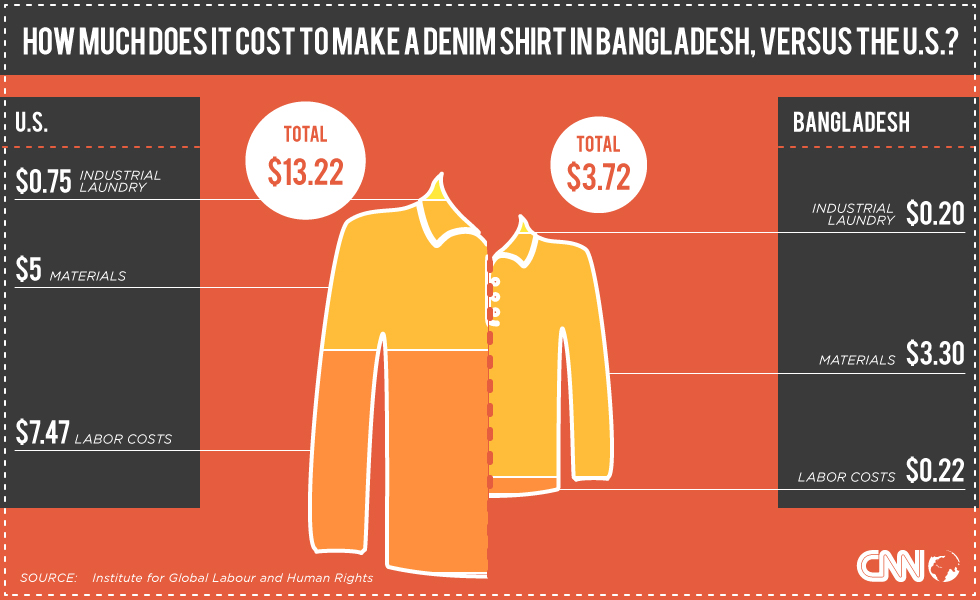
Not only that, but it's cheap labor that is driving globalization.  Cheap labor means we make things for less - and that is good for us as consumers.  Consider this chart we looked at today:


The production cost is often reflected in the price - though not always.  ...I know I'm happy when I save money.


Globalization:  The Bad

As we saw from Banananovia, global culture is replacing local cultures.  The Banananovian culture has essentially died out - and if not died out, it has irrevocably been changed.  ...Changed and supplanted with our own culture.


Furthermore, globalization has allowed for the exploitation of workers in developing nations - formerly called third-world countries.  It allows companies to take advantage of places that don't (or won't) honor the rights of workers.  It allows them to move their base where the standard-operating-procedures wouldn't be deemed illegal - even if we all agree this is unethical.

Today we watched a Simpsons clip where Mr. Burns outsourced his nuclear power plant to India in order to exploit the workers.  You'll have to ask my students what they thought about the clip.


Globalization: The Guilty

We watched another short clip today as well.  Maybe you recall the 2013 Savar building collapse?  It was the factory in Bangladesh that collapsed - there weren't enough fingers to point out the blame.  Here's what we watched:


There is a reason we have safety regulations in these United States.  The question I posited to my students is, should we share in the guilt of these deaths?  This is not a mere rhetorical question.  I only wish we had more time to discuss it in class.

Some (hopefully) unbiased thoughts:  

  • Most of our clothes (98%) come from overseas; selection... what choice do we have?
  • Should we adapt to a smaller selection?
  • Some businesses treat their employees well - both at home and abroad.
  • Some factories exploit their workers.
  • Is it our place to fight for the rights of workers overseas?
  • Should we leave that up to their country?
  • Is it my responsibility to find out the working conditions of the people who made my clothes?
  • How is this similar from the north buying goods from the south during US slavery?
  • How is this different?
  • Should we share in the guilt?
You can see that tons and tons of tough questions can come up when we discuss globalization - or really, any aspect of social studies.  There is never enough time in the class day.  The biggest question is, "what is my role in all of this?"  And that one may be the most difficult to answer.

To get the extra credit for reading and discussing the blog today, you have to read and discuss it with an adult.  I would suggest focusing on some of the questions/thoughts mentioned in the bullet points.  Respond to a couple of those on a piece of scrap paper.  Have the adult you read and discussed with sign the paper.  (Make sure your name is on it as well.)  Turn it in tomorrow.

PS: Some classes also discussed this cartoon, which I originally saw in Jr. Scholastic:


Thursday, September 26, 2013

Banananovia Revisited

Due to volleyball, I can't post a new link about Banananovia.  So, I'm asking you to look at this one for extra credit.  Do whatever it tells you to do.

If you were absent, and missed the story, read the blog - maybe you'll be able to understand part of it.  You should probably talk to someone who was in the class.

Have a great evening.

Friday, September 28, 2012

Banananovia II

Yeah... you decide:
Who is that guy?  Mr. Frizwhitelbecker.  Bam!  And he can even snowboard.  Poorly.

We broke down the Banananovian story today.  We looked at the ingredients in its culture, and how they changed.  Most of our time was spent debating whether we should have contacted them or not.  Unfortunately, we didn't get that all sorted out.  Both sides were argued well.

We also looked at a story I came across today on CNN.  It was interesting, and related to Banananovia in a number of ways.  Sometimes people mock others - or the culture of others - and they do it without thinking, or realizing it's inappropriate.  Often, they are bringing themselves down in the act.

In order to get the extra credit for today's blog, read it and discuss it with an adult.  Some questions to ask: should it be illegal to contact uncontacted peoples?  How does globalization help and hurt smaller cultures?

When you're done, write two sentences from your discussion on a scrap piece of paper, then have the adult you discussed it with sign the paper.

Wednesday, September 17, 2014

Going Bananas

There are few things I get asked about more than Banananovia.  ...By former students, I mean.  Every year I'll have multitudes of 8th graders come up to me and ask if it's happened yet.

...Well, it's happened.  Today, students got to hear the first half of the story.  I've never recorded it before, and I'm a little worried it's going to lose something if I try to record it...  but who knows.  Mr. Helmuth agreed to give it a shot.  So, if you missed the story, there's a chance you'll get to watch it.

Here's what happened in the story today:


  • We took a trip in a Magic Flying School Bus
  • We crashed on an island shaped like a crescent moon
  • It was inhabited.
  • The people gave us bananas.
  • We'd never had bananas before.
  • They wore banana peels for clothes.
  • They ate only bananas.
  • They offered sacrifices of their first-fruits to their banana-god The Big Banana.
  • They spoke Banananovian.
  • They had the Banana-fest, and did the Banana-dance at it.
  • Their nourishment was lacking, as was their overall standard of living.
  • But they were hard-workers, polite, and very friendly.
  • We're still stuck on this annoyingly banana-infested island.

We'll finish off the story tomorrow.

Until then, thanks for checking the blog.  If you want extra credit, you're supposed to read and discuss the blog with an adult.  Maybe you could give them your version of how the story went in your class.  When you're done, find a piece of scrap paper and write two sentences telling me what you think should happen in the story tomorrow.

Have the adult you read the blog with sign the paper.

Turn it in tomorrow for extra credit.

Don't forget to fill out the CONTACT FORM if you haven't already.  (If you're here, you probably filled out the homework paper...)

For fun, here are some pictures:


Monday, October 8, 2012

Cromarty Fisherfolk, Farewell

Bobby Hogg died.

 I'm tracking with you. You don't know who Bobby Hogg was, or how he relates to my class. Well, Bobby Hogg (according to this CNN article) was the last speaker of a Scots dialect known as Cromarty Fisherfolk.

As a class, we've been studying globalization, the economy, and the effects of technology on both.  My Banananovian story spoke explicitly about a nation that - due to globalization lost its culture.  It was a fictional story.

This is true.  Some points from the article:
  • When a culture becomes technologically advanced, it loses its culture faster.
  • Industrialization and trade spurs this on.
  • Languages (it is estimated) are disappearing at the rate of one every two weeks.
  • 96% of the world speak 4% of the worlds languages.
This was the point the Banananovian story was trying to hit home.  I'm not sure if it was accomplished or not.  But I know my students got something out of it.  One student made me a children's book.  I'm publishing it here:

(Text:  The students on the bus are saying, "An island over there," "I see it," and "Me too.")


 (Text: Arrow pointing at man: "Mr. Frizzile White Becker" - He is thinking about money, and telling the students to follow the Banananovians.  The Banananovians are saying, "follow us.")

(As they follow the Banananovians: Mr. FWB is complaining about the bus breaking down.  They pass the statue of the Big Banana.  Some Banananovians are bowing down to it.)

(Mr. FWB: "Lets take some bananas back to our country."  - Backstory: Up until this point in human history nobody has ever tried bananas before...  -  They load the bananas on the bus.)

(Text: "Mr. Frizzile Banana Becker: 'I'm Gonna Be rich'"  The sign says: "By some Bananas.  10$ Really Good!"  People: "I'll take some."  "Me Too."  "So will I.")

(The text is a little out of order on this picture, but essentially Mr. FBB/FWB tells the students they made $10 Million.  Everyone is excited.  One student suggests going back and paying the Banananovians for their bananas.)


(Back on the bus.  The Banananovians are saying, "They're Back.")

(We give money to the Banananovians, they're grateful.)

(Banananovia 40 years later.  Notice Mr. FBB/Mr. FWB's hair isn't what it used to be.  He's saying, "This place looks GOOD!"  But of course, their culture is no longer the same.)


To get the extra credit for the blog, read and discuss it with an adult.  Then, write 3 sentences base on your discussion.  You may want to include a comparison of the Banananovian story to what happened to the Cromarty Fisherfolk.


Monday, September 22, 2014

Death, Languages, and T-Shirts

HEY!!!  IT'S MONDAY!!!  :)


So, you may  have heard that the Banananovian culture died out...  or at least it is slowly dying out.

The language is no longer spoken anywhere - not even in Banananovia.

On Friday we looked at an example of this happening.  (I gave 10 points for the assignment which can be viewed or downloaded HERE.)  And this Scots dialect isn't an isolated example.  If you read the end of the article, you'll see this quote:

"There are some 6000 to 7000 languages in the world and it is estimated that they are disappearing at a rate of one every two weeks."

By this point, the students should have realized some of the benefits and consequences of globalization.  The Banananovians, for instance, improved their standard of living - had access to better medicine, a written language, electricity, etc... But they lost their culture (and their very identity) in the process.

I ask the students if our interactions with the Banananovians was positive or negative for them overall.  Of course, that's a horrible question, because 99% of my students will answer the same way: I think it was both.

So, reword: if we took could go back in time and take the trip again, should we?  You're in charge - do we take the trip or not?

I wanted them to think of it from the perspective of the Banananovians, but of course, some took it further and brought up that we made a lot of money - which led to the driving force behind globalization: money and the demand for cheap labor.

We traced the route of a t-shirt, and wondered why it costs less to have it made all over the world and shipped here.  And we watched the first minute or so of this video:


I suppose some of you want the extra credit, and you don't have the time to read any more.  Fair enough...  To get the extra credit, you were supposed to read and discuss this with an adult.  If you did that find a piece of paper and write down why it costs less for a sweatshirt or a T-shirt to be made in Bangladesh than in the United States.

Have the adult you read the blog with sign the paper.  Turn it in to the extra credit tray tomorrow.