Showing posts sorted by relevance for query globalization. Sort by date Show all posts

Tuesday, April 12, 2016

Troublesome: Globalization

Yesterday, upon arriving back to class after spring break, I decided to give my students a little review sheet for bellwork.  When they had finished, and graded the sheet, I tallied up how many students missed each question in each class.

Most students did well - even thought they hadn't thought of school in over a week.  For instance, here are the numbers of students who missed a question about the British Empire in each class: 4, 1, 4, 5, 5, 3.

One question question (on human capital) came out like this: 3, 6, 3, 6, 14, 5.  So, I know I need to review with the class that had 14 students miss that one.

But two questions really stood out to me: one was on globalization, and one was on urbanization.

Here are the numbers: globalization:  17, 14, 20, 13, 19, 8.  Urbanization: 18, 21, 24, 15, 25, 19.

A SIGNIFICANT number of students missed those questions.  The globalization question is especially troubling, because we spent quite a bit of time covering it.  (...Although I didn't always tie the topics - such as cultural borrowing, cultural diffusion, etc... back to the term globalization.)

The two parts to globalization that students really need to know are world culture and international trade.  And even though they didn't get the answer on the test, my gut is they understand the concept.

The urbanization question had even worse results, but the students explained why they got it wrong.  I gave them a definition: "the increasing growth and spread of cities all all over the planet."  They had to come up with the term urbanization.

Several students pointed out that the definition I'd given them before was, "people moving to the city - usually for better paying jobs."

It didn't take long to point out that these definitions were essentially the same thing: if people move to the city for better paying jobs, what is going to happen to that city?  It's going to grow.

It's a continual struggle for teachers to get students to understand ideas and concepts rather than just memorize facts and definitions.

We've been studying Hinduism.  But, with ISTEP coming up, and the results of the globalization question on that review, I'm going to continue to review globalization while teaching Hinduism.

Today, we started in on a series by NPR.  It's worth checking out.  Here's what we watched today:


If you want extra credit for reading and discussing the blog with an adult, write a paragraph about your discussion.  Explain the two parts of globalization (world culture and international trade).  Have the adult you read the blog with sign the paper.  Turn it in tomorrow in the extra credit tray.

Thursday, September 25, 2014

Globalization: The Good, The Bad, The Guilty

First of all, don't forget that my classes have a quiz tomorrow.  You may want to study.

Globalization: The Good

Countries (and individual people) produce what they have access to, and what they are good at producing.  We went to Banananovia - and this was great, because we couldn't grow bananas in northern Indiana.  (Or Northern Industralia - thanks to the anonymous person who left the comment).  We wouldn't be good at it.  Globalization allows us to get the things we want and need - as well as make money selling what we are good at producing.

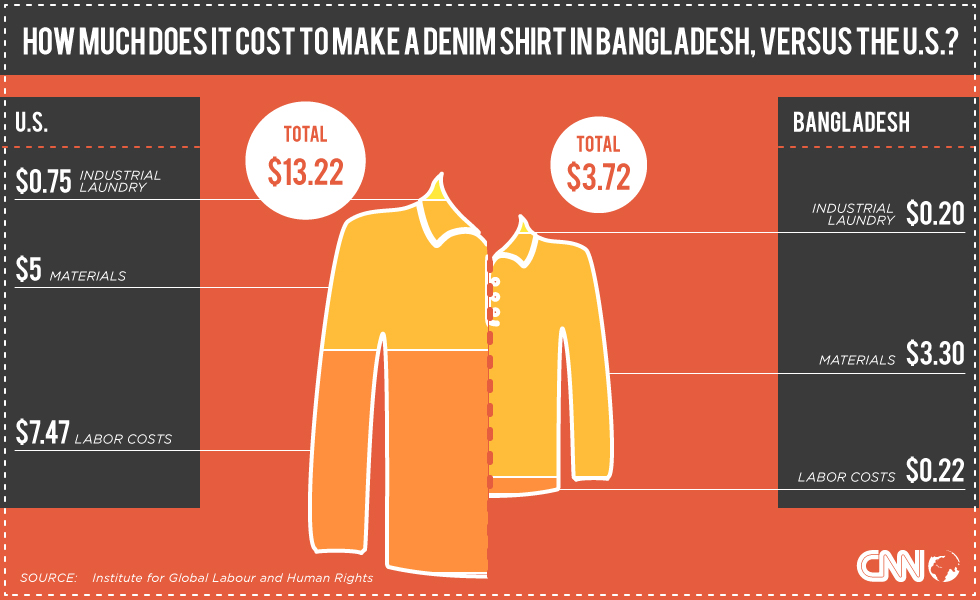
Not only that, but it's cheap labor that is driving globalization.  Cheap labor means we make things for less - and that is good for us as consumers.  Consider this chart we looked at today:


The production cost is often reflected in the price - though not always.  ...I know I'm happy when I save money.


Globalization:  The Bad

As we saw from Banananovia, global culture is replacing local cultures.  The Banananovian culture has essentially died out - and if not died out, it has irrevocably been changed.  ...Changed and supplanted with our own culture.


Furthermore, globalization has allowed for the exploitation of workers in developing nations - formerly called third-world countries.  It allows companies to take advantage of places that don't (or won't) honor the rights of workers.  It allows them to move their base where the standard-operating-procedures wouldn't be deemed illegal - even if we all agree this is unethical.

Today we watched a Simpsons clip where Mr. Burns outsourced his nuclear power plant to India in order to exploit the workers.  You'll have to ask my students what they thought about the clip.


Globalization: The Guilty

We watched another short clip today as well.  Maybe you recall the 2013 Savar building collapse?  It was the factory in Bangladesh that collapsed - there weren't enough fingers to point out the blame.  Here's what we watched:


There is a reason we have safety regulations in these United States.  The question I posited to my students is, should we share in the guilt of these deaths?  This is not a mere rhetorical question.  I only wish we had more time to discuss it in class.

Some (hopefully) unbiased thoughts:  

  • Most of our clothes (98%) come from overseas; selection... what choice do we have?
  • Should we adapt to a smaller selection?
  • Some businesses treat their employees well - both at home and abroad.
  • Some factories exploit their workers.
  • Is it our place to fight for the rights of workers overseas?
  • Should we leave that up to their country?
  • Is it my responsibility to find out the working conditions of the people who made my clothes?
  • How is this similar from the north buying goods from the south during US slavery?
  • How is this different?
  • Should we share in the guilt?
You can see that tons and tons of tough questions can come up when we discuss globalization - or really, any aspect of social studies.  There is never enough time in the class day.  The biggest question is, "what is my role in all of this?"  And that one may be the most difficult to answer.

To get the extra credit for reading and discussing the blog today, you have to read and discuss it with an adult.  I would suggest focusing on some of the questions/thoughts mentioned in the bullet points.  Respond to a couple of those on a piece of scrap paper.  Have the adult you read and discussed with sign the paper.  (Make sure your name is on it as well.)  Turn it in tomorrow.

PS: Some classes also discussed this cartoon, which I originally saw in Jr. Scholastic:


Wednesday, September 24, 2014

Short and Sweet. ...Well, Short, At Least...

After yesterday's latitude and longitude review, we decided to spend a little bit more time on it.

There will be a portion of Friday's test/quiz devoted to this.  The continents and oceans will also be on there again.  I like to think of these things as easy points.

The other big concept we hit on today was another aspect of globalization.

Some things to consider;

Globalization is not new.

Technology is shrinking the world.

Technology has increased the rate of globalization.  Because we can contact foreign countries with the click of a mouse, or Face Time or Skype with them in seconds to minutes, they seem closer.  Furthermore, planes and high speed rail, let alone cars allow us faster access to foreign places, and all signs seem to indicate this trend will continue.

The search for cheap labor is driving globalization.


That's it.  That's the blog post for today.  If you want credit for reading it and discussing it with an adult, write down what the phrase "the search for cheap labor is driving globalization" means.  Then, to prove you read and discussed it with an adult, have the adult sign the paper.

Turn it in tomorrow.

Saturday, September 21, 2013

Outsourcing

We're continuing on with globalization, and soon we'll be moving into economics.

Yesterday in class (I'm writing this on Saturday) we watched a 5 minute clip of the Simpsons.  In it, we find out that Mr. Burns, the boss of Springfield's nuclear power plant is going to move the factory to India.  He says no one should worry - the jobs are still there - they're just being done by someone else in a foreign country.

We look at the causes of globalization, and I also ask the students to refer back to previous lessons as well - for instance we note ingredients of culture in the clip.

Monday we'll be reading about and discussing the factory that collapsed in Bangladesh.  Soon we'll tie it all together - looking at the positive and negative implications of globalization as a whole.

Students, I hope you have time to discuss some of this with a parent or other adult.

Adults, please feel free to ask them what outsourcing is, why it happens, and how it is an example of globalization.

When you're done, write this phrase on a scrap of paper: "Last night I dreamt I went to Manderley again."  Then have the adult you read and discussed with sign the paper.

Friday, September 13, 2013

Disneylandia Globalization and The Hunger Games

We listened to (and discussed) Jorge Drexler's  "Disneylandia" in class.  The students read a translated version, and I had them point out examples of globalization in the song - examples like:

"Armenians naturalized in Chile are looking for their relatives in Ethiopia."

and

"Greek literature adapted for Chinese children in a European Community."

and

"African zebras and Australian Kangaroos at the London Zoo."

...The song is one example of globalization after another.  And it's beautiful, and moving, and there's a lot more going on in it that we don't have time to talk about - like... what IS Disneylandia, for example?


We also read The Hunger Games.  We're moving along.


Here's a video of Drexler's song.  It's not the video of his song, but it's good - and the images depict globalization - although many are biased one way or another.


If you want the extra credit, watch the video and discuss it with the adult you read the blog with.  On a piece of paper, write down a few thoughts, and have them sign it.  Turn it in on Monday.

Have a great weekend.

Thursday, October 3, 2013

Review for the Test

We're having a test in here on Wednesday.  It's probably a good idea to review for the test.  So, here's what's going to on it:


Latitude & Longitude:
     • Know the difference
     • Plot on a map
     •  Locate places using
Cultures:
     • Ingredients
     • Definitions of ingredients
     • Examples of ingredients
     • Standard of living
             o Infant mortality rate
             o Literacy rate
     • Ethnocentrism
     • Cultural borrowing
     • Cultural diffusion
Globalization:
     • Technology speeds globalization
     • Positives of globalization:
             o i.e. gain knowledge
             o improve standard of living
             o etc…
     • Negatives of globalization:
             o i.e. loss of culture
             o outsourcing
             o spread disease
             o etc…
   Economics:
     • Definition
     •  4 types
             o Traditional
             o Market
             o Command
             o Mixed
Anything I forgot…   ...like continents and oceans or 9/11.

If you want the extra credit for reading and discussing the blog today, read and discuss it with an adult.

Adult, ask them about 5 topics from this list.  Hopefully they're able to answer.  If not... looks like it's time to break out the notes.

If you discussed at least 5 topics, find a sheet of scrap paper, and write: "No need to break out the notes here..."  Then have the adult sign it.

FYI, there will be no blog post tomorrow.

Tuesday, October 4, 2016

Globalization and Technology

This has been our progression:

The world (latitude, longitude, geography...) → cultures → cultural borrowing/cultural diffusion → globalization → technology's influence on globalization.

There have been other topics interspersed.  We've introduced industrialization (with Industralia) and some negative consequences of globalization (the loss of culture).

We learned about standard of living, and the September 11th attacks.  But in general, the progression holds.

The past couple days I've tried to hit home how much smaller the world is - or at least seems.  When we say that technology is shrinking the world, we mean that the world seems smaller.  Various classes have had google hangouts with people from all over the country and world.  In order to get the extra credit today, watch 5 minutes of one of the following videos.  When you're done, write at least 3 sentences about what you watched, and how it shows technology shrinking the world.


Technology has, and continues to shrink the world.  I think we should do some more of these.

Thursday, October 29, 2015

Tying Things Together

So many of these big, BIG concepts that we've been learning about tie in with other big concepts we've been learning about.  The term and idea of globalization encompasses so much.  Economy is the production (making), distribution (selling), and consumption (buying/using) of goods - but we could go off on lessons about standard of living, and human capital, and banks, and economic spillover (externalities), and jobs, and industrialization, and urbanization...  And each one of those terms/concepts/ideas/whatever you want to call them is another lesson or series of lessons.

Yesterday, we discussed the factory collapse in Bangladesh.  We talked about people who lived in countries with low standards of living, where they worked for so much less than the U.S. minimum wage.  And how, consumers possibly share the blame for the deaths of those factory workers.

In a way, globalization has led to the exploitation of those workers.  Our desire to have well-made, inexpensive clothes led to that.

But globalization is also strengthening the economies of these countries.  Their production is getting them money, and getting us the products we want.  This is a case of everybody elevating everybody else.

Today, we showed this with a trading simulation.  We formed groups of countries.  Each country had a main export.  All the other countries wanted that export.  Yarn represented a trade deal between two countries.  If there was talking, the trade deal fell apart, and I cut the string.

Ultimately, by trading, everybody

  • Got better stuff and a variety of stuff
    • because certain goods only come from certain areas
    • i.e. if you could only eat bananas grown in Indiana, you probably wouldn't be eating too many bananas
  • Got cheaper stuff
    • people can focus on producing what they're good at producing and make a lot of it
    • i.e. if I had to make my own telephone, I would have no telephone
    • also... cheap labor is driving globalization

We still haven't really tied all these things together, but we're going to try to.  Maybe tomorrow?  Maybe next week.

Here are some pictures of today's activity.  Instructions on how to get the extra credit points will be below them.


If students want extra credit, they should read and discuss this blog post with an adult.  When they've finished that, they should find a scrap of paper and write 2 sentences telling what they thought of the activity.  Have the adult that they read and discussed the blog with sign the paper.  Make sure your name, date, and hour are on it.  Then, turn it in tomorrow in the extra credit turn-in tray.


...One more thing, for those who care.  I try to conserve.  You know, reduce, reuse, recycle.  So, I spent a lot of my free time winding up the yarn.  But boy, there were a lot of knots.  Several times, I thought of the Gordian Knot.  Alexander and I... we're two of a kind.


Thursday, September 27, 2012

Banananovia Goes Global

Well, I thought I might record the Banananovia story this year, but I didn't have time to get it all hooked up.  Hollywood, you'll have to wait at least one more year before your next big star can take off.

I've heard there are some pictures of Mr. Shaun White Frizzle floating around out there.  If I come across any I'll post them.  I did an image search on Shaun White to see if we were as similar as everybody said.  I think the real Shaun White would be highly insulted if he heard the comparisons.  So, sir: please don't blame me.  Blame the students.  They're the ones who compared us.


The Banananovia story is a look at culture, globalization, and the loss of culture.  The question for tomorrow is, "Was it worth it?"  It's interesting that this question actually comes up for Anthropologists.  The ethical and moral implications of the question: should we contact uncontacted tribal nations abound.  And as of 2010, there were over 100 "Uncontacted Tribes" in the world.  But I'm getting ahead of myself.  We'll talk about that tomorrow.

We also watched the "Banksy Simpsons Intro."  When it comes to globalization, there's a lot to think about.  Yesterday I said that the search for cheap labor was the driving force behind globalization.  Perhaps the Banksy Intro is overstated (I mean, the unicorn is a bit much...)  But it makes its point - even if it's biting the proverbial hand that's feeding it and perhaps misplacing some of its outrage.

Truth be told, there are a lot of companies - American and other that outsource jobs to get around labor laws.  Nike, Adidas, Walmart, as well as many others have been accused of such practices.  Whether the allegations are true or not, they're worth talking about.

Here's the Banksy Intro in case you're interested in watching it:


Well, I think that's enough writing for today.  I'm sure all you extra credit lovers have other stuff you want to get to as well.  If you want the extra credit, read and discuss the blog with an adult.  Talk about:

  • Banannovia
    • What was the story about?
    • Who were the Banananovians?
    • Was what happened to them good or bad?  Why?
  • The Simpsons Intro
    • How did that tie in with the Sweatshirt Map we looked at yesterday?
    • What parts of the intro were fake?

When you're done discussing, write two questions you have about Banananovia (or anything else we're discussing in class) on a sheet of paper.  Then, have the adult you read the blog with sign the paper.

Monday, April 28, 2014

In Honor of ISTEP

We went back and brushed up on latitude and longitude.  We gave it a shot on paper, then moved to globes.  After we practiced on the globes, we reviewed globalization a little bit.  You guys all remember that, don't you?  Banananovia and what not?  If not, you should click on the link.

We reviewed the positives and negatives of globalization, once again referring to Banananovia.

Most classes got a chance to watch this video, although some did not finish it:


If you want the extra credit for reading and discussing the blog today, tell the adult reading with you whether 30°N is a line of latitude or longitude.  Then, tell them what the driving force behind globalization is - and whether it is good, bad or both, and why.

After you discuss it, write a simplified version of your answers on a scrap of paper, and turn it in tomorrow.

See you then.

Don't forget your calculator.  Seriously, post something to facebook reminding everybody to bring one tomorrow.  And get a good night sleep.  You owe it to yourself, and to Mrs. Gowdy.

Tuesday, October 2, 2012

What Would You Do?

You own a factory.  (Congratulations.)  An opportunity has arrived that will allow you to relocate your factory to Nicaragua.  Because you can pay your workers less, and you won't be burdened with paying over-time or benefits, etc... you will end up making quite a bit more money.

However, moving the factory will not gain you a lot of friends here in the United States.  You have been in business for over 25 years, and many people that work for you have been with you since the beginning.

Will you move your factory or not?

Here are some aspects of globalization we've hit upon so far

Globalization: 
  • development of world culture/ loss of individual culture
  • benefits of trade: goods, services, technology, possibility of higher standard of living
  • possibility of exploitation
  • learn about other cultures
  • technology's impact on globalization
  • outsourcing/ loss of US jobs
We won't talk about it too much longer, but as you can see it is very easy to go into great detail on one standard.  And, as the ISTEP often asks very specific questions, this is necessary.  Of course, this means that we can't cover all of the standards...  C'est la vie, I guess.

If you want extra credit, read and discuss the blog with an adult.  Tell them whether you would move your factory to Nicaragua or not. And tell them why.  Then write the following quote on a scrap piece of paper: "What's wrong with me?  I've just been layin' around."  Then, have the adult you read and discussed the blog with sign the scrap piece of paper.  Turn it in tomorrow.

Friday, September 5, 2014

A Yarn About Globalization

My colleague/ student teacher came up with a great activity, which he taught in class yesterday.

You may be aware that we've been discussing what we mean by "culture."  And we've discussed some of the various aspects and ingredients that go into making a culture.  ...What is it that gives a group of people a collective identity?

Well, Mr. Helmuth took it to the next level - one culture interacting with another culture.  If you're an adult, you may recognize this as globalization.  If you're one of my students visiting the blog... you should definitely recognize this as globalization, since we just had a lesson on it.

Mr. Helmuth split the class into groups of countries.  Each country had a major export listed.  Bangladesh exported clothing, Saudi Arabia exported oil, etc...  He then took a ball of yarn, and started in one group.  That group had to determine what it wanted.  It passed the yarn to another group - so if it wanted grain, it would pass the yarn to the United States, establishing a trade partnership.

Because different cultures often speak different languages, and have various other cultural obstacles to overcome, speaking at all was not allowed in this activity.  ...Ok... this also made the activity easier to control.  If the students broke the rules and spoke, Mr. Helmuth came around with a pair of scissors and cut the yarn... stupid break-down in trade.  Sometimes he was the U.N. imposing sanctions.  Bravo, Helmuth!

By the end, an elaborate web of trade was woven all around the classroom:


This activity introduced many topics that could come up later in the year, and which may be used as a reference point later - even if we didn't explicitly discuss it yesterday.  (For instance, this illustrates the idea of economic interdependence, quite well - but we didn't give that term yet.)

If you want the extra credit, you were supposed to read and discuss the blog with an adult.  To prove that you did that, go to google, and type "Define interdependence."  Then, find a scrap of paper and write the first sentence of the definition.  Have the adult you discussed the blog with sign the paper.  If you want to discuss it further, go ahead.  But if you'd rather watch football or something, go ahead.  Thanks for stopping by. 

Monday, October 1, 2012

Outsourcing and Globalization

It's unfortunate, but some days I just don't have time to write a decent blog about what we accomplished in class.

Today is another one of those days.

We reviewed some terms: globalization, interdependent, ethnocentrism.  We also looked at positive and negative consequences of globalization.  Now, we're not done studying it, so the list isn't exhaustive.

We watched a short clip on outsourcing, and read about technology shrinking the world.

Your blog points today will come more from your discussion than from the reading.  Discuss what is meant by the phrase, "technology is shrinking the world."  Ask what the biggest technological advancements have been during their lifetime.  Also, discuss how you feel about outsourcing.  Finally, define the three words for the adult you're discussing the blog with.

When you're done, write down three thoughts your parent (or whoever you discussed the blog with) had about technology shrinking the world and outsourcing.  Have them sign the paper as proof that you discussed it with them, then bring it in for extra credit.

Thursday, September 19, 2013

Globalization and Apologies

I was surprised by the number of comments I received today mentioning the fact that I missed posting last night. Sorry, I was swamped. Several people who don't turn it in for extra credit brought it up as well. If you're here, you may as well get the points, right?

Either way, thanks for reading, and don't give up on me. I'm just a little behind on my grading.

Today we read and discussed globalization - and cheap labor. I didn't use the term "outsourcing." That will come up tomorrow.

Hopefully, students understand that cheap labor is the driving force behind globalization. I also hope they understand the term "interdependent." (Although I don't think we defined it until 2nd hour.)


If you want the extra credit for reading and discussing the blog tonight, tell the adult you're reading it with why an American business my be interested in moving its factories to another country. Also, tell them what "interdependent" means - if you remember.

When you're done, write the words "dependence, independence, and interdependence" on a scrap of paper, and turn it in tomorrow.

Wednesday, November 4, 2015

Malala and Kailash and Externalities

In class, we've been really focused in on globalization and its consequences.  Consumers pay less for goods, but cheap labor is exploited.  We have exposure to more cultures, but many cultures are dying out.

Every action has positive and negative consequences.  Economic development is no different.  Today we learned the term "externality."  It used to be called "economic spillover."

An economic spillover (externality) refers to the unintended positive and negative outcomes of economic development.

You can see why we have to teach what the economy is before we can begin teaching about externalities.

Countries (and states, and cities) want economic development.  They want people in their area to have jobs making and selling goods.  They want to have money to buy.  Often, they'll come up with incentives to bring companies or factories in.

When those factories come in, they're coming in because they want to make money.  THAT is what they care about.  Money.

The economic spillover would be the positives and negatives other than that money.

Does the factory take up space that used to be a park?  Negative economic spillover.
Did building the factory encourage others to check out the town?  Positive economic spillover.
Does the factory pollute?  Negative economic spillover.
Did the factory increase the standard of living for the town?  Positive economic spillover.


This idea of unintended consequences touches many areas of our lives.  Students wrote me a paragraph about it this morning.  Many were quite interesting: holding the door to be nice resulting in a piece of candy; play-fighting resulting in getting in trouble; forgetting to close the gate leading to the dog getting out of the yard and getting hurt.

Yesterday we read about Kailash Satyarthi, who won the Nobel Peace Prize in 2014 for his efforts to end modern slavery.  This was an unintended consequence of his actions.

He shared the award with Malala Yousafzai, who was shot in the face for speaking out in favor of education.  Being shot; winning the award - these were both unintended consequences of Malala's actions.

Their paring for the Nobel Peace Prize makes sense.  They were both fighting for children to have the opportunities they deserve.  No child should be forced to work 17 hour shifts 7 days a week.  All children should have the right to an education.  

Perhaps an unintended consequence of globalization is that children are being forced to work long hours so first-world nations can have cheap clothes.  But another unintended consequence of globalization is that we all have the opportunity to speak up and speak out - and our words have the potential to be heard all over the world.

If you are interested in how you can raise money for education - and specifically girls education - worldwide, check out The Malala Fund.  They've got some really interesting ideas.

If you are interested in Kailash Satyarthi's organization BBA, check this out.

As always, students in my class may earn extra credit if they read and discuss this post with an adult.  To prove you did this, write a paragraph about your discussion and have the adult you read it with sign the paper.

Here's the trailer to He Named Me Malala.  We watched the trailer in class today.


Tuesday, October 13, 2015

Death of Language, Death of Culture

At the end of our fictional Banananovia Story, there are a couple ladies who are walking down the street clinging to their culture even as it is disappearing around them.

They are mocked by young Banananovians, but they do their best to maintain their dignity.  Heads held high, they continue down the street.

Even though they continued wearing the traditional clothes, and speaking the old language, there was nothing they could do to stop the onslaught of globalization.

It reminds me of a scene from The Matrix.  "You hear that, Mr. Anderson?  That is the sound of inevitability."


Sometimes, there's just nothing you can do.  (Granted, the Matrix analogy doesn't completely pan out if you've seen the movie... but you get my point.)

While Banananovia was fictional, we are becoming a world culture (or monoculture.)  Yesterday we discussed the Columbian Exchange.  Globalization was already happening before Columbus, but boy did he speed things up.

We read an article from 2012 which states, "There are some 6,000 to 7,000 languages in the world and it is estimated that they are disappearing at a rate of one every two weeks..."

Here's the article.  If you were absent today, make sure you read it.

We also watched this short video.  If you were absent, watch it:


If you were absent and want the points, or if you want extra credit, write a short summary of the article and the video, "Marie's Dictionary."  Discuss them with an adult.  (If the adult doesn't have time to read/watch with you, explain to the adult what the stories were about once you've finished.)

Then, have the adult sign your summary.  Turn it in tomorrow for extra credit.  The end of the marking period is going to be here soon.  Make sure you're keeping up.

Friday, October 30, 2015

Urbanization

We're still tying everything together, and looking at the pros and cons of globalization - and there are a lot of both.  We worked on understanding some of the terms that tie in to globalization:


  • GDP
  • Economics
  • Interdependence
  • Industrialization
  • Standard of Living
...All things we've talked about before.  We added two today: developing nations, and urbanization.

To teach urbanization, I had students draw flowers on their bellwork.  They were in their groups, as they always are.  Each group represented a village, or town.  I told them I'd pay them in construction paper for the flowers they were drawing.  And I did.

But one group was a city.  They drew cars instead of flowers.  ...And I paid that group in Starburst.

At the end of the week, I offered students the opportunity to move to the city, if they wanted to.  Many, MANY students did.

Some students still did not move.  Maybe they liked drawing flowers more than cars.  Maybe they didn't feel like moving their desk.

This is like real life: maybe moving to the city is worth it to get a higher paying job.  ...But it may not be worth it for everybody.

Hopefully this sent home the idea that urbanization = moving to the city.  It usually happens because the person moving is looking for a higher paying job.

If you want the extra credit, tell the adult you're reading and discussing this with what you thought of the activity.  Then, when you're done, write a couple sentences from your discussion on a piece of notebook paper.  Make sure your name, date, and hour are on it.  Turn it in on Monday.

There are some pictures below the page break:

Wednesday, September 26, 2012

Banananovia Begins

One of these days, I'm going to have to tape my Banananovia story.  I was going to this year, but I'm splitting it up into two parts.

Maybe I'll still go down to the media center and get a camera.  We'll see.

Students, if you're reading this for extra credit, you'll have to tell the adult what the story is about so far.  It's just been introduced.

We also played a little bit of Jenga today.  I thought it was a nice little object lesson for globalization and interdependence.  (Our definition - or perhaps the book's definition of globalization is 'the development of a world culture and interdependent (world) economy.)

In Jenga, a point comes where every block relies on every other block for support.  All of the blocks are interdependent.

If you want extra credit, read and discuss the blog with an adult.  Talk about Jenga and Banananovia.  Explain why making a sweatshirt in the U.S. would probably cost more than if it was made in China.  On a scrap piece of paper, tell me if you're looking forward to the second part of the story or not.  If you're not, that's ok.  I'll take an honest person over a sycophant any day.  Then, have the adult you read and discussed the blog with sign the paper.  Turn it in tomorrow.

Wednesday, October 3, 2012

More Pictures

Dear Earthlings,

We're finishing up globalization and moving on to economics in general tomorrow or Friday.

Students today did some *shock* book work.  ...Yes, it still exists.  After that, we continued our discussion on technology's impact on globalization and society in general.

My grandfather was born in 1902.  My father in 1941... hopefully they don't mind that I'm publishing that online...  You'll have to look up the history of the automobile on your own - and what constitutes a horse-less carriage that was accessible to the majority of the world...  For all intents and purposes, my grandfather was born before the car.  True, Oldsmobile was producing in 1902, and there were precursors to that - history builds on itself as does technology.  But the Ford Model T didn't come around until 1915, and in Lancaster County Pennsylvania in 1902, automobiles were still a long way off.  My grandfather went from walking, to driving, to flying, to seeing the U.S. put a man on the moon.  (We think, right?)

I asked my 7th hour class to imagine my grandfather at their age.  They've somehow found themselves back in time 1914 or so... They're tasked with explaining the internet, and how it's impacted the world.  It's tough, given they couldn't use words like "digital, computer, pixels, etc..."

Anyway, maybe I'll make that tomorrow's bellwork.  Currently, I have it set to be, "Finish the picture you started in class yesterday."

We'll see.  The students started a visual representation of "Technology is Shrinking the World."

If you want the extra credit for reading and discussing this, write three sentences about how the discussion went.  Have the adult you discussed it with sign the paper with those sentences.

Wednesday, November 13, 2013

Review

We spent the day going over some of the bigger topics/concepts from the year:


  • Human capital
  • Trade routes
  • Globalization
  • Economics (consumers)
  • International trade
  • Ancient civilizations - rivers/development
  • Standard of living
As is generally the case, the students who got it, got it.  The students who didn't, didn't.  And some students were strong in one area, and weak on another.

I was planning on going over the review, and then finishing The Hunger Games, but the review took most of the hour.  I tried to get into some of the aspects of each topic we may have overlooked.  For instance, when we did the gold/salt trade simulation we learned that Ghana made it's money by taxing the people who came through.  But we didn't really talk about the importance of the location of Ghana.  And really, isn't that what is't all about?  Location, location, location?

And earlier in the year, we studied globalization quite a bit - but I worded questions a bit differently.  I've been trying to get students to see how it applies to us.

If you want the extra credit today, you had to read and discuss the blog with an adult.  If you did that, explain to them why location was so important to Ghana.  Then tell them about the speech Mr. Zook gave at convo - and what it actually had to do with.  (I didn't share this with every class, so students, if you forget that one, don't worry about it...)

Write the answer to the location question down on a piece of scrap paper.  Have the adult you read it with sign it.  Then, turn it in tomorrow.