Thursday, January 31, 2013

Pillars of Being a Good Student

We graded the quiz today.  They'll be in the grade book shortly.  It's a good idea to check your grades at least once a week to make sure you're keeping up with everything.  This might be a good time to do that.

We're basically finished with the 3 monotheistic religions.  However, some people still don't understand the 5 Pillars of Islam.

So, I had the students come up with "The 5 (or a couple more) Pillars of Being a Good Student."

Here are some they came up with:
  • Attentive
  • Respectful
  • Does the work/ Productive
  • Organized/ Prepared
  • Prompt
If my students want to be "good students" they have to do all these things.  Now, they might be good kids, and have a good heart.  They might be intelligent.  But that doesn't necessarily make them good students.  If a student is constantly disrespectful, he's not a good student.  If he never brings his materials to class, he's not a good student.

We applied this to the "5 Pillars of Islam."  Hopefully it made a little more sense.

We also talked about OPEC today.  We're introducing international organizations.  We didn't deal with this much yet, but we will.  Oh, we will.

If you want the extra credit, read and discuss the blog with an adult.  Then, on a scrap piece of paper write a sentence telling whether or not you are a "good student" as defined by the pillars above.  If you're lacking in any category, tell me which one or ones.  If you think the list is missing something, write it down.

Have the adult you read and discussed the blog with sign the paper.

Turn it in tomorrow.

Wednesday, January 30, 2013

3 Monos Quiz

This post will be short.

Obviously, I wasn't at school today.  But, I can now save your life if you have a heart attack.  Also, I'm trained with an Epinephrine Pen.  (Lets hope I never have to use one.)

I had a chance to stop by and talk to the substitute.  He said the day went really well.  We got the January fire drill in just under the wire, huh?

We'll be grading those quizzes tomorrow.  Be prepared.

And then we're moving on.

If you want extra credit for reading the blog today, tell the adult you're reading it with how the day went.  Tell them how you think you did on the quiz.  Were you prepared?

Then, find a scrap of paper and write the three monotheistic religions.  Have the adult you discussed the blog with sign the paper.  Turn it in tomorrow for extra credit.

See you then.

Tuesday, January 29, 2013

Human Capital II

First of all, don't forget that we have a quiz over the 3 monotheistic religions tomorrow.  I posted the chart yesterday, so if you forgot it, you can find it there.

Today we tied social studies in to a number of other subjects.  Students wrote about a protagonist from a book they read in LA.  They had to explain how the character had gained human capital through the course of the story.

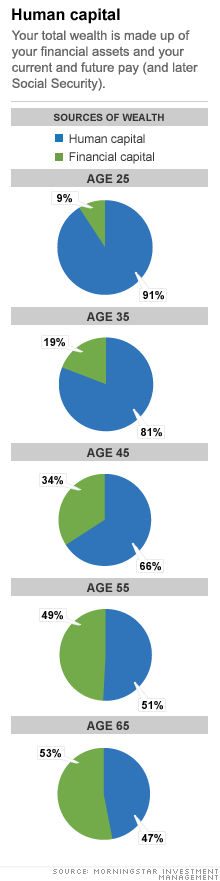
We also discussed kinetic energy and potential energy.  I compared human capital to potential energy, and financial capital (money) to kinetic energy.  Human capital is the amount of potential financial capital you have.  I showed the students this chart I got from CNN.

(It's embedded in THIS ARTICLE if you want to check it out...)

My students probably want extra credit for reading and discussing the blog.  They can get this by reading it and discussing it with a parent or adult.  To prove that you read today's post, please write the following on a scrap piece of paper: "Never be so focused on what you're looking for that you overlook the thing you actually find."  Then, have the parent/adult sign the scrap piece of paper.  Turn it in tomorrow.  (Parent/adult: by signing that scrap of paper, you are stating that you read and discussed the post with my student.)

Monday, January 28, 2013

Human Capital

To start off, I didn't create this graphic - I only created this version of it:

I originally obtained it from hcdexperts and linked back to their webpage.  Unfortunately, that is now defunct, and I have no way of contacting them.  If you work for hcdexperts and have any questions regarding the use of this graphic, please feel free to email, or leave a comment.

We spent a lot of time going over human capital today.  I had the students explain the chart.  Then they thought of a job, and gave examples of human capital that would help them in that job.  The students were supposed to be specific.  If they listed "doctor" they couldn't just say, "A doctor needs knowledge, life experience, skills and abilities, and to be creative."  Students had to explain the types of knowledge a doctor would need.  What life experiences would be beneficial, etc...

I recently went to a 1:1 conference at East Noble School Corporation.  Concord paid my way.  This increased my human capital.  My knowledge, and skills/abilities increased.  I learned creative ways to incorporate 1:1 technology in the classroom.  I asked the students if it was worth it for the school to invest in my human capital.

It's also worth mentioning the quiz Wednesday.  Yes... a quiz.  The quiz will be over the three monotheistic religions.  It'd be a good idea to study the chart.  I had the students write a little bit more information today as well.  You can check it out below:

Study study study...


Remember, to get the extra credit, you're supposed to read and discuss this blog with an adult.  I would suggest talking about the human capital chart, and spending some time studying for Wednesday's quiz.  To prove you did this, write the following quote on a sheet of scrap paper:  "Better for my having been there."  St. Petersburg High School Motto; St. Petersburg, Florida.  Have the adult you discussed the blog with sign the paper.


Friday, January 25, 2013

Time Travel

Ahhhh... The Grandfather Paradox.  If you were to travel back in time and kill your grandfather - you wouldn't be born...  Which means you couldn't travel back in time to kill your grandfather... which means your grandfather lives.  If he lives - you'll be born... which means...  Ugggggg!

I love time travel.

It came up while we finished talking about the monotheistic (believes in 1 God) religions today.

Think about this:
  • Christianity: 2.1 Billion
  • Islam: 1.6 Billion
  • Nonreligious: 1.1 Billion
  • Hindu: 1 Billion
  • Chinese traditional: 394 Million
  • Buddhism: 376 Million
  • Primal-Indigenous: 300 Million
  • African Traditional: 100 Million
  • Sikh: 23 Million
  • Juche: 19 Million
  • Spiritism: 15 Million
  • Judaism: 14 Million
  • Baha'i: 7 Million
  • Jainism: 4.2 Million
  • Shinto: 4 Million
This is all taken from the more and more reliable Wikipedia -  though I don't advise using the site for academic purposes.

Here's the question I asked: I only teach 5 religions during the year.  Judaism is not in the top 5.  Why do I teach about Judaism?

It's the grandfather paradox.  Judaism is taught because of its influence.  Without Judaism, Christianity and Islam would not exist as we know them today.  Furthermore, the influence extends past the religions: Israel (and the teachings of Judaism) influence the Middle East as a region today.

Some students still got caught up in the difference between being the "founder" of a religion, and "tracing roots back to..."  As in, the founder of Christianity is Jesus Christ.  However, Christianity can trace its roots back to Abraham.

I told a story about this.  It involved Papa John in most classes.

You probably read this because you want extra credit.  Well, I hope you discussed the three monotheistic religions.  Write down two sentences telling me how the discussion of the blog went - maybe tell me what you talked about.  Have the adult you read the blog with sign the paper.  Turn it in on Monday.

Have a great weekend.  I can't believe it's already here.