Showing posts sorted by relevance for query ancient. Sort by date Show all posts

Wednesday, December 4, 2013

Ancient Civilizations Venn Diagram... And Cuneiform

We're almost finished with ancient civilizations - and we're having a test over them next Thursday.  ...Not tomorrow, mind you, but Thursday the 12th - and we may extend it to the 13th.

So, we worked on a Venn Diagram today.  Students took it home, but they didn't actually have to do it for homework.  The diagram will be handy when it comes to studying for the test.  In fact, it's the first part of the review guide.  They'll receive the second one tomorrow or Friday.

I made some pictures to help you with the diagram.  And to help you study.


Ancient Egypt


Ancient Indus River Valley Civilization


Ancient Mesopotamia


Click on the pictures to enlarge them.  ...Yes, these are basically the answers.  Again, this would be one of the posts to come to if you want to study.  I'll tag it as "Study 2013" that way if you type that in to the search bar in the upper left of the webpage, it will bring you right to this post.  (Also, if I missed anything important for any of the civilizations, let me know either in class or in the comments.)

If you want the extra credit for reading and discussing this blog with an adult, have the adult quiz you over the various civilizations for about 3-5 minutes.  Have them ask you what each item on the list means.  Have them ask you which language goes with which civilization - NO PEEKING!  Etc...

When you're done, write down the word "architecture" and then write a quick definition for that word.  (If you don't know the definition, look it up.  If you don't have a dictionary, google it.  The adult can tell you, if that's easier - but you have to be the one to write it.)  Then, write down an example of architecture for each of the 3 ancient civilizations.  Have the adult you read the blog with sign the paper, and turn it in tomorrow.

We also wrote in cuneiform (SUMERIANS!) today.  So, if you want to check out some pictures (and maybe a video) from that, feel free to keep scrolling.  ...You might be in here.  


Wednesday, January 9, 2013

Ancient Egypt

We graded the maps today.  They should be in the grade book by the end of the day.

While the students finished working on their maps, I played a song.  It's a loose tie-in to Ancient Egypt, but I figure it's nice to have some background music.  And I already like the song.  Here's the music video if you want to check it out:


Once the maps were graded, we read from the text book.  I interrupted the reading a couple times to show some other clips.  Ancient Egypt was polytheistic, so I showed a clip from The Prince of Egypt.  It's a scene where they go through the different gods.  ...Ok... I realize that it's in Bulgarian.  Apparently, youtube took the English version down.  It didn't really matter though, because we didn't make it that far into the clip.  Here it is:


We also read about theocracy, mummies, and their view of the afterlife, so I showed another little clip too.  If someone's going to interrupt their reading, it might as well be a guy with a Ph.D.


Some of you probably want extra credit for reading and discussing the blog.  If you're one of those people, you have to discuss this with an adult.  Talk about Ancient Egypt.  Maybe you could compare it to Ancient Mesopotamia.  You could watch the videos.  If you find any other short videos that you think are pretty good, you could put them in the comments section, or email them to me...  At any rate, once you're done discussing this post with an adult, find a scrap piece of paper.  On that paper, write the following quote: "Think of them as an immense invitation." - Josh Ritter.  Have your parent (or whatever adult you discussed the blog with) sign the paper.

Turn it in tomorrow in the extra credit tray.

Monday, November 25, 2013

Ancient Civs

The bellwork today was sort of a catch-all for ancient civilizations.  Where they are.  Where we are.  What they were.

We graded it, so it was worth a little more than the typical five points.  That also means students can make it up.  You can get it by going to the H-Block Assignments page and clicking on "27.2 ancient civs map bellwork," or just click on the link right there - and  it will take you straight to it.

We've got a couple more ancient civilizations to cover before we get into governments.  Rest assured there will be a test shortly after we get back from break.  I'll have a review guide for you all soon.  For now, just rest easy.

We spent 2/3 of the class working on and grading the paper.  After that, we watched the first part of the Indus River crash course.  I would put it up here, but I'm not going to because we're going to finish it tomorrow.  You can watch it then.  Of course, it's on youtube.  So if you want to check it out now, I can't stop you.

As always, thanks for reading and discussing the blog.

If you want the extra credit for reading and discussing it today, click on the link above.  Adults, quiz your kid over the bellwork we did today.  It should be pretty easy since it was already review, and we just did it in class.  If they struggle with it too much, glare at them a little bit for me, ok?  That's the type of stuff that will show up on the test.

Then, when you're done.  Write down which question was the easiest, and which one was the most difficult.  (You don't have to ask every question.  But ask at least five.)

Then, as always, have the adult sign the paper and turn it in tomorrow.

Monday, December 2, 2013

Ancient Egypt

The first half of class today, we worked on our Ancient Egypt maps.  You can download it HERE.  You can do most of it without the book.  In fact, to help you out I'll post a map here where you can get most of the information:


Now, that won't get you everything - but it will get you started.  If you don't know where to go from there, CLICK ON THIS LINK.


...Seriously, people...  ...Yes you'll have to do the work of clicking the "images" icon at the top...

We'll finish it up during the bellwork time tomorrow, and then we'll grade it.  It should be done by then.

We also watched the Egypt Crash Course - or most of it at least.  I should add that John Green pushes the envelope in these - so when he uses a substitute word for donkey to keep the attention of the students, I turn it down.  If the kids aren't allowed to say it, he shouldn't be either.

Of course, you won't be able to turn it down at home, so watch at your own risk.


If you want extra credit you're supposed to read and discuss the blog with an adult.  If you did this, find a scrap of paper and write down one similarity between Ancient Egypt and Ancient Mesopotamia.  Then, write down one difference.  When you're finished, have the adult you read with sign the paper.  Make sure your name is on it, and turn it in tomorrow.

Wednesday, November 5, 2014

Start Writing

Today's lesson was mainly about writing.  How did it originate?  How does written language work?  What ancient languages should students be familiar with in this class?

I started the lesson by connecting it to previous learning.

Students came in and had to quickly draw two pictures.  One picture depicted the reasons ancient civilizations were found near rivers.  The other picture showed some of what helps anthropologists qualify a civilization as a civilization.

Here are the pictures.  We're all artists:


If you weren't here today, you should draw these and show them to me tomorrow.  If you were here, don't worry about it.  That's not the requirement for extra credit.

Hopefully most students already knew this - as Mr. Helmuth taught it to them.  I know they spent quite a bit of time checking out Hammurabi's Code.  You know - the code of laws for Mesopotamia.

Written language (a system of writing) is crazy.  It's like magic.  Most of you are probably reading this right now.  RIGHT NOW.  You just read that.  I wrote this a while ago, and you're reading it now.  That's a big deal.  And you can read it again if you want to.  (Ok... rereading this paragraph might seem a little pointless...  but I'm sure some of you just did...)

Obviously, when writing first came about, not everyone could do it.  Scribes must have looked like magicians.

We discussed writing coming from ideograms and pictograms.  Hieroglyphs.  We looked at the move to symbols representing sounds.  Phonetics.   The Phoenicians.  We discussed how ancient languages started as a mnemonic device - and that we still use ideograms, pictograms, and mnemonic devices today.

Obviously, we covered a lot more in 45 minutes, but I don't want to overwhelm you - you were here.  I just want you to talk to the adult you read this with and tell them how class went.  You could also mention the maps we looked at (on population/ population density) or what we read on the SMARTboard.

If you've read and discussed the blog and want extra credit.  Write a sentence or two from your discussion.  Then, have the adult you read and discussed with sign the paper.

Turn it in tomorrow in the extra credit tray.

See you then.  What a great day!  Am I right?

Saturday, December 17, 2011

Judge and Jury

Hopefully you noticed the polls I put up at the top of the blog.  As a class, we finished up the webquest and powerpoint about Hammurabi yesterday.  Most of them looked really good.  There were a couple kids who didn't get done, but the majority did.

I don't know if you can access them from home or not.  The students that read the blog Thursday said they couldn't get them to open up from home.  I'm going to look into that because... I mean... what's the point of having all this technology if you can't access it?

The project reviewed a lot of what we covered in class - reasons ancient civilizations were found near rivers, what it took to be an ancient civilization, ethnocentrism, as well as some of the specifics about Mesopotamia.

It really introduced historical context though.  We haven't had discussions about this before.  Good teachers are always trying to include higher level questioning and Bloom's Taxonomy into their lessons:

Bloom's Revised Taxonomy (revised)


(Image courtesy of: dkuropatwa)

This lesson, and the question of historical context really nails the upper levels of Bloom's.

Oftentimes social studies is memorizing facts: ancient civilizations are found near rivers for silt, transportation, drinking water, and irrigation...  But to answer the questions of which legal system is more just, and whether or not it's even fair to ask that question take critical thinking skills like analyzing and evaluating both sets of laws and coming to a personal conclusion.


And, lets face it... the question of historical context and justification of the past is tough.  Maybe we say we shouldn't judge Hammurabi according to today.  Being beat 60 times with an ox whip for hitting someone of a higher rank seemed like a just punishment at the time...  But then can we apply that to other areas of history?  Slavery? Nazism/Fascism?  Child sacrifice to Moloch?  If we went back in time, would we say... "well... when in Rome...?"

The opposite, to me seems equally distasteful.  If we come down too hard against the past, how will we be judged based on the lives we're leading?  What if in the future, the world is overpopulated and people are upset at the "selfishness" of families in the past that had more than one child?

We'll be wrapping up this discussion on Monday in class.  We'll see what everyone thinks.

Like I mentioned at the top of the blog, I hope you noticed the polls.  In order to get the extra credit, first have your kid vote on them.  Then, discuss why they voted the way they did.  Ask them about the two laws we looked at as a class.  What were the punishments doled out under each legal system?  Ask them if there are ever any exceptions to their views.

In order to get the extra credit, vote on the polls and discuss those questions directly above the bold text.  Once you have done that, write the following phrase on a scrap of paper: "Four more days until a little break."  Finally, adult: sign your name.  By signing, you're saying that you really did read the blog and discuss it with whoever is turning in that paper.

Monday, November 17, 2014

Ancient Civs Venn

Students completed a Venn Diagram of the ancient civilizations today.  It was classwork, and we graded it already.  The grades should be entered by 3:30 today.

If you weren't here, you can download it and print it from THIS PAGE.  Actually, if you're missing anything, it can be downloaded from that page.  If you don't have a printer - don't fear: there's one in the Media Center.  Just ask your CAP teacher if you may go during CAP.  Ask early, CAP teachers only have 2 passes a piece.

We reviewed the ancient civilizations, and I tried to reinforce some of the more minor differences.  Since we do have a test coming up on Friday, it might be a good idea to review these:


If you've read and discussed the blog with an adult, write two sentences telling me about that discussion.  Then, have them sign the paper.  Turn it in tomorrow.  (Make sure your name, date, and hour are on the paper.  If they're not, you won't receive the credit for it.)


Wednesday, December 11, 2013

Study For the Test.

Study.  Study.  Study for the test.

Here's how I want you to do it: get your review guide - OR A NEW ONE, if you must.

At the top of this webpage, on the left-hand side - there's a search engine.  Use it to search for the topics you need to study about.  Try typing Ancient Civs, Ancient, Ancient Civilizations, Economy, Economics, etc...  Let your study guide guide you.

When you're done, write down 5 things you searched.  For each one, tell me one thing you found.  Have the adult you studied them with sign the paper.  Turn it in tomorrow.

Tuesday, November 11, 2014

Egypt

To any veterans that stumble across this page, Happy Veteran's Day, and thank you for your service.

We will be studying ancient civilizations a little while longer.  I'm debating whether I'll try to finish before Thanksgiving or not.  We have yet to talk about Ancient China, but the concepts students have learned about the other civilizations may be enough for now.  (Ancient China began by a river for it's silt, irrigation, drinking water, fish, and transportation/trade.  They had their own code of laws, specialized workers, cities, and written language...  You know...)

Today the students worked on a map, reviewed the Indus River Valley Civilization, and watched a short (2 minute) video on Egypt.

The map was 20 points.  If you were absent, you can download it HERE.  (It's pretty easy.)

If you want the extra credit for reading and discussing the blog today, define "architecture" and then draw a picture of the most famous piece of architecture for each of the 4 civilizations we've studied.  Don't spend more than 1 minute on your drawing.

Have the adult you discussed with sign the paper.

Turn it in tomorrow.

Wednesday, January 20, 2016

Ancient Civs Quiz Friday

Make sure you're ready for a quiz over the ancient civilizations on Friday.  It shouldn't be anything TOO difficult.

If you weren't in class today, you need to print out this EGYPT MAP and turn it in as soon as you are able.

I'm not going to make a long post today, as I'm getting tomorrow's review game together.

If you want extra credit, here's how you can prove you were here:

List all 4 ancient civilizations that we've studied, and tell me what rivers they are found near.

Make sure your name, date, and hour are on the paper.

Turn it in tomorrow.


Also, if you didn't watch this video last week, here it is:


Tuesday, November 29, 2011

Judaism to Christianity

I am exhausted. My seventh hour class certainly enjoys talking.

We'll be spending the next several days on monotheistic religions. Today I incorporated some language development into the lesson. I gave a brief overview of pictograms and idiograms without going into too much detail or defining those words. (I linked some wiki definitions if you're so inclined...)

We talked about how written language was not originally meant to be read, but developed from a mnemonic device (proto-writing), and that Ancient Hebrew was written in a later developmental stage... (I didn't use all those words, so parents... if you're kid says I didn't teach them that stuff, I did... but not in that way...)

I gave them an example or two of how that would work. Ancient Hebrew was written without vowels, spaces, lower case, or punctuation. Some students asked how this worked, so I wrote something on the board for them. (Most every class had something different, that way they couldn't cheat.) You could have them write it down for you right now to see if you can figure it out.

We then talked about the Hebrew name of God, YHWH - and the reason some people won't say the name. This all hit a number of standards, including language development and religions. And I thought it was very fun.

We started into Christianity by watching 15-20 minutes of the video that the department uses. Honestly, I don't think any of us (teachers) really love these videos, but they're the best ones we've found. Every year we talk about making our own. Maybe this is the year...

To get the extra credit: Ask whoever is in my class to show you what mnemonic language would look like... have them write something without spaces, vowels, lower case, or punctuation and see if you can figure it out. Then discuss some of the similarities between Judaism and Christianity.

Sign the piece of paper that they wrote on, and have them turn it in for 5 extra credit points.

Wednesday, November 19, 2014

The Fate of Mankind; The Issue of My Friend

The Epic of Gilgamesh is almost always credited with being the oldest written story in the world.  It's a fantastic story, and if you've never read this - mankind's first piece of writing - I highly recommend it.

We've been studying ancient civilizations, so it's only appropriate that we take a peek inside Mesopotamia's most famous book - and their most famous super-hero.

Since the book was written in Cuneiform, it was written on clay tablets.  We only read a portion from Tablet 10, the translation of which comes from San Jose State University's webpage.  You can read what we read HERE.  It's only a page, and it will give you some context for this post.

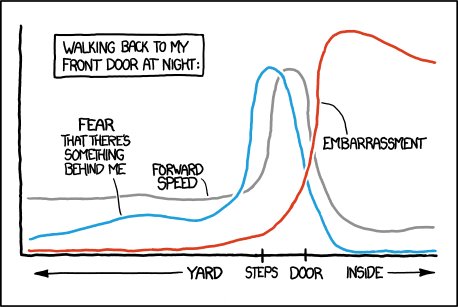
In the portion we read today, Gilgamesh is afraid.  Gilgamesh - this EPIC warrior - is afraid.  Terrified.  The guy who challenged the gods.  The guy who killed Humbaba (the body-guard to the gods), the guy who killed the Bull of Heaven: he's afraid.  The text says his cheeks are emaciated, his expression is desolate and his features are haggard.  From fear.

We've all dealt with fear before.  Sometimes it's embarrassing, right?  I shared this picture with most of my students:


Most of us aren't as fearless as Gilgamesh.  Why is he afraid?  What is he scared of?  What is "the fate of mankind" that so terrifies him?  And why does it terrify him?  And if it's something that scares one such as Gilgamesh, is it something I should fear as well?

If you were in class today, you know your job: read and discuss the blog with an adult.  Tell them what we talked about in class.  What was it that Gilgamesh feared?  What was the fate of Enkidu, his friend?  Is it a legitimate fear?  Why or why not?  After your done discussing, write a short paragraph about your discussion.  Have the adult you discussed it with sign the paper, and turn it in tomorrow.

If you weren't in class, read the section of the story we read today: found here.  Then write me a paragraph telling me what it is Gilgamesh fears.  Give me 3 examples from the text that support your conclusion.  You don't have to do all this with your parents or an adult.  Just turn it in when you return to school.  

Not to show my hand too much, but this is what we'll be talking about tomorrow as well.  Part of the point I'm trying to get across (aside from teaching ancient texts from the civilizations we're studying) is the commonality humanity shares across both time and cultures.

The fears of Gilgamesh are the same as the Pharaohs.  The same as Emperor Qin, who drank the mercury and jade.  The same as Juan Ponce de Leon - or at least, the legend of him which says he was searching for the Fountain of Youth.  ...And it's the same as one of our newest heros: Augustus Waters.  This is one of the major themes of The Fault in Our Stars, right?  Raise your hand if you've read it.  The point is, maybe we're not so far removed from the Mesopotamians after all.

Wednesday, December 9, 2015

The Biggest Discovery/Invention of All Time

Every year, we discuss the agricultural revolution.

I tell the students that agriculture is the most important invention, or discovery of all time.

It would be worthwhile to scroll through some old blog posts.  Like I said, I've taught this every year.

Agriculture = farming.

Think about what all farming has given us.  I ask students to think about how hungry they are.  They're all hungry.  Pretty much all of them.  All the time.

A burger from McDonalds or Burger King?  How much of that come from farms?  Wheat.  Lettuce.  The cow.  ...Pretty much every part of it, right?

If we had to chase our food down (as in, we couldn't grow it ourselves, or have others grow it for us) we would be in trouble.  

I can just imagine that first person who came up with the idea.  ...Why not bring the food to us?  The crowd slowly lowering their spears.  Each person thinking, "WHY DIDN'T I THINK OF THAT?"

Students today discussed inventions and discoveries that were game-changers.

Agriculture tops my list.  And we're leading into ancient civilizations.  Most all ancient civilizations were found near rivers.  Any guesses as to why?  #agriculture.

If you want extra credit for reading and discussing the blog, ask the adult you read and discussed it with what they think the most important invention/discovery of all time is.  Write it down with a brief explanation telling why.

Make sure your name, date, and hour are on it.  Then, turn it in tomorrow.

Don't forget, we've got a government quiz on Friday.  We have a quiz over the Middle East next week.

I'd study.

Thursday, January 15, 2015

Monotheism: Abraham's Journey; Judaism, Christianity, and Islam

Yesterday we started class by reading a passage from Genesis - from the Christian and Jewish Holy books.  According to Jews and Christians, God and Abraham made a covenant, or agreement/promise.

You can read what we read HERE.  They answered a few questions from the reading.

After they were done, we had a little refresher on the ancient civilizations of Mesopotamia and Egypt.  Abraham left Mesopotamia, and by the end of the passage we read yesterday, ended up in Egypt.

We reviewed the polytheism of these ancient civilizations, and then I read a section from the Qur'an.  In book 6, God shows the errors of polytheism.  Abraham tries to explain this to the people of Mesopotamia, but they will not listen.  (In fact, later in the Qur'an Abraham's father threatens to stone him if he doesn't accept the Mesopotamian gods.)

You can read the section of the Qur'an HERE.  (We actually read 72-81.)

The point of yesterday's lesson was that all three major monotheistic religions trace their roots back to Abraham.  An interesting thing to consider: the lives of more than 3 billion people today are directly influenced by that man.  (2 billion Christians, and 1 billion Muslims.)  That doesn't even take into account the number of non-religious people whose lives are influenced by him because of the countries in which they live.  Governments are set up that use the Qur'an or Bible or Torah to help inform how their countries are run.

Side note: In a couple classes, we discussed social media: many of my students have Facebook or Instagram.  We all agreed that it's fun when people "like" the stuff we post.  I happen to love being able to experience winter.  Driving in to work yesterday, the trees looked AMAZING, so I snapped a picture.


Social media connects us to other people.  It allows us to influence others.  It's crazy to think about how much influence Abraham has had on the world.  How many people would follow him on Facebook or Twitter...

We finished out yesterday by beginning a map of Abraham's journey.  Instead of giving it as an assignment, we're completing it as a class.

We haven't finished it yet.  I plan on wrapping it up tomorrow.  I'll post a picture when it's finished.

Today we've moved on from Judaism and Christianity to Islam.  We watched the Islam video - the last video we'll watch for quite some time.

If you want extra credit today, you need to write two names on a piece of scrap paper, then have the adult you read it with sign the paper.  All three major monotheistic religions trace their roots back to one man, who is it?  Who is the founder of Islam?  Those are the names you need.  ...Well... you should also make sure your name is on it...

...Man... I didn't even get to tell how I time-traveled with a couple classes...  Was it your class?

Thursday, October 10, 2013

Rome and H.G.

The students finished taking their test today.  I'm hoping to have the grades in by Monday - sooner if I can.

The marking period ends tomorrow, so this will be the last chance to get extra credit this 9 weeks.  If you missed it, that's ok.  But I hope you did well on the test.

After they finished the test, we read The Hunger Games.

There's a lot in the book that ties into aspects of history that I don't teach.  Much of it is characteristic of ancient Rome.  The arena and the premise of the games seem to have come straight from the Roman Colosseum.

It becomes even more evident in the subsequent books when the excesses of Capital life are the same excesses that led to the moral deterioration of Rome - possibly causing its ultimate collapse.

And of course, one wonders if this was the intent of Ms. Collins when she wrote the book.  ...To point out the similarities between our society and that of Ancient Rome...

I was please to see that a number of students had studied this before.  We didn't go into much detail, since Rome is not officially part of our curriculum - but it's nice to see how it all fits together.

I found this interesting as well.

If you read the blog for extra credit, discuss The Hunger Games.  Tell the adult you read what's going on in the book currently.  Then, find a piece of scrap paper and write down the phrase: "The arenas are historic sites, preserved after the Games... visit the sites where the deaths took place...  They say the food is excellent."

Put it in the extra credit tray tomorrow.

Monday, March 4, 2013

T minus 67 Hours

67 hours until the social studies ISTEP.  ARE. YOU. READY.?!?!

I like to think we are.  We spent today (and will spend the next couple days) going over a light review.

Today we went back over the ancient civilizations and the religions we studied earlier this year.  ...In the case of the civilizations, much earlier.

Teaching is crazy.  Sometimes I'm shocked by what my students forget, other times I'm shocked by what they remember.  Shocked, I tell you.

We spent some time looking at synonyms and various ways of wording questions.  It's probably a good skill to have in general.  And it always frustrates me when students act like I didn't teach them something because the question uses the wording "Nile River Valley Civilization" instead "Ancient Egyptian Civilization."

If you want the extra credit today, read and discuss the blog.  In the discussion, students, tell the adult some of the types of questions that were given today.  What all did you compare?  (If you have the paper, it'd be handy to go over it...)

Then, find a scrap piece of paper and write the following quote on it: "Stupid people are dangerous." -Katniss Everdeen, from Suzanne Collins' The Hunger Games.

Wednesday, October 8, 2014

Back, Baby! (Governments)

The bellwork today asked students to tell us which government would be the scariest government to live under, and then explain why.

We are guessing that they'll all give one of the unlimited governments.  At least, I can't imagine anyone would find a constitutional monarchy scarier than an absolute monarchy.

And I know that Taylor (from Stars Hollow... from The Gilmore Girls) can be pretty abrasive, at times... but I would hardly count him (or the direct democracy of Star's Hollow) as scarier than, say... Islam Karimov...

For the record, I know that Taylor Doose has an elected position in Stars Hollow, but the position - at least as it's portrayed on the show - has no real power.  He's just in the front at the meetings, and the people of the town get to vote.

(...Not that I watched tons of The Gilmore Girls or anything...  Sheesh...)

Mr. Helmuth is slowly moving from governments into ancient civilizations.  And what better way to do that then with Hammurabi?  You know, I was a little bit nervous when Mr. Helmuth said that the following video was pretty graphic, and that if students couldn't hack it, they should go to the hall.  But I shouldn't have doubted him.  It's not THAT graphic.


High production quality.  Some of my students were confused... "Is that the real Hammurabi?" they asked.

We looked at some of the laws the ancient Mesopotamian government created.  It was a good day.

If you want the extra credit for reading/ discussing the blog with an adult, write two sentences from your discussion and have the adult you read it with sign the paper.

Tuesday, December 3, 2013

Graded Some Maps

I'll keep this blog post short today.  Yay!  Free time!

We graded maps, which is why the post will be short.  ...Your free time = my time entering those grades.  They should be up by 4:30.

We also messed around with Google Earth today.  Although we're studying ancient Egypt, and the 1860s hardly qualify as "ancient,"  the Suez Canal was on the map.  So we looked at its purpose.  Students were also having some trouble with scale, so most classes zoomed in on a baseball diamond.  And we looked at how different it looked the farther away we got from it.  ...How different everything looked.  How small we are from outer space.

I told you I'd keep the post short, so in keeping with promises... If you read and discussed today's post with an adult, go check your current grades in all your classes.  Write down your grades.  If you're missing any assignments, write them down.  If you're missing anything for me - get them and complete them.  (Other than bellwork, of course.)  Once you have the list, have the adult you read and discussed the blog with sign it.  Turn it in tomorrow.

(If you're doing all your assignments, this should be really easy.)

Friday, October 17, 2014

Beginning of Ancient Civilizations

Whew! It has been a crazy week here at CJHS, and it has been several days since we last spoke. This is Mr. Helmuth wrapping up a week of ancient civilizations here on the blog.

The students spent most of their time this week learning about the Fertile Crescent, and why civilizations began to form in this area. Today our focus was on Mesopotamia, which is just another name for the Fertile Crescent. We spent most of our time reading a section from the textbook as a class, with occasional interruptions from Mr. Helmuth (sorry!).

Following our discussions, questions, and answers about the reading, the classes got to see a music video produced by students of a similar age from a different school. While it may seem a little bit goofy, it helps to remind us of the names of some of the great leaders from this time period and their accomplishments.

You can watch the video here: 


Finally, after a long week, I’m sure everyone is ready for a break…or just the extra credit. That’s understandable. For the extra credit tonight, discuss the blog with an adult, have them sign a piece of paper, put your name, date and hour on it, and turn it in on Monday. Make sure to include something interesting you did this weekend.

Have a great weekend, and we will see you “BETWEEN THE TIGRIS AND EUPHRATES, BABY!”

Tuesday, May 20, 2014

???

What?  11 days left?  How does this happen?

We don't have school on Monday?  What?  Didn't we have basically every day off this winter?

Here's the way I see the rest of this year finishing up:

We're done with North Korea tomorrow -and we start Ancient China.
We finish up Ancient China next week and review for the final and tie everything together.
Take the final.

Go on summer break.

...How does that sound?

The only change I can hope for is that I can still get my friend in here to speak.  Also, that Sanabel replies.

The questions I want you to discuss today:


  • What type of Government does North Korea have?
  • What was that cartoon about in class?  Explain it.  What was it trying to say?
  • Overall, do the people in North Korea have a high standard of living or a low standard of living?

After you discuss those questions, write one of you answers down on a scrap of paper, and have the adult you discussed it with sign the paper.

Turn it in tomorrow for extra credit.