Make sure you're ready for a quiz over the ancient civilizations on Friday. It shouldn't be anything TOO difficult.
If you weren't in class today, you need to print out this EGYPT MAP and turn it in as soon as you are able.
I'm not going to make a long post today, as I'm getting tomorrow's review game together.
If you want extra credit, here's how you can prove you were here:
List all 4 ancient civilizations that we've studied, and tell me what rivers they are found near.
Make sure your name, date, and hour are on the paper.
Turn it in tomorrow.
Also, if you didn't watch this video last week, here it is:

Showing posts with label ancient civs. Show all posts
Showing posts with label ancient civs. Show all posts
Wednesday, January 20, 2016

Tuesday, January 5, 2016
Hunting and Gathering - Agriculture+Rivers - Civilization Flowcharts
Yesterday my students made flowcharts showing humanity's progression from hunting/gathering to civilizations. (If you weren't here, please download it and complete it.)
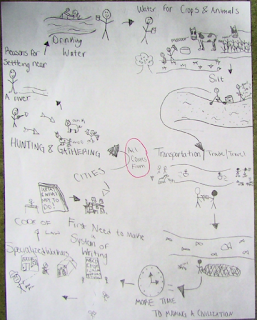
This wasn't a worksheet where students had to find the answers. It was more like a puzzle: I gave the students the answers, they had to put it together in a way that made sense to them.
I liked a lot of these. And I thought it was especially interesting how students who are given the same material can come up with quite different ways of expressing and representing what was given.
Here are a couple examples:

I liked this one because it included a lot of detail, and it all made sense. I like the explanation of silt, the different cultures trading, a net for catching fish... There's a lot to like. The clock at the bottom shows me that this did not happen quickly, an idea one might get if the clock wasn't present.
Thursday, December 10, 2015
Population Density Around Rivers
We covered a lot of material today:
- Started by studying for TOMORROW'S GOVERNMENT QUIZ.
- Labeled the parts of a river:
- Had a student act out the river. (Mouth at the end... delta formed at the mouth)
- Had ancient civilizations formed around the river
- Discussed the difference between population and population density while students were in the taped off boxes.
- Did some population/population density (basic) math problems
- Watched a video about a snake: point? The mouth is at the end.

So often, students confuse source and mouth. Which one is the beginning? Which one is the end? The mouth is at the end. The source is at the beginning. (Think of the source of a problem... You're trying to think of the beginning of a problem.)
If you've read and discussed this post with an adult, explain to them the difference between population, and population density. Then, write down your explanation. Have the adult sign the paper. Turn it in tomorrow for extra credit. Make sure your name, date, and hour are on it.
Here's the winning group for the year: 4th hour. We fit 30 people in here. The all-time record still stands at 33. We almost had it, though.

Here's the winning group for the year: 4th hour. We fit 30 people in here. The all-time record still stands at 33. We almost had it, though.

Wednesday, December 4, 2013
Ancient Civilizations Venn Diagram... And Cuneiform
We're almost finished with ancient civilizations - and we're having a test over them next Thursday. ...Not tomorrow, mind you, but Thursday the 12th - and we may extend it to the 13th.
So, we worked on a Venn Diagram today. Students took it home, but they didn't actually have to do it for homework. The diagram will be handy when it comes to studying for the test. In fact, it's the first part of the review guide. They'll receive the second one tomorrow or Friday.
I made some pictures to help you with the diagram. And to help you study.


So, we worked on a Venn Diagram today. Students took it home, but they didn't actually have to do it for homework. The diagram will be handy when it comes to studying for the test. In fact, it's the first part of the review guide. They'll receive the second one tomorrow or Friday.
I made some pictures to help you with the diagram. And to help you study.

Ancient Egypt

Ancient Indus River Valley Civilization

Ancient Mesopotamia

Click on the pictures to enlarge them. ...Yes, these are basically the answers. Again, this would be one of the posts to come to if you want to study. I'll tag it as "Study 2013" that way if you type that in to the search bar in the upper left of the webpage, it will bring you right to this post. (Also, if I missed anything important for any of the civilizations, let me know either in class or in the comments.)
If you want the extra credit for reading and discussing this blog with an adult, have the adult quiz you over the various civilizations for about 3-5 minutes. Have them ask you what each item on the list means. Have them ask you which language goes with which civilization - NO PEEKING! Etc...
When you're done, write down the word "architecture" and then write a quick definition for that word. (If you don't know the definition, look it up. If you don't have a dictionary, google it. The adult can tell you, if that's easier - but you have to be the one to write it.) Then, write down an example of architecture for each of the 3 ancient civilizations. Have the adult you read the blog with sign the paper, and turn it in tomorrow.
We also wrote in cuneiform (SUMERIANS!) today. So, if you want to check out some pictures (and maybe a video) from that, feel free to keep scrolling. ...You might be in here.


Wednesday, May 15, 2013
Qin
We're into Ancient China - and looking at their first Emperor, Qin Shi Huang Di. (Normally, I just call him Qin.)
Qin was a beast. Seriously, he led a pretty grandiose life. (As far as being a beast, he is referred to as "The Tiger of Qin.) We started studying that life today, and we'll go a little more in depth the rest of the week.
Students will be making presentations based on Qin's unification of China, his standardization of the culture, his burning of Confuscian books, his building of thepretty good Great Wall, and his death and burial. I'm expecting some great presentations.
It's worth mentioning that I'm calling him China's first Emperor - as many people do. But someone out there may be reading this and saying, "but he WASN'T China's first Emperor." True, true. Kind of true. We addressed that today as well.
John Hanson agrees with you. Qin wasn't China's first Emperor. Yu was. (Well, Paoxi may take issue with that...)
If you want the extra credit, read and discuss the blog with an adult. Tell the adult what we did in class today. Then, click on the three links at the end. On a scrap of paper, write a sentence explaining why you think I included them in the blog. Have the adult sign the paper. Turn it in tomorrow.
Qin was a beast. Seriously, he led a pretty grandiose life. (As far as being a beast, he is referred to as "The Tiger of Qin.) We started studying that life today, and we'll go a little more in depth the rest of the week.
Students will be making presentations based on Qin's unification of China, his standardization of the culture, his burning of Confuscian books, his building of the
It's worth mentioning that I'm calling him China's first Emperor - as many people do. But someone out there may be reading this and saying, "but he WASN'T China's first Emperor." True, true. Kind of true. We addressed that today as well.
John Hanson agrees with you. Qin wasn't China's first Emperor. Yu was. (Well, Paoxi may take issue with that...)
If you want the extra credit, read and discuss the blog with an adult. Tell the adult what we did in class today. Then, click on the three links at the end. On a scrap of paper, write a sentence explaining why you think I included them in the blog. Have the adult sign the paper. Turn it in tomorrow.
Wednesday, December 19, 2012
Can't Keep Myself Away...
Well, I just can't seem to keep myself away from the blog. I know I said that yesterday's post was going to be the last post until the break... but here I am, posting even more extra credit for all you extra credit lovers out there.
Here's today's bellwork. Students had to draw this picture. It lists reasons ancient civilizations were found near rivers.
 Yes. I'm an artist. Go me.
Then, we went up to the computer lab and continued to work on our presentations. They are coming along quite nicely. If you haven't checked it out yet, go ahead. I have made some minor changes to it, so if you're working on it from home - then you need to delete your cookies, and empty/clear your browser cache - at least of the questgarden page. Either way, you should still check it out HERE HERE HERE! if you haven't already.
If you want the extra credit, you have to read and discuss the blog with an adult. If you've done that, draw a quick picture of Hammurabi - you can make him look however you want. Have the adult you read the blog with sign the picture and put it in the extra credit tray tomorrow.
Here's today's bellwork. Students had to draw this picture. It lists reasons ancient civilizations were found near rivers.

Then, we went up to the computer lab and continued to work on our presentations. They are coming along quite nicely. If you haven't checked it out yet, go ahead. I have made some minor changes to it, so if you're working on it from home - then you need to delete your cookies, and empty/clear your browser cache - at least of the questgarden page. Either way, you should still check it out HERE HERE HERE! if you haven't already.
If you want the extra credit, you have to read and discuss the blog with an adult. If you've done that, draw a quick picture of Hammurabi - you can make him look however you want. Have the adult you read the blog with sign the picture and put it in the extra credit tray tomorrow.
Friday, October 19, 2012
Rivers, Population Density, and Civilizations
Yesterday we talked about the importance of agriculture, and the reasons ancient civilizations were found near rivers.
Today we looked at that a little bit more closely - including population density, and river terms.
Here's a picture we drew 7th hour. It's not the best, but I erased the other ones. I don't generally have the river snake eating someone, but whatever... I had a little time while the students were working. (Apologies to the family of the stick figure man being devoured.)
 We talked a little bit about why a river's delta is called a delta. I didn't teach them the entire Greek alphabet, but I did also point out that's where we get the term "alpha, bet..." (αβ)
We also looked at the difference between population and population density. I put students in taped in areas at the front of the room. One was over a desert... well, we changed it to The Sahel - not quite so dry... Another had a river running through it. (A student wearing blue was the river. He had to make a delta by raising his arms in the air. Good jobs to all rivers.)
I think most students understood the difference before the end. It's always encouraging when they struggle with something at the beginning of class, but then completely get it at the end. (Or at least appear to...)
Here's the last picture from the day:
 YO! STUDENTS! If you want extra credit, read and discuss this blog with an adult. Tell the adult about the boxes of tape, what did you think about the activity? Did you go in either box? Were you a river? What did you have to say to get to go into the box with the river? Why? Etc... I'm sure you can think of plenty more to talk about.
When you're finished discussing, find a scrap piece of paper and write me your favorite part of the activity. Then, have the adult you discussed it with sign the piece of paper.
Have a great weekend. I look forward to meeting a bunch of parents on Monday. Students, make sure you come too.
Today we looked at that a little bit more closely - including population density, and river terms.
Here's a picture we drew 7th hour. It's not the best, but I erased the other ones. I don't generally have the river snake eating someone, but whatever... I had a little time while the students were working. (Apologies to the family of the stick figure man being devoured.)
We also looked at the difference between population and population density. I put students in taped in areas at the front of the room. One was over a desert... well, we changed it to The Sahel - not quite so dry... Another had a river running through it. (A student wearing blue was the river. He had to make a delta by raising his arms in the air. Good jobs to all rivers.)
I think most students understood the difference before the end. It's always encouraging when they struggle with something at the beginning of class, but then completely get it at the end. (Or at least appear to...)
Here's the last picture from the day:

When you're finished discussing, find a scrap piece of paper and write me your favorite part of the activity. Then, have the adult you discussed it with sign the piece of paper.
Have a great weekend. I look forward to meeting a bunch of parents on Monday. Students, make sure you come too.
Subscribe to:
Posts (Atom)