Wednesday, August 19, 2015

Latitude and Longitude: 2015

We're learning about latitude and longitude today, and plotting coordinates.

This is one of the many places math and social studies overlap.  I asked my students how many of them studied geography...  Not too many hands.  Yet, they all knew what a triangle, circle, and square were.

More than that, they know the difference between a right angle, an acute angle, and an obtuse angle.

(Not to be confused with obtuse angel):

Obtuse Angel
It's one thing to know what lines of latitude and longitude are - it's quite another for students to understand how they're determined.

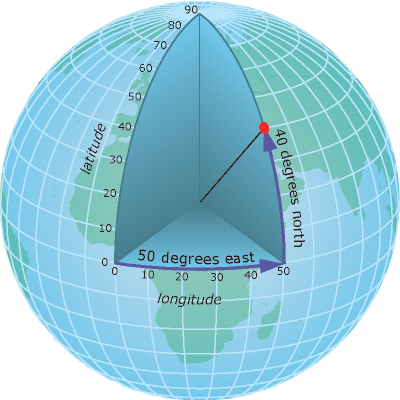
This year, I had them imagine they were floating at the middle of the earth - with a laser.  If they shot their laser straight out - it would be 0°.  If they aimed north at a 45° angle, they would hit the 45° N line of latitude.  If they aimed south 30°, they would hit the 30° S line of latitude.

There are lots of good pictures out there depicting the concept:


We also went over some ways to remember which lines are latitude, and which are longitude.  If you want, you can check out some previous posts about that.  Just click on the "latitude and longitude" link on the side of your screen.  (Or in the drop-down menu, if you're using a mobile device.)

Students can get extra credit if they read and discuss the blog with an adult.  To prove that they did this, have the adult ask the students a question or two - perhaps explain back the "laser from the center of the earth" example of how latitude is determined.  ...Or what is the 0° line of latitude?

Have the students write their answer on a piece of paper, then adults should sign it.

Turn it in tomorrow in the extra credit tray.


Tuesday, August 18, 2015

The World

We're working on some basic geography and spatial recognition.  Yesterday, I had students draw a map of the world from memory.

Today, I let them look off of another map.  Obviously, today's looked better.

I want my students to start off the year being able to reference various places in the world - at least the continents and oceans.  If they can draw the world, they'll be able to do this.  And we can build off it.

Of course, everything is more complicated than it seems -  even something as simple as continents and oceans.  We watched a video today discussing that.  If you have a chance, check it out:


Students can get extra credit if they read and discuss the blog with an adult.  To prove that they were here today, find a scrap of paper and have them draw a map of the world from memory.  (Do not allow them to take more than 2 minutes on this.)  When they're done, sign the map.  (Feel free to try it yourself.  It's tough.)

Turn in the paper tomorrow.  Make sure your name, date and hour are on it.

Monday, August 17, 2015

Observations and the World

Social studies is a lot like science: both deal extensively with observation.

In 7th grade, at least, science deals with observing the physical world, whereas social studies deals with observing how that world relates and affects people - and vice versa.

To practice our observation skills, I had the students describe the junior high commons from memory.  (I didn't give them long to do this.)  Then, I had them describe what Mr. Ogle was wearing - most students had just seen him out in the hall.

Finally, I had them close their eyes, and describe what the person across from them was wearing.  It's tough, being attentive.

We can make lots and lots of observations about the things and people we see and know about.  How much more difficult is it to try to understand people and places we've never been?

Students can get extra credit if they read and discuss this blog with an adult.  To prove that they've done this, have either the student or the adult close their eyes.  The other person should keep reading out loud.

...

...

..

Got it?

Alright.  You!  The person who is reading!  Have the person with their eyes closed describe what you are wearing.  When you're done, write down a sentence or two telling me how they did.  Have the adult sign the paper.  

Turn it in tomorrow in the extra credit tray.


Wednesday, August 12, 2015

WELCOME BACK!!!

I can't believe the school year has started.  For me, that was the shortest summer break we've ever had.  ...Ever.

I'm having a great time learning all of the students.  So far, I've been impressed.

Today, we went over procedures and expectation.  ...I imagine that's what students did in almost all of their classes.

I'm asking students to bring the following to my class every day:


  • A 3-Ring Binder - at least 1 inch thick
  • Pencil or pen (blue or black ink)
  • Planner
  • AR book (they'll go to the media center to choose these)
  • A pack of pencils for me

I'm also asking the students to bring 1 of the following:

either:  A pack of red pens
OR       A pack of tissues
OR      A pack of colored pencils
OR      A pack of dry erase markers


If you have any questions about any of this, please let me know.


Finally, at some point we'll probably discuss The Hunger Games.  We'll leave that for another day.

Students may be here because they want some extra credit.  To get that, they need to read and discuss this blog with an adult.  After they've done that, students should find a scrap of paper and write the phrase of the day: "This is going to be AMAZING!!!!!"  Students should have the adult they read and discussed the blog with sign the paper.

Put it in the extra credit tray tomorrow.

Wednesday, July 8, 2015

Summer Government: What I Taught

My section of summer government dealt with primary sources: reading them and interpreting them.

This is the same the same thing I did last year, but with some tweaks.

Last year we FLEW.  I wanted to hit as many of "the greats" as possible: The Magna Carta, The Declaration of Independence, The Constitution, Federalist 10, Federalist 58, Bill of Rights, Gettysburg Address...

I also wanted to show that there was so much more out there: truly riveting reads - for instance, a letter from General Pickett to La Salle Corbell, where Pickett is coming to grips with the thousands of death's he is responsible for:

"Even now I can hear them cheering as I gave the order, “Forward”!  I can feel their faith and trust in me and their love for our cause.  I can feel the thrill of their joyous voices as they called out all along the line, “We’ll follow you, Marse George.  We’ll follow you – we’ll follow you.”  Oh, how faithfully they kept their word – following me on – on – to their deaths, and I, believing in the promised support, led them on – on – on – Oh, God!"

The class went well, and I was glad to be able to introduce the students to so much.

I gave a survey at the end, though and a respectable number said they wished they could have spent more time focusing on "the greats," as we moved so quickly over them, some students still weren't sure what was in them.

So THIS year, that's where we stayed.

We started by reading 1 Sam. 8 and moved to the Magna Carta.

In 1 Sam. 8, the Israelites are warned about what will happen when they get a king.  The king will take their children, their crops, their cattle, their donkeys...  It was truly a "hide your wife, hide your kids" moment.  ...Because the king was coming for everybody.

So, we had a king with unlimited power.  For our next reading, we moved to the Magna Carta - which limited the King's power.  Good news of the day?  The Magna Carta's 800th Birthday came the week after we read it.

Spoiler alert: We had a party.

800* Donuts.  Happy Birthday, Magna Carta!!!

Students Brought in Cake and Other Dishes

A Good Time Had By Almost All

And by party, I mean we had snacks before the day started.  Still: Success.

After the Magna Carta, we read The Declaration of Independence.

For those of you following along, here's the narrative structure:


  1. The King will be (and was) bad.
  2. Limit the power of the king.
  3. Get rid of the king entirely.

We then went back and read Patrick Henry's famous, "Liberty or Death" speech (AKA "The War Inevitable.")  It's true this is a little out of order now, but what can you do?  It is a fine piece of speechifying.  Perhaps the finest.  (I love that in the opening paragraph, Henry doesn't vilify those who disagree with him.)

We skipped the Articles of Confederation, and moved on to the Constitution.  And here, we buckled down.  I should add that this year, I tried out Google Classrooms.  For this assignment, students commented on/ summed up every clause of every section of each of the articles of the Constitution.  All online.  They turned in work that looked something like this:

Constitution Commentary: Student #1**

I read through all of them.  They averaged about 9 pages.  There were 120? 130? of them.  #GoMe.

When they were finished, I passed them back with my comments, and recommendations.  It looked something like this:

Constitution Commentary: Student #2***

Before students received credit, they went through and addressed all the comments I made.  ...And I made comments, believe you me.

We spent a goodly amount of time on the Constitution.  ...I mean... It is the basis of our government.

After that, we moved on to The Gettysburg Address and read some of the writings of William Lloyd Garrison.  There was a controversy over the Confederate Flag, (please, no history lessons about the Battle Flag, etc...  We all know the flag I'm talking about, right?) so that took up a little time as well, as we looked at the reasons Mississippi gave for secession, and the reasons South Carolina gave for secession.

And we did a math problem: Subtract four score and seven from 1863.

My section didn't cover the judicial branch*+, but as much of the argument in Roe v. Wade hinges on when life starts, the Civil War/ Declarations of Secession/ Gettysburg Address hinges on when our nation was conceived or born - when life started.

(Take this line for instance: "...a new nation, conceived in liberty and dedicated to the proposition that all men are created equal..."  Lincoln's Gettysburg Address goes back Four Score and Seven Years... to the Declaration of Independence - not just to the Constitution.

Yet, we celebrate our first president as George Washington - who became president in 1789 - and not John Hanson, who was president in 1781.  ...But we recognize the birth of the nation as July 4th, 1776, even though the inappropriately named "War of 1812" was really The Revolutionary War Part II.)

At any rate, the next to the last full day, we had a guest speaker - State Representative Timothy Wesco - come in and address the class.  He spoke about the legislative process, the difference between Indiana's Constitution and the U.S. Constitution, as well as other topics the students grilled him on.  It went really well, and was very informative.

The last full day we debriefed about the visit, and studied for the final.

...And that was it.

This was as much for me as it was for you.  I hope you found it helpful.

*If there were only 260 donuts, the world will never know, right?  
**I hope you read that as "Student Hashtag 1."
***Similarly, I hope you read that as Student Hashtag 2.
*+It was covered though, don't you worry.  Every day students had 4 one hour sections.  My section lasted an hour.  Another teacher focused on the Judicial Branch.