Showing posts sorted by date for query Ancient Civilizations. Sort by relevance Show all posts

Tuesday, February 6, 2018

A Little Dissent

The past two days, I've been called out twice by students.  We've started talking about the purpose of governments, different types of governments, etc...

I teach them that according to Jefferson, a good government is there to protect people and their rights.  "We hold these truths to be self-evident, that all men are created equal, that they are endowed by their Creator with certain unalienable Rights, that among these are Life, Liberty, and the pursuit of Happiness. - That to secure these rights,, Governments are instituted among Men..."

I generally start off the discussion with some kind of bellwork question.  Sometimes it ends up dominating the lesson.  "Should students and teacher have the same authority?  Why or why not?  What do you think would happen?..."  or maybe "Explain the quote, 'Power corrupts, and absolute power corrupts absolutely.'"

Monday's was, "What is the purpose of government?  What does it do?  Do we (human beings/ Americans) need a government?  Why or why not?  What do you think would happen if we didn't have a government?"

We haven't really dug into governments yet, but we've touched upon the concept.  We've been keeping a "Threat List" this year of all the threats facing America.  So we talked about the purpose of government a bit there.  And studying ancient civilizations we looked at government, and law, and why we punish.  Government plays a key role in The Hunger Games - which we've been reading all year.  So a lot of students were regurgitating what they'd learned in some form.  This was nice, you know, because it showed me that they'd learned something.  But here was my favorite response to the question, which was definitely not a regurgitation: 

"The purpose of a government is to protect us.  Our government argues more than it does anything.  I think that we - the Americans - do not need a government because we are supposed to have freedom and all that stuff, but we don't get that.  If you speed, you have to pay the government.  And the government lies to us, and watches us, and spies on its own people.  I do not think the government is necessary.  I don't think it is necessary because they are a bunch of fools and phonies.  I don't think too much would happen if we didn't have a government.  For sure there would be less sexual allegations (against government officials).  I say this because the government is like a reality show - they talk a lot around cameras, but don't do anything behind closed doors."*

There's quite a bit of truth there - even though I wholeheartedly disagree with his conclusion.  There is a lot of posturing talk.  Oftentimes things (sometimes obvious things) don't get done.  Our government doesn't completely trust the people, and the people don't completely trust the government.  And our system is weird, because the people are the government.

And today, when I asked people to compare the ways that The Capitol (from The Hunger Games) takes rights away from its citizens, and ways that The United States secures the rights of it's citizens a student said, "this sounds a lot like propaganda."  And I was so glad to have that kid in class.  And sometimes I wonder, is it?   I spend a lot of time talking about the rights we have in our country - both guaranteed in the Bill of Rights, and others which we maybe take for granted:

Freedom of speech, press, religion, assembly, movement, the right to own weapons... The freedom to complain and ask for things to get better without fear of retribution from our government.  Freedom from torture, or the threat of torture, or other cruel and unusual punishments.  The right to privacy, and freedom of thought...

But we haven't really discussed current situations where other governments protect their citizens and extend rights where ours don't.  Senator Sanders may bring up other countries offering Universal Health Care.  Colin Kaepernick might say police brutality and racial injustice is still a major issue in The United States.  Indiana Rep. Jim Lucas might be concerned that the right to own guns is being chipped away.

We often tiptoe around controversy until the controversy has passed.  We can look back (as we did today) at Fannie Lou Hamer and see the rights that were granted after they had been denied and talk about how great America is.  But Senator Sanders, Colin Kaepernick, and Rep. Lucas are all - from different sides of the aisle - telling us that there's always more work to be done.

My students are right to remind me about that as well.


*lightly and incompletely edited for spelling, grammar, and clarity.

Wednesday, May 10, 2017

The Test to End All Tests

So, we're finishing up our brief introduction to World Wars I and II.  And if WWI was billed as "the war to end all wars," may I bill my final as "the test to end all tests?"

I just want to put this out as an all-call.  We've got a final coming up.  We're going to start our review tomorrow, as well as finish up some thoughts on Japanese Imperialism and WWII.

In honor of the final, choose one of these topics.  Pick a previous year's blog post from one of the topics.  (You don't have to read every post.  Just scroll through until you reach one that interests you.)  Read it and discuss it.  Treat it as a regular extra credit blog post.  The only thing to add along with your name, date, and signature of the grown up you read and discussed with, you need to add the date and title of the original post.

Ancient Civilizations

Agriculture

Monotheism

Globalization


Good luck.

Wednesday, January 20, 2016

Ancient Civs Quiz Friday

Make sure you're ready for a quiz over the ancient civilizations on Friday.  It shouldn't be anything TOO difficult.

If you weren't in class today, you need to print out this EGYPT MAP and turn it in as soon as you are able.

I'm not going to make a long post today, as I'm getting tomorrow's review game together.

If you want extra credit, here's how you can prove you were here:

List all 4 ancient civilizations that we've studied, and tell me what rivers they are found near.

Make sure your name, date, and hour are on the paper.

Turn it in tomorrow.


Also, if you didn't watch this video last week, here it is:


Thursday, December 10, 2015

Population Density Around Rivers

We covered a lot of material today:

  • Started by studying for TOMORROW'S GOVERNMENT QUIZ.
  • Labeled the parts of a river:
  • Had a student act out the river.  (Mouth at the end... delta formed at the mouth)
  • Had ancient civilizations formed around the river
  • Discussed the difference between population and population density while students were in the taped off boxes.
  • Did some population/population density (basic) math problems
  • Watched a video about a snake: point?  The mouth is at the end.


So often, students confuse source and mouth.  Which one is the beginning?  Which one is the end?  The mouth is at the end.  The source is at the beginning.  (Think of the source of a problem...  You're trying to think of the beginning of a problem.)

If you've read and discussed this post with an adult, explain to them the difference between population, and population density.  Then, write down your explanation.  Have the adult sign the paper.  Turn it in tomorrow for extra credit.  Make sure your name, date, and hour are on it.


Here's the winning group for the year: 4th hour.  We fit 30 people in here.  The all-time record still stands at 33.  We almost had it, though.


Wednesday, December 9, 2015

The Biggest Discovery/Invention of All Time

Every year, we discuss the agricultural revolution.

I tell the students that agriculture is the most important invention, or discovery of all time.

It would be worthwhile to scroll through some old blog posts.  Like I said, I've taught this every year.

Agriculture = farming.

Think about what all farming has given us.  I ask students to think about how hungry they are.  They're all hungry.  Pretty much all of them.  All the time.

A burger from McDonalds or Burger King?  How much of that come from farms?  Wheat.  Lettuce.  The cow.  ...Pretty much every part of it, right?

If we had to chase our food down (as in, we couldn't grow it ourselves, or have others grow it for us) we would be in trouble.  

I can just imagine that first person who came up with the idea.  ...Why not bring the food to us?  The crowd slowly lowering their spears.  Each person thinking, "WHY DIDN'T I THINK OF THAT?"

Students today discussed inventions and discoveries that were game-changers.

Agriculture tops my list.  And we're leading into ancient civilizations.  Most all ancient civilizations were found near rivers.  Any guesses as to why?  #agriculture.

If you want extra credit for reading and discussing the blog, ask the adult you read and discussed it with what they think the most important invention/discovery of all time is.  Write it down with a brief explanation telling why.

Make sure your name, date, and hour are on it.  Then, turn it in tomorrow.

Don't forget, we've got a government quiz on Friday.  We have a quiz over the Middle East next week.

I'd study.

Tuesday, April 21, 2015

No Computers

We gave up the computer labs today for the practice ISTEP test.  Still, I feel like the lesson went pretty well, even if we didn't get to work with google drawings.  We'll get there.

Yesterday's video dealt with Mexico and Cambodia, among other things.  One of the questions on the google doc asked students to tell me which continent the countries were located on.  (The video showed them on a map, so I thought it wouldn't be too difficult.  Also, ...Mexico.  I mean, we know what continent Mexico is on, right?)

Turns out a lot of us don't.  I know what you're thinking: Mexico is not in your jurisdiction.  It's not a 7th grade standard.  Well, you're right.  But still.

Today, I gave students a pop quiz over the continents and oceans.  It was the same quiz they all had to pass at the beginning of the year.  It's interesting that almost everybody earned a perfect score, and almost everybody could place Mexico on the map, but so many students still named Mexico as being in South America when the map wasn't in front of them.

Well, hopefully we cleared that up.

I'm also trying to go over any of the smaller standards that I've missed.  Some standards are huge.  Religions?  Ancient civilizations?  Governments?  Economics?  Those take a lot of time.

Banking is pretty straight forward - at least for what 7th graders need to know.

Here's the 3 minute video we watched on that.  We discussed quite a bit as well.


We talked about allowances, and doing chores.  Keeping money in a jar, versus keeping it in a bank where it can collect interest...  the irony of having a savings account while also having a mortgage.  

Students may earn extra credit by reading and discussing this post with an adult.  Discuss money a little bit.  Talk about saving versus spending.  Talk about buying now and interest rates.  When you're done, students should write a couple sentences about their discussion.  The adult they discussed the blog with should sign the paper.  That will prove that they've been here.

Turn it in next time you see me.

Monday, April 20, 2015

Review and Google Docs... Reviewgle Docs... Heh...

Alright... that title needs a little work.  It's been a long day in the classroom.  I'm still trying to figure out how google docs will work for me.  For us.  For everyone.  (Kudos to those of you out there that already have all this down!)

We've got the ISTEP coming up, so I thought it best to review a little bit while also figuring out this technology piece.  Fellow Hoosier and all around awesome person Mr. John Green (et al) helped us out with that today:


After 11 minutes of historical brain candy, students had to work together on their google docs answering questions from both the film and the school year as a whole.  Some of the questions were factual recall.  Some asked for discussion...  If you want to know what I asked, here it is:  RIGHT HERE.  (I capitalized that in case you got lost.)

Here's some stuff the youtube video addressed (directly or indirectly) that may show up on the final:
  • ancient civilizations
  • water 
    • drinking
    • agriculture
    • sanitation
  • standard of living
  • code of laws
  • natural resources
  • theocracy
  • Hamurabi
  • system of writing
  • human capital
  • empire
  • religion
  • culture
  • architecture
  • Great Bath
  • Asia 
  • South America
  • ...Yeah...  that's already a lot, and I haven't had to stop and think yet...


Students, you can access your own files from home if you have a computer and the internet.  Or maybe a phone.  I haven't tried google drive on my phone yet.  I should.

In case you've forgotten your new email address, it's firstnamelastname@stu.concord.k12.in.us.  Go ahead and send Firstname Lastname some letters.  He really wishes he'd been named differently.  Don't forget the s when you type in your password.

If you came to my blog for the extra credit, you were supposed to read and discuss it with an adult.  If you did that, write down a couple sentences from your discussion.  Tell me what you talked about.  Hopefully you told them how google docs went today.  (It was much better from my vantage point.  Students were working in smaller groups instead of the whole class working on the same document together.)  Have the adult sign the paper.  Make sure your name, date, and hour are on it.  Turn it in tomorrow.

You might take the time to show them your group's google doc.  You could even change it a little bit to show them how it works, if they're not familiar with the technology.  ...I get that most of you probably have your own google account...

Also, if you want to change your profile picture, go for it.

Thursday, January 15, 2015

Monotheism: Abraham's Journey; Judaism, Christianity, and Islam

Yesterday we started class by reading a passage from Genesis - from the Christian and Jewish Holy books.  According to Jews and Christians, God and Abraham made a covenant, or agreement/promise.

You can read what we read HERE.  They answered a few questions from the reading.

After they were done, we had a little refresher on the ancient civilizations of Mesopotamia and Egypt.  Abraham left Mesopotamia, and by the end of the passage we read yesterday, ended up in Egypt.

We reviewed the polytheism of these ancient civilizations, and then I read a section from the Qur'an.  In book 6, God shows the errors of polytheism.  Abraham tries to explain this to the people of Mesopotamia, but they will not listen.  (In fact, later in the Qur'an Abraham's father threatens to stone him if he doesn't accept the Mesopotamian gods.)

You can read the section of the Qur'an HERE.  (We actually read 72-81.)

The point of yesterday's lesson was that all three major monotheistic religions trace their roots back to Abraham.  An interesting thing to consider: the lives of more than 3 billion people today are directly influenced by that man.  (2 billion Christians, and 1 billion Muslims.)  That doesn't even take into account the number of non-religious people whose lives are influenced by him because of the countries in which they live.  Governments are set up that use the Qur'an or Bible or Torah to help inform how their countries are run.

Side note: In a couple classes, we discussed social media: many of my students have Facebook or Instagram.  We all agreed that it's fun when people "like" the stuff we post.  I happen to love being able to experience winter.  Driving in to work yesterday, the trees looked AMAZING, so I snapped a picture.


Social media connects us to other people.  It allows us to influence others.  It's crazy to think about how much influence Abraham has had on the world.  How many people would follow him on Facebook or Twitter...

We finished out yesterday by beginning a map of Abraham's journey.  Instead of giving it as an assignment, we're completing it as a class.

We haven't finished it yet.  I plan on wrapping it up tomorrow.  I'll post a picture when it's finished.

Today we've moved on from Judaism and Christianity to Islam.  We watched the Islam video - the last video we'll watch for quite some time.

If you want extra credit today, you need to write two names on a piece of scrap paper, then have the adult you read it with sign the paper.  All three major monotheistic religions trace their roots back to one man, who is it?  Who is the founder of Islam?  Those are the names you need.  ...Well... you should also make sure your name is on it...

...Man... I didn't even get to tell how I time-traveled with a couple classes...  Was it your class?

Wednesday, November 19, 2014

The Fate of Mankind; The Issue of My Friend

The Epic of Gilgamesh is almost always credited with being the oldest written story in the world.  It's a fantastic story, and if you've never read this - mankind's first piece of writing - I highly recommend it.

We've been studying ancient civilizations, so it's only appropriate that we take a peek inside Mesopotamia's most famous book - and their most famous super-hero.

Since the book was written in Cuneiform, it was written on clay tablets.  We only read a portion from Tablet 10, the translation of which comes from San Jose State University's webpage.  You can read what we read HERE.  It's only a page, and it will give you some context for this post.

In the portion we read today, Gilgamesh is afraid.  Gilgamesh - this EPIC warrior - is afraid.  Terrified.  The guy who challenged the gods.  The guy who killed Humbaba (the body-guard to the gods), the guy who killed the Bull of Heaven: he's afraid.  The text says his cheeks are emaciated, his expression is desolate and his features are haggard.  From fear.

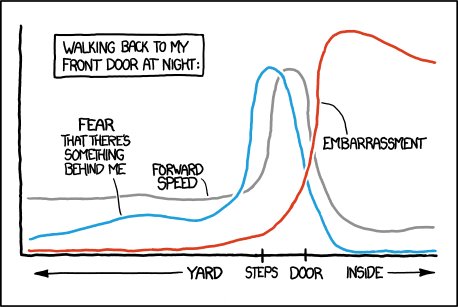
We've all dealt with fear before.  Sometimes it's embarrassing, right?  I shared this picture with most of my students:


Most of us aren't as fearless as Gilgamesh.  Why is he afraid?  What is he scared of?  What is "the fate of mankind" that so terrifies him?  And why does it terrify him?  And if it's something that scares one such as Gilgamesh, is it something I should fear as well?

If you were in class today, you know your job: read and discuss the blog with an adult.  Tell them what we talked about in class.  What was it that Gilgamesh feared?  What was the fate of Enkidu, his friend?  Is it a legitimate fear?  Why or why not?  After your done discussing, write a short paragraph about your discussion.  Have the adult you discussed it with sign the paper, and turn it in tomorrow.

If you weren't in class, read the section of the story we read today: found here.  Then write me a paragraph telling me what it is Gilgamesh fears.  Give me 3 examples from the text that support your conclusion.  You don't have to do all this with your parents or an adult.  Just turn it in when you return to school.  

Not to show my hand too much, but this is what we'll be talking about tomorrow as well.  Part of the point I'm trying to get across (aside from teaching ancient texts from the civilizations we're studying) is the commonality humanity shares across both time and cultures.

The fears of Gilgamesh are the same as the Pharaohs.  The same as Emperor Qin, who drank the mercury and jade.  The same as Juan Ponce de Leon - or at least, the legend of him which says he was searching for the Fountain of Youth.  ...And it's the same as one of our newest heros: Augustus Waters.  This is one of the major themes of The Fault in Our Stars, right?  Raise your hand if you've read it.  The point is, maybe we're not so far removed from the Mesopotamians after all.

Monday, November 17, 2014

Ancient Civs Venn

Students completed a Venn Diagram of the ancient civilizations today.  It was classwork, and we graded it already.  The grades should be entered by 3:30 today.

If you weren't here, you can download it and print it from THIS PAGE.  Actually, if you're missing anything, it can be downloaded from that page.  If you don't have a printer - don't fear: there's one in the Media Center.  Just ask your CAP teacher if you may go during CAP.  Ask early, CAP teachers only have 2 passes a piece.

We reviewed the ancient civilizations, and I tried to reinforce some of the more minor differences.  Since we do have a test coming up on Friday, it might be a good idea to review these:


If you've read and discussed the blog with an adult, write two sentences telling me about that discussion.  Then, have them sign the paper.  Turn it in tomorrow.  (Make sure your name, date, and hour are on the paper.  If they're not, you won't receive the credit for it.)


Friday, November 14, 2014

Test Next Friday

We graded the Egypt map today.  The grades should all be entered by 3:30 today.  If you see that you're missing it, you should consider doing that.  Progress reports are coming out soon.  It might be a good idea to check your grades.

I also passed out the review guide for the test on ancient civilizations - which will be next Friday.  You can view or download the review guide HERE.

I'm keeping the extra credit simple today: study for the test with an adult for at least 5 minutes.  Let them quiz you.  Then, on a scrap of paper, write down 1 thing you knew, and one thing you struggled with or didn't know.  Have the adult you studied with sign the paper.  Make sure your name, date and hour are on it and turn it in on Monday.

Tuesday, November 11, 2014

Egypt

To any veterans that stumble across this page, Happy Veteran's Day, and thank you for your service.

We will be studying ancient civilizations a little while longer.  I'm debating whether I'll try to finish before Thanksgiving or not.  We have yet to talk about Ancient China, but the concepts students have learned about the other civilizations may be enough for now.  (Ancient China began by a river for it's silt, irrigation, drinking water, fish, and transportation/trade.  They had their own code of laws, specialized workers, cities, and written language...  You know...)

Today the students worked on a map, reviewed the Indus River Valley Civilization, and watched a short (2 minute) video on Egypt.

The map was 20 points.  If you were absent, you can download it HERE.  (It's pretty easy.)

If you want the extra credit for reading and discussing the blog today, define "architecture" and then draw a picture of the most famous piece of architecture for each of the 4 civilizations we've studied.  Don't spend more than 1 minute on your drawing.

Have the adult you discussed with sign the paper.

Turn it in tomorrow.

Thursday, November 6, 2014

Geography Games

We were in the computer lab today.  When students entered, they were greeted by my daughter, Gwennie.  It's her birthday.


They spent most of the hour playing geography games.  We're studying ancient civilizations.  I want them to know that the land we're studying still exists today.  In fact, many of the present day countries are countries of key interest to U.S. foreign relations.  (Did I mention the cradle of civilization, Mesopotamia, is present day Iraq?)

I won't write a long blog post.  Instead, I want students to play the games again.  Don't forget that they can get unlimited extra credit by playing them as well.  They just have to prove to me that they played.  Screen shot their scores and email them to me, or print them out.  Something.

Here's my big question though, how many of you can play these games from a Smart-phone or tablet?  That's what I want to know.  If you have one, HERE'S THE LINK.  Have the kid you're reading and discussing the blog play it once.  Then, on a scrap of paper, have them write down whether it worked or not, and tell me what device they played it on.  If you don't have a Smart-phone just play it on the computer.  Then, the adult that's reading and discussing the blog should sign that paper.  Turn it in tomorrow.

I'll write a little bit more, but don't feel like you need to read it or do anything about it.

Towards the end of class we looked at this map.  (I made it based off a map I got from eduplace.)


Hopefully, by the end of the day, they know which countries these are - along with all the countries in the Middle East.  It might be helpful to quiz them over this, as it will show up later as well.


It was a good day.  :)


Wednesday, November 5, 2014

Start Writing

Today's lesson was mainly about writing.  How did it originate?  How does written language work?  What ancient languages should students be familiar with in this class?

I started the lesson by connecting it to previous learning.

Students came in and had to quickly draw two pictures.  One picture depicted the reasons ancient civilizations were found near rivers.  The other picture showed some of what helps anthropologists qualify a civilization as a civilization.

Here are the pictures.  We're all artists:


If you weren't here today, you should draw these and show them to me tomorrow.  If you were here, don't worry about it.  That's not the requirement for extra credit.

Hopefully most students already knew this - as Mr. Helmuth taught it to them.  I know they spent quite a bit of time checking out Hammurabi's Code.  You know - the code of laws for Mesopotamia.

Written language (a system of writing) is crazy.  It's like magic.  Most of you are probably reading this right now.  RIGHT NOW.  You just read that.  I wrote this a while ago, and you're reading it now.  That's a big deal.  And you can read it again if you want to.  (Ok... rereading this paragraph might seem a little pointless...  but I'm sure some of you just did...)

Obviously, when writing first came about, not everyone could do it.  Scribes must have looked like magicians.

We discussed writing coming from ideograms and pictograms.  Hieroglyphs.  We looked at the move to symbols representing sounds.  Phonetics.   The Phoenicians.  We discussed how ancient languages started as a mnemonic device - and that we still use ideograms, pictograms, and mnemonic devices today.

Obviously, we covered a lot more in 45 minutes, but I don't want to overwhelm you - you were here.  I just want you to talk to the adult you read this with and tell them how class went.  You could also mention the maps we looked at (on population/ population density) or what we read on the SMARTboard.

If you've read and discussed the blog and want extra credit.  Write a sentence or two from your discussion.  Then, have the adult you read and discussed with sign the paper.

Turn it in tomorrow in the extra credit tray.

See you then.  What a great day!  Am I right?

Tuesday, November 4, 2014

Population vs Population Density

Welcome, first timers!  My students can earn extra credit by reading this post and discussing it with an adult.  Read, discuss, then follow the instructions at the bottom.

What is the difference between population and population density?

Population = total number of people.  Population density = number of people in a certain area; how tightly packed together people are.

When my students came in today, we took the population of the class.  They began working on a short bellwork I made up.

I asked questions like what's the population of Box City, what is the population/ population density for each quarter, and what's the population density for Box City...  Pretty simple.

In the middle of working on this, we took a time out and changed the population density of our class.  Generally speaking, it's pretty even.  We decided to concentrate it in a box.

I like to tie things together, so I pointed out that ancient civilizations were almost always found near rivers - population density is higher around rivers.  So, Tito was our river first hour.  You can see him forming a delta with his arms in this picture:


Tying it together even further, I mentioned that to be recognized as an actual civilization, that civilization had to develop cities.  More and more people moved to these cities by rivers.  The movement into cities is called...   EVERYBODY NOW!!!  ______________________.  (Remember this blank, you will need it later...)

So, students moved into the city - concentrating our class's population density in this box.  As of 10:31 AM, first hour has the 2014 record with 29 people in the box:


Yeah...  second hour didn't even have a chance:


Notice in that first picture - all the empty desks.  Although the population of the class didn't change, the population density did.  Our population density increased around the Tito River because of the silt, the water for transportation and trade, water for our crops and animals, for fishing, and drinking water of course.

If I remember to take pictures throughout the rest of the day, I'll post them on here around 3:15.

Students: if you want extra credit for reading and discussing the blog, you were to have read and discussed it with an adult.  Explain to them the difference between population and population density.  Tell them about the map we looked at as well.  Explain to them why India was shaded darker than China - even though China had more people.

Then, find a scrap of paper (I wouldn't print anything out... ink is expensive...)  Write down the word that goes in the blank above.  If you don't remember that word, write two sentences from your conversation.  Then, have the adult you discussed the blog with sign the paper.  Turn it in tomorrow in the extra credit tray.

See you then.

*Alright - here are the rest of the pictures, sorry it's after 3:15.*

Fifth hour broke 1st hour's record: 30.


Sixth hour did not break fifth hour's record: 29.  The first picture shows a town with a low population density...  Well, right now it's really low...  0 people per... square box of tape...  And behind it, the town with the much higher population density.  31 people per square box of tape...  (That's counting the river.)


Seventh hour: Helmuth makes a cameo.  They had 28, I believe.


BUT THIS YEAR'S WINNER?  EIGHTH HOUR!  WITH 31 PEOPLE INCLUDING THE RIVER!


Hopefully by concentrating our population into that box of tape the students understand the difference between population and population density.  I guess we'll find out on the test.  (Don't worry, it's not for a while.)

Friday, October 24, 2014

Mimes

Mr. Helmuth is having the students mime presentations.  It's more or less a review over several topics we've covered.  Students could present the reasons ancient civilizations were found near rivers, or cuneiform.  They could present Hammurabi's Code, or agriculture.

They had yesterday to prepare the presentations, and today to present them.  Mr. Helmuth said overall he was pleased with how they performed, and that they understand the concepts he's been teaching.

Here are some pictures of the presentations:


If you want extra credit for reading and discussing the blog today, tell the adult you are reading this with what you did for your presentation.  Tell them whether you thought it went well or not.  Then, find a scrap of paper and write a sentence from the discussion.  Have the adult you read and discussed with sign the paper.  Turn it in on Monday.  Make sure your name, date, and hour are on the paper.


Thursday, October 23, 2014

We've Got Spirit

It's "Red-Ribbon Week" here at Concord Junior High.  Several of us are participating.  I feel kindof bad, though.  Yesterday we told students what we were going to wear for twin day, and we invited them to join in: blue shirt, blue tie, black pants, black shoes.  But, I forgot that we were double booked.  Mr. Helmuth and I had a curriculum development meeting.  So, we went there dressed like twins - and received some fun looks.  (It was not what I would call a "shirt and tie" meeting.)

So, this is my formal apology to all the students who were let down because they felt stood up: I'm sorry.  We're sorry.  And you were still our twin even though we were in a different building.


...Also, we probably should have clarified the shade of blue.

Today was "wacky day," so we were at it again:


Tomorrow is "Color Splash Day."  Each quad is supposed to wear their designated color:

I'm not sure what the colors are for the other quads, but H is white.  Which, I guess is technically the absence of color... so... I'm just not going to ask about that...

In class Mr. Helmuth has been studying ancient civilizations - right now he's focusing on Mesopotamia.  Yesterday, the students worked on a map while we were away.  It was due today, and it will be graded and turned in tomorrow.

It was interesting.  At the meeting yesterday, we found out that the 6th graders started incorporating Mesopotamia into their curriculum last year.  So, thanks for the help, 6th grade teachers!

If you didn't complete the map, you can print one off on the school website.  Just go to H-Block Assignments.  (Or click THIS LINK. - You'll need to use maps on the internet to label it.)

To prove that you were here today, find a scrap of paper and write a sentence telling me what you learned about the Mesopotamians last year.  Then, write a sentence telling me something that Mr. Helmuth has taught you about them so far this year.

Then, have the adult you read and discussed the blog with sign the scrap of paper.  Put it in the extra credit tray tomorrow.

Tuesday, October 21, 2014

It's pajama day here at CJHS, and everyone is looking fly. This is Mr. Helmuth again with a star-studded blog entry.

The weekend came and went, and we are now back into ancient civilizations. The students have spent these past two days in class looking at Mesopotamia, watching several music videos, and taking their government quiz!

The quiz was short and sweet, and went off without a hitch. Most of us did pretty well, so Mr. Helmuth considers himself a happy camper.

With the last half of class we spent our time reviewing Mesopotamia, and watching a John Green video in his "Crash Course" series. Nothing like a little Red Bull-injected education!

If you're only here for the extra credit, this is what you need to complete: Discuss the blog with an adult, have them sign a piece of scrap paper mentioning what you discussed, date it, and turn it in tomorrow. Be sure to include your favorite part of the John green video so that I know you were actually here. Have a good evening, and we'll see you bright and early on twin day!

Friday, October 17, 2014

Beginning of Ancient Civilizations

Whew! It has been a crazy week here at CJHS, and it has been several days since we last spoke. This is Mr. Helmuth wrapping up a week of ancient civilizations here on the blog.

The students spent most of their time this week learning about the Fertile Crescent, and why civilizations began to form in this area. Today our focus was on Mesopotamia, which is just another name for the Fertile Crescent. We spent most of our time reading a section from the textbook as a class, with occasional interruptions from Mr. Helmuth (sorry!).

Following our discussions, questions, and answers about the reading, the classes got to see a music video produced by students of a similar age from a different school. While it may seem a little bit goofy, it helps to remind us of the names of some of the great leaders from this time period and their accomplishments.

You can watch the video here: 


Finally, after a long week, I’m sure everyone is ready for a break…or just the extra credit. That’s understandable. For the extra credit tonight, discuss the blog with an adult, have them sign a piece of paper, put your name, date and hour on it, and turn it in on Monday. Make sure to include something interesting you did this weekend.

Have a great weekend, and we will see you “BETWEEN THE TIGRIS AND EUPHRATES, BABY!”

Tuesday, October 14, 2014

Rivers

Mr. Helmuth is teaching the students why ancient civilizations were found near rivers.

Here are 5 reasons:

Silt
Agriculture (water for crops and animals)
Transportation and trade
Fishing
Drinking water


He told an interactive story, with different students coming to the front to participate.  He had several rivers, farmers, fishermen, fish, rain...


He then spent some time going over timelines and calendars.


If you want the extra credit for reading and discussing the blog, write a paragraph explaining today's story.  Make sure you explain the point of the story.

Then, have the adult you read and discussed the blog with sign it.  Turn it in tomorrow for extra credit.  (Make sure your name, date and hour are on it as well...)